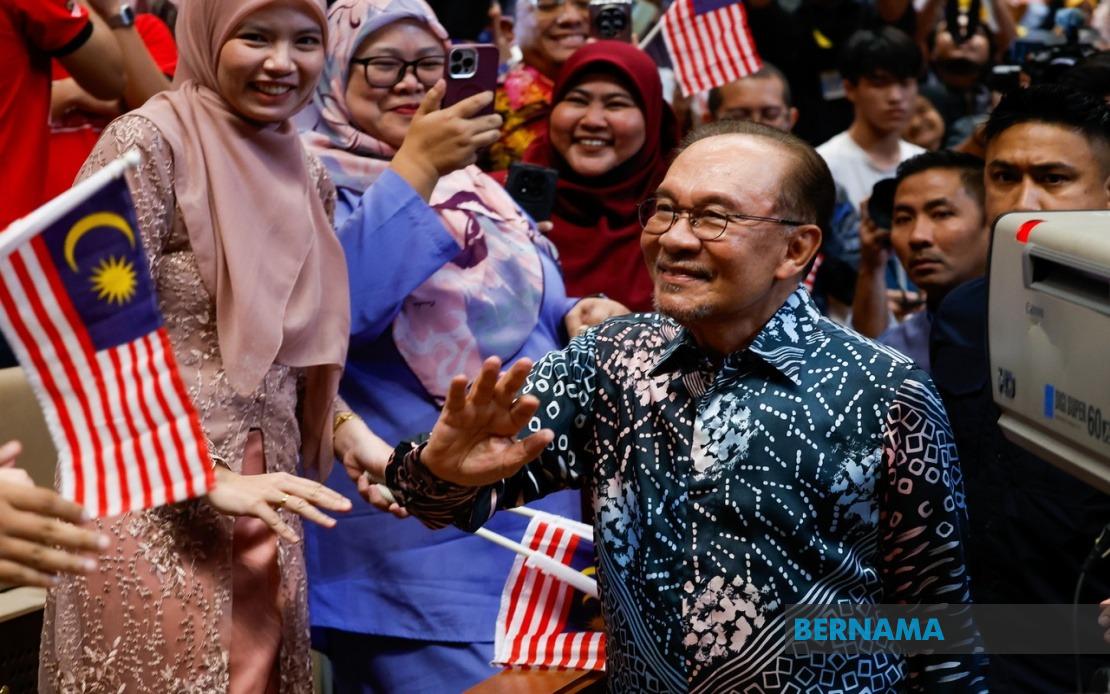
Prime Minister Datuk Seri Anwar Ibrahim has emphasized that the essence of independence extends far beyond constitutional frameworks and institutional structures, calling instead for every Malaysian to nurture a deeply personal and authentic commitment to the nation's founding principles. Delivering the National Day address at the Putrajaya International Convention Centre, he articulated a vision of independence rooted in individual consciousness and collective civic virtue rather than merely formal political arrangements.
Anwar's remarks underscore a critical distinction between the mechanics of self-governance and the cultural and psychological dimensions that sustain it. While Malaysia achieved formal independence in 1957, he suggested that the ongoing challenge lies in fostering an internalized sense of independence within each citizen—a commitment to personal autonomy balanced with national obligation. This framing reflects contemporary concerns about social cohesion and civic engagement in an increasingly complex, pluralistic society where formal independence must translate into lived national identity.
The Prime Minister stressed that rebuilding national resilience requires deliberate cultivation of this independent spirit across Malaysian society. His language of "rebuilding from the ruins" carries implicit acknowledgment of recent institutional challenges and public scepticism toward governance, suggesting that restoring confidence in national institutions depends not on administrative reform alone but on rekindling widespread commitment to shared civic values. This resonates with ongoing efforts by his administration to reframe national narratives around unity and collective purpose.
Central to Anwar's message is an explicitly inclusive vision of national unity that moves beyond traditional communal boundaries. He invoked the wisdom of Malaysia's founding generation, noting that their vision was never about uniting along ethnic, geographic, or regional lines but rather about binding together successive generations of citizens across all backgrounds. This interpretation deliberately emphasizes shared citizenship over communal identity, a rhetorical strategy particularly significant given Malaysia's complex ethnic and religious landscape and the persistent salience of community-based politics in national discourse.
The formulation acknowledging Malays and Bumiputera as "the core" while calling for all communities to participate reflects Malaysia's constitutional settlement, particularly Articles 153 and 181, which enshrine special provisions for indigenous groups while guaranteeing minority rights. By situating this within a broader narrative of collective national responsibility, Anwar attempts to frame special constitutional provisions as compatible with, rather than antagonistic to, multiethnic solidarity. This balancing act remains delicate in Malaysian politics, where competing interpretations of social contracts often generate controversy.
Anwar's emphasis on defending rights and upholding justice carries particular resonance in contemporary Malaysia. The phrase appears deliberately chosen to evoke commitments to rule of law and institutional integrity that his administration has promoted as central to governance reform. References to defending rights implicitly acknowledge ongoing public concerns about civil liberties, while mention of justice points toward concerns about corruption, accountability, and equitable treatment—issues that have animated Malaysian political discourse in recent years and feature prominently in government messaging.
The presence of high-ranking officials including Deputy Prime Minister Datuk Seri Dr Ahmad Zahid Hamidi, Communications Minister Datuk Seri Fahmi Fadzil, and Chief Secretary to the Government Tan Sri Shamsul Azri Abu Bakar underscored the government's commitment to this message. Their attendance signalled that independence-themed messaging represents coordinated policy positioning rather than isolated rhetoric, suggesting alignment across executive leadership regarding how national narratives should be framed as Malaysia navigates contemporary challenges.
For Malaysian readers, this address reflects broader governmental efforts to articulate a post-pandemic national vision centered on social cohesion and shared purpose. The emphasis on internal psychological commitment to national values responds to documented concerns about rising polarization, social fragmentation, and declining institutional trust. By positioning independence as fundamentally about individual conscience and cross-community cooperation, Anwar's framing offers an alternative to zero-sum political competition that often characterizes Malaysian public discourse.
The message holds particular relevance for Southeast Asian neighbours facing similar challenges of maintaining national unity amidst ethnic, religious, and regional diversity. Malaysia's constitutional approach to managing pluralism, while imperfect, remains a reference point for other regional democracies. Anwar's articulation of how formal independence must be continuously renewed through genuine civic commitment speaks to broader regional conversations about sustaining democratic institutions and social cohesion beyond founding moments.
Looking forward, this address suggests the government will continue emphasizing narratives of shared national destiny and mutual obligation as central to its legitimacy messaging. Whether such rhetorical appeals successfully translate into reduced polarization and increased cross-community cooperation remains an open question, particularly given the entrenched nature of Malaysia's communal political structures and competing visions of national identity. Nonetheless, the consistency with which Anwar and colleagues invoke these themes indicates they represent core positioning for his administration's broader governance agenda.

