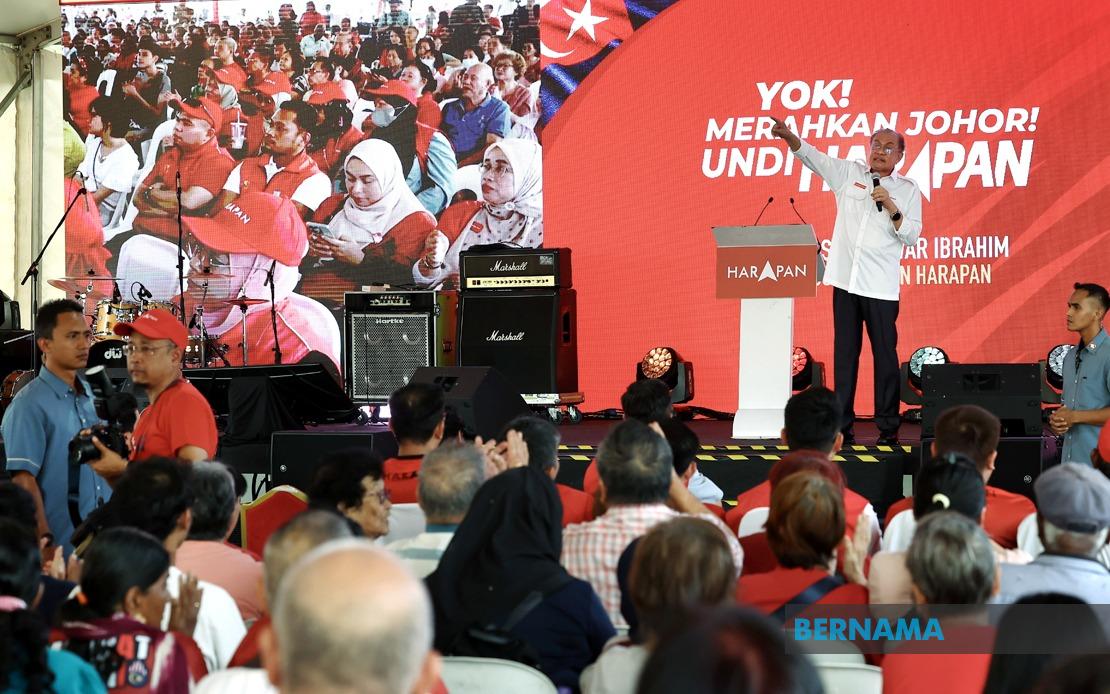
Prime Minister Datuk Seri Anwar Ibrahim has called on all political factions participating in the Johor state election to refrain from making capital out of Datuk Seri Najib Razak's custodial status, emphasising instead that the campaign should centre on substantive governance priorities. Speaking at the Yok! Merahkan Johor! Undi Harapan event in Kulai on July 10, Anwar made clear that while Najib remains incarcerated, the broader political debate should move beyond his circumstances and toward matters directly affecting ordinary Malaysians' lives.
The Prime Minister's intervention reflects growing tension over how the former prime minister's legal predicament continues to feature prominently in electoral discourse. Rather than perpetually revisiting Najib's situation, Anwar argued, political actors would better serve the nation by concentrating on tangible challenges—economic stability, job creation, social protection, and infrastructure development. His remarks suggest a desire to elevate campaign standards above personalised grievances toward a more substantive exchange of policy platforms.
Central to Anwar's case is the enduring financial burden inherited from the 1Malaysia Development Berhad (1MDB) scandal. He highlighted that outstanding liabilities connected to the fund manipulation episode total approximately RM51 billion—a staggering sum that continues to constrain the government's fiscal flexibility and capacity to invest in critical public services. This massive debt obligation serves as the concrete consequence of what Anwar termed irresponsible conduct by those who misappropriated funds, anchoring his argument that discussing Najib's imprisonment matters far less than confronting the material damage his administration inflicted.
The RM51 billion debt burden represents not merely an accounting problem but a strategic constraint on national development. Anwar articulated this plainly, noting that resources consumed by servicing these obligations could otherwise be redirected toward education infrastructure, healthcare facilities, road construction, and poverty alleviation programmes. The trade-off is neither abstract nor insignificant—every dollar remitted to satisfy 1MDB-related claims is a dollar unavailable for improving schools, equipping hospitals, or supporting vulnerable populations.
Anwar's positioning carries particular weight during state-level campaigns, where local grievances often intersect with national narratives. By insisting that campaigners focus on welfare and economic stewardship rather than recirculating the Najib controversy, he appears intent on establishing new norms for electoral engagement in Malaysia. This reflects a broader diplomatic calculation: demonstrating that the current administration prioritises forward momentum and constructive governance over perpetual recriminations.
The timing of his appeal is strategically significant. As Johor, a state with substantial economic influence and political sway, prepares for electoral contests, the Prime Minister's intervention signals to Pakatan Harapan partners and rival coalitions alike that the government's messaging will emphasise delivery on economic commitments and welfare enhancement rather than relitigating past administrations' failures. This approach may also be designed to discourage opposition parties from exploiting Najib's legal troubles as campaign shorthand, instead forcing them to articulate competing visions for Johor's future.
The gathering included Youth and Sports Minister Mohammed Taufiq Johari, Deputy Investment, Trade and Industry Minister Sim Tze Tzin, PKR Youth chief Muhammad Kamil Abdul Munim, and Pakatan Harapan candidate Arthur Chiong Sen Sern for the Bukit Batu seat. This ministerial presence underscored the administration's investment in the Johor campaign while demonstrating institutional alignment behind Anwar's messaging framework.
For Malaysian voters and regional observers, Anwar's remarks illuminate a significant strategic shift within government discourse. Rather than dwelling on accountability mechanisms or revisiting the institutional failures that enabled large-scale financial misconduct, the focus ostensibly moves toward demonstrating tangible improvements in living standards and economic management. This pivot potentially reflects confidence that the 1MDB narrative, while historically important, no longer requires constant reiteration to sustain public support.
However, the persistent RM51 billion obligation ensures that 1MDB will remain economically relevant regardless of electoral rhetoric. Anwar's implicit argument—that discussing Najib's imprisonment distracts from acknowledging the actual costs of misgovernance—carries logical force. The financial hemorrhage continues; personalised condemnation of an imprisoned former premier cannot address that reality. Instead, demonstrating fiscal rectitude, prudent budget allocation, and measurable welfare improvements becomes the legitimate terrain for political competition.
The call for parties to abandon Najib-focused campaign narratives also reflects regional imperatives. Southeast Asian political systems increasingly face credibility challenges as electorates demand substantive responses to inflation, employment, and public service quality. Malaysian politics, viewed from this perspective, would benefit from campaigns centred on concrete policy proposals rather than protracted litigation over past wrongdoing. Such reorientation could elevate regional standards for electoral discourse while signalling maturation within Malaysia's democratic institutions.
Anwar's appeal ultimately frames the choice before Johor voters as one between backward-looking recrimination and forward-looking governance. Whether opposition parties will heed this implicit call for campaign elevation remains uncertain, but the Prime Minister has clearly staked his government's electoral positioning on demonstrating that the administration merits continued public confidence through economic management and welfare delivery rather than punishment narratives against predecessors. This framing will likely shape the contours of the Johor campaign and potentially establish expectations for subsequent electoral contests.

