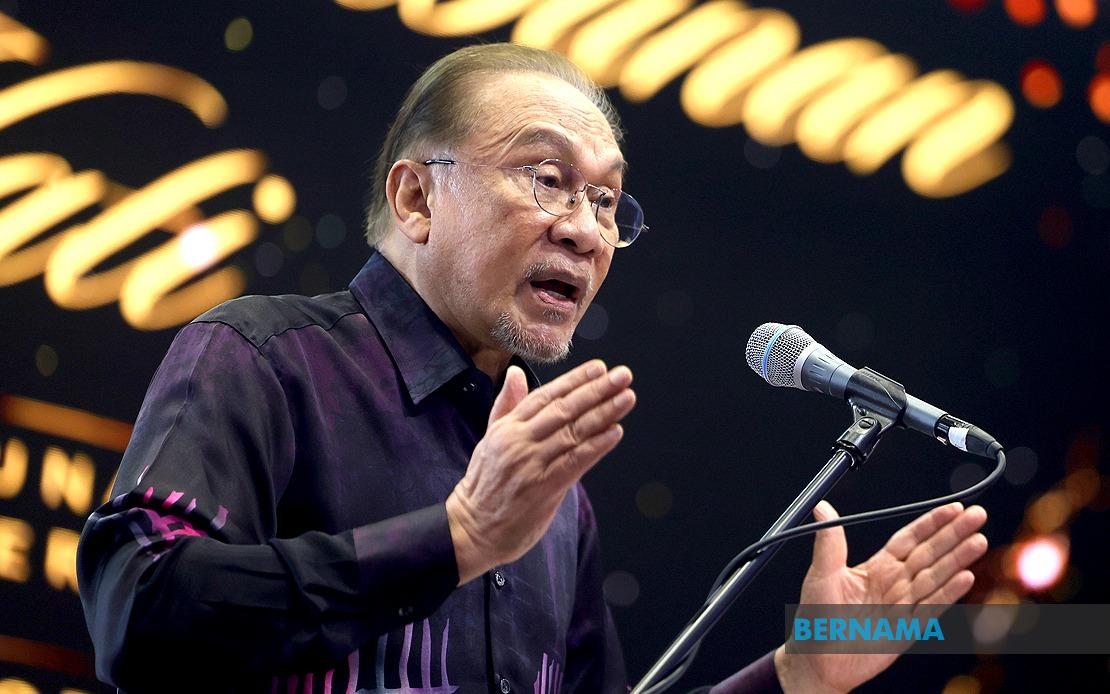
Prime Minister Datuk Seri Anwar Ibrahim delivered a forceful message on the importance of maintaining social cohesion, cautioning Malaysians against the dangers of racial polarisation that he said some political figures were deliberately fomenting. Speaking at a dinner event organised by Pertubuhan Lima Generasi (PLG) Malaysia in Seremban on June 20, Anwar emphasised that the country's multiethnic composition represented a vital competitive advantage that could only be preserved through genuine commitment to mutual understanding and collaborative efforts across community lines.
Anwar's remarks came at a gathering attended by more than 1,000 members of PLG, with Negeri Sembilan Menteri Besar Datuk Seri Aminuddin Harun also present at the occasion. The prime minister articulated concern about the deliberate exploitation of ethnic differences by certain quarters, painting a stark picture of the threat posed by leaders who sought to create animosity between Malays, Chinese, Indians, and other communities. His language suggested awareness of ongoing tensions in the political sphere, where race-based messaging has occasionally surfaced in recent years, particularly during election campaigns and policy debates.
The fundamental thesis underlying Anwar's appeal rested on the assertion that Malaysia's diversity, when anchored by strong institutional frameworks and interpersonal trust, functioned as a distinguishing strength rather than a liability. This framing represented a deliberate counterpoint to zero-sum narratives that portray ethnic coexistence as inherently competitive. By positioning unity as a force multiplier, Anwar positioned rejection of racial politics not merely as a moral imperative but as a pragmatic necessity for national competitiveness in an increasingly globalised economy.
The specific warning about leaders deliberately pitting communities against each other suggested Anwar's recognition that racial sentiment does not arise organically but requires active cultivation by political actors. His call to "rise above this" represented an appeal to citizens to recognise and resist such manipulation. This framing shifted responsibility away from communities themselves and toward those in positions of influence who chose divisive rhetoric over bridge-building.
For Malaysian readers, the message carried particular resonance given the country's complex history of managing ethnic relations. Malaysia's constitutional framework, enshrined in the Federal Constitution, was itself designed around recognition of plural communities with distinct needs and safeguards. Anwar's invocation of unity while simultaneously acknowledging the reality of distinct ethnic identities—he specifically named Malays, Chinese, Indians, Kadazans and others—reflected an attempt to navigate between erasure of identity and embrace of divisiveness.
The emphasis on "working together as one strong force" suggested that Anwar envisioned cooperation not as requiring abandonment of individual communal identities but rather as a complementary layer of belonging that operated above ethnic particularism. This multilayered approach to identity and nationalism has been central to Malaysia's official ideology, though implementation and public acceptance have occasionally faltered when political incentives favour more divisive appeals.
Anwar's intervention at a PLG dinner also carried strategic significance, suggesting targeted outreach to a particular demographic or organisational base. The specificity of the venue and audience indicated deliberate effort to reinforce his position on unity with constituencies that may have particular concern about social cohesion or who represent cross-communal membership. The presence of Aminuddin Harun suggested state-level political alignment on this messaging, potentially indicating coordination between federal and state leadership on the unity agenda.
The broader context of these remarks reflected ongoing challenges in Malaysian politics, where periodic concerns about racial tensions and polarisation have emerged despite decades of relative intercommunal stability. Recent years have witnessed debates over religious authority, economic equity, and representation that sometimes have invoked ethnic or religious identity in ways that generated discomfort among observers concerned with maintaining cohesion. Anwar's speech represented a direct restatement of the official position on such matters.
For Southeast Asia more broadly, Malaysia's experience with managing diversity carries implications. The region faces increasing tensions related to identity politics, economic inequality along ethnic or religious lines, and competition for political power expressed through communal appeals. Anwar's framework—emphasising that diversity constitutes strength only when coupled with deliberate institutional and interpersonal commitment to cooperation—offered a perspective grounded in Malaysia's particular experience and potentially relevant to other plural societies in the region grappling with similar challenges.
The call to reject racial sentiments also carried economic implications worth considering. Malaysia's position as a regional hub for finance, commerce, and education depends partly on its reputation for stability and intercommunal tolerance. Political figures have periodically noted that investors and international partners view racial harmony as prerequisite for confidence in governance and rule of law. Framed in these terms, Anwar's appeal operated on multiple levels simultaneously, addressing both moral imperatives and pragmatic national interests.
Moving forward, the effectiveness of such messaging will likely depend on whether political actors at all levels consistently reinforce these themes and whether institutions actively work to address legitimate grievances that might otherwise be exploited through divisive rhetoric. Anwar's speech represented a reaffirmation of principle, but translating principle into sustained practice across the political ecosystem remains an ongoing challenge requiring commitment from leaders across party lines.

