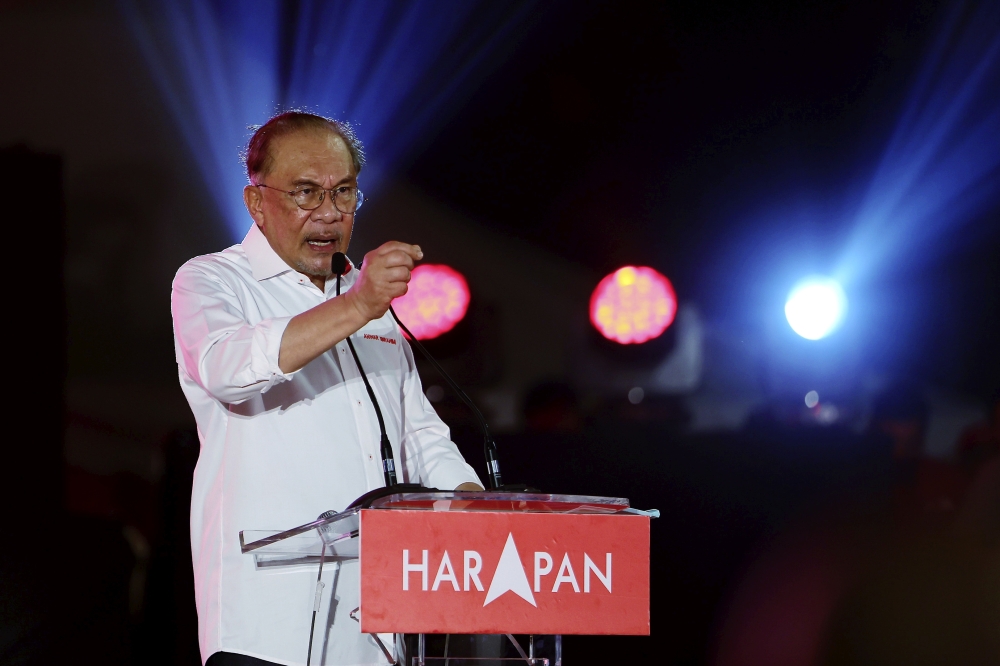
Prime Minister Datuk Seri Anwar Ibrahim addressed Negeri Sembilan voters in Seremban on July 16, making a direct appeal for continued support of the Pakatan Harapan coalition. The message, delivered at a campaign event, centred on the importance of maintaining political stability to allow the state government to execute its development agenda without interruption. Anwar framed the upcoming electoral decision as a critical juncture for the state's economic trajectory, warning that political uncertainty could derail infrastructure projects and investment plans already in motion.
The Prime Minister's visit underscores the significance Kuala Lumpur places on Negeri Sembilan's political alignment. The state, with its mixed urban and rural constituencies, represents a microcosm of broader Malaysian voting patterns. Control of Negeri Sembilan carries symbolic weight for the federal government, as the state's electoral performance often reflects broader regional sentiment. Anwar's direct intervention suggests the coalition views the state as neither safely secured nor irretrievably lost, necessitating high-level political engagement to consolidate voter confidence.
Anwar's core argument revolved around development continuity as a tangible benefit of sustained Pakatan governance. He highlighted the relationship between political consistency and infrastructure delivery, suggesting that regime changes would interrupt long-term planning cycles and disrupt projects in their execution phases. This narrative attempts to reframe electoral politics around pragmatic governance outcomes rather than ideological disputes, appealing to voters concerned with schools, roads, and healthcare facilities rather than partisan rhetoric.
The emphasis on development continuity reflects a broader strategy within Pakatan to defend its record by pointing to concrete achievements rather than engaging in adversarial politics. For Malaysian voters, particularly in states like Negeri Sembilan where swing voters often determine election outcomes, this approach carries resonance. Many constituents prioritise visible improvements in their communities over abstract policy debates, making infrastructure completion and service delivery enhancement powerful electoral arguments.
Negeri Sembilan's strategic importance extends beyond its electoral arithmetic. As a smaller state wedged between Selangor and Pahah, it serves as a testing ground for policies before wider implementation. The state government's initiatives in agriculture modernisation, small business development, and tourism infrastructure receive scrutiny from investors and observers across Southeast Asia, influencing perceptions of federal government competence and economic direction.
Anwar's appeal also carried implicit messaging about the costs of political alternation. In Malaysian state politics, changes in government frequently result in project cancellations, policy reversals, and administrative disruptions that consume resources and delay public services. By highlighting this risk, the Prime Minister sought to activate voter concerns about wasted opportunities and inefficiencies that accompany political transitions, particularly for voters who have invested hopes in ongoing development schemes.
The Pakatan Harapan coalition faces a distinct challenge in states like Negeri Sembilan where opposition parties have marshalled significant support networks and traditional voting blocs. The coalition's tenure in power has generated both achievements worthy of electoral appeal and disappointments that opposition campaigns exploit effectively. Anwar's presence in the state represented an attempt to anchor voter attention on the former while minimising focus on the latter.
Regionally, Negeri Sembilan's election carries implications for Southeast Asian political stability and investor confidence in Malaysia. The state's electoral outcome informs assessments of whether Pakatan maintains sufficient popular support to govern effectively, or whether fragmenting voter coalitions presage broader political realignment. International observers and regional business communities monitor such elections as indicators of Malaysia's political direction and economic policy continuity.
Anwar's messaging also reflected awareness of younger voters' concerns about economic opportunity and employment. Development projects directly translate into job creation during construction phases and service delivery expansion requires trained personnel. By connecting infrastructure development to employment prospects, the Prime Minister sought to engage voters concerned about livelihoods and economic advancement, constituencies that swing elections in competitive states.
The appeal for sustained support carries embedded assumptions about voter sophistication and political memory. Anwar presumed voters would retain awareness of specific projects initiated under Pakatan governance and recognise their incompleteness as justification for continuity. This approach demands voters remain engaged with incremental progress narratives rather than embracing transformative promises from challengers.
Negeri Sembilan represents a microcosm of Malaysian electoral dynamics where development narratives, political stability, and incumbent performance dominate voter calculus. The state's mixed demography and competitive political structure make it genuinely contestable territory where high-level political leadership must actively campaign rather than assume voter compliance. Anwar's intervention reflects this reality, signalling that Pakatan treats Negeri Sembilan not as secure territory but as a state requiring sustained political engagement and performance justification to maintain voter confidence.

