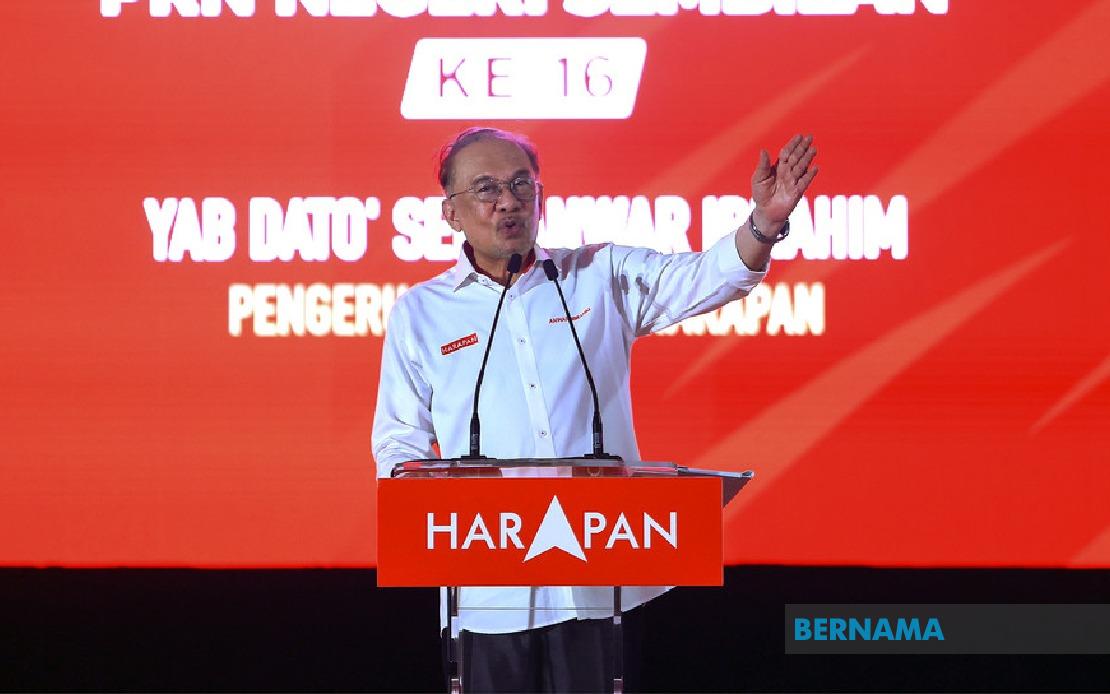
Prime Minister Datuk Seri Anwar Ibrahim has launched a direct appeal to voters in Negeri Sembilan to maintain their backing for Pakatan Harapan (PH) in the state election scheduled for August 1, framing the electoral contest as a choice between continuity and disruption. Speaking through a Facebook post, Anwar positioned the contest as pivotal for preserving the policy momentum that has accumulated since the coalition assumed control of the state in 2018, warning that abandoning PH would risk derailing initiatives that have begun to reshape the state's economic and social landscape.
The Prime Minister's intervention underscores the national significance of the Negeri Sembilan contest despite its provincial character. While state elections might appear peripheral to federal politics, control of individual state governments carries weight in Malaysia's complex power-sharing arrangements and influences resource allocation, development priorities, and the broader narrative of governmental effectiveness. For Anwar's administration, a PH victory would provide validation of the coalition's governance model and reinforce the political momentum that the federal government has struggled to maintain amid internal coalition tensions and economic headwinds.
Anwar's endorsement explicitly credits Menteri Besar Datuk Seri Aminuddin Harun, referred to informally as Tok Min, with steering Negeri Sembilan through a period of administrative reform and project implementation. The Prime Minister's characterization emphasizes integrity, humility, and responsibility—values that carry particular resonance in Malaysian politics given the legacy of the 1Malaysia Development Berhad scandal and broader concerns about governance standards. By tethering Aminuddin's leadership to these attributes, Anwar attempts to shift electoral discourse away from partisan positioning toward questions of governmental integrity and competence.
The narrative of intergovernmental cooperation that Anwar articulated deserves scrutiny, as it reflects the coordination mechanisms that have evolved between state and federal authorities under PH governance. Development initiatives spanning infrastructure, education, healthcare, and social services typically require financing, technical capacity, and regulatory frameworks that operate across multiple governmental levels. Anwar's reference to "close cooperation" suggests that PH control at both levels has facilitated smoother project implementation compared to scenarios where state and federal governments operate under competing political umbrellas—a reality that resonates across Malaysia's federal system.
The electoral calendar that Anwar outlined—nominations on July 20, early voting on July 28, and general polling on August 1—compressed the campaign period into a tight timeframe that typically advantages incumbent administrations with superior organizational capacity and media presence. This compressed schedule also limits the scope for opposition campaigns to develop sustained thematic messaging, a structural advantage that Anwar's implicit framing of electoral timing as background detail actually highlights for politically attentive readers.
Anwar's invocation of the phrase "Do not let the progress we have built together come to a halt halfway" carries psychological weight by suggesting that development initiatives represent collective achievements rather than partisan accomplishments. This framing attempts to neutralize opposition critiques by presenting electoral choice as affecting not merely party fortunes but community advancement itself. However, this rhetorical strategy also implicitly concedes that development remains incomplete—a tacit acknowledgment that five years of PH governance in Negeri Sembilan has not yet delivered comprehensive transformation.
The economic implications of state-level governance matter significantly for Malaysian voters. Negeri Sembilan's economy depends on palm oil production, light manufacturing, tourism centered on attractions like the Seremban City Centre, and emerging sectors like digital services. The state's fiscal health determines investment in human capital through education and healthcare, infrastructure quality that influences business location decisions, and public safety and social cohesion that affect quality of life. Anwar's appeal thus carries concrete material dimensions beyond abstract notions of political stability.
Pakatan Harapan's governance record in states where it holds power has become increasingly central to the coalition's credibility, particularly given the fractious dynamics within the broader alliance. Failures or perceived underperformance in any PH-controlled state provide ammunition for opposition parties and undermine the coalition's foundational claim that it offers superior governance alternatives. Conversely, demonstrable success in delivering services, managing finances transparently, and executing development projects strengthens PH's argument for continued voter confidence at both state and federal levels.
The appeal also reflects demographic and generational considerations within Negeri Sembilan's electorate. Younger voters, particularly those who came of political age after the 2018 general election, may lack direct memory of governance under previous administrations and thus evaluate PH based on contemporaneous performance rather than historical comparison. Anwar's emphasis on tangible development outcomes appears calibrated to appeal to voters whose priorities center on employment, housing affordability, educational quality, and public safety rather than ideological positioning.
Anwar's characterization of continuation as securing a "clean, stable administration that served the interests of the people" implicitly contrasts with alternative governance scenarios without explicitly naming opposition parties. This rhetorical restraint reflects calculation about campaign effectiveness—direct attacks often trigger defensive responses, whereas positive framing of incumbent performance allows voters to draw their own inferences about alternatives. The invocation of religious language through "Alhamdulillah" and "Insya-Allah" grounds Anwar's appeal in values register that resonates across Malaysia's Muslim-majority electorate, embedding political messaging within spiritual register.
For regional observers monitoring Malaysian politics, the Negeri Sembilan election illuminates broader patterns in how Anwar's administration attempts to sustain coalition cohesion and electoral viability. The compressed campaign period, the emphasis on administrative competence and continuity, and the intergovernmental coordination narrative all suggest an administration confident in its organizational capacity but conscious that electoral outcomes remain uncertain. The August 1 result will provide valuable data about voter sentiment toward PH governance specifically and toward Anwar's federal administration more broadly.

