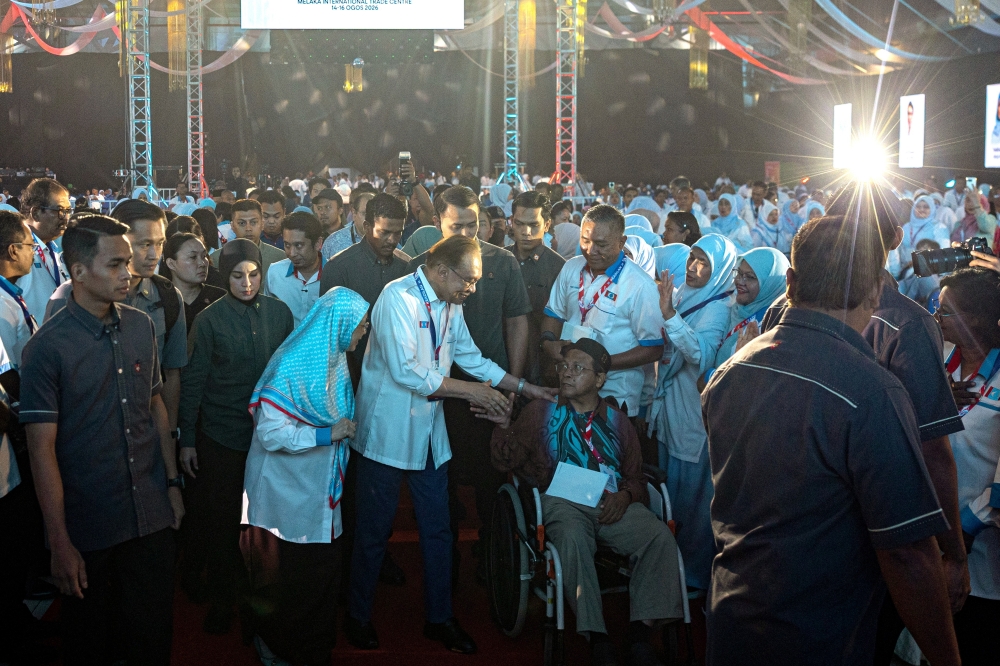
Prime Minister Datuk Seri Anwar Ibrahim has called on PKR members to adopt a principled and measured stance when evaluating party positions on Umno, emphasising that decisions affecting Malaysia's political trajectory must serve the broader national interest rather than satisfy partisan frustrations. Speaking at a party gathering in Melaka, the PKR president articulated a vision of governance grounded in rational assessment of policy outcomes rather than visceral political responses to rivals, reflecting the complexities of managing a diverse ruling coalition in a fractious political environment.
Anwar's remarks underscore the delicate balancing act required of his administration, which must navigate the intricate dynamics between PKR and Umno—two parties with fundamentally different ideological roots yet currently bound by the Pakatan Harapan-led government. The tension between these partners has periodically surfaced, with grassroots members of both parties harbouring deep reservations about collaboration. By explicitly instructing party delegates to prioritise welfare considerations over emotional reactions, Anwar is attempting to institutionalise a pragmatic approach that transcends historical animosities and party rivalries that have defined Malaysian politics for decades.
The context of Anwar's intervention is significant for understanding contemporary Malaysian political dynamics. PKR, as a reformist party founded partly as a vehicle for Anwar's own political rehabilitation, has traditionally positioned itself against what it characterises as Umno's rent-seeking and patronage-driven governance model. Many PKR supporters retain deep scepticism about Umno's commitment to reform and anti-corruption measures. Conversely, Umno members view PKR with suspicion rooted in its challenge to their historical political dominance. This mutual mistrust creates constant friction within the coalition framework, threatening stability and effective governance.
Anwar's framing of coalition decisions through a welfare lens represents an attempt to establish objective criteria that transcend emotional decision-making. By anchoring policy positions in measurable impacts on citizens' livelihoods—economic growth, employment, public services, cost of living—the Prime Minister seeks to create space for pragmatic cooperation despite ideological differences. This approach acknowledges that voters ultimately judge governments on delivery rather than political purity or ideological consistency. The Malaysian electorate, having experienced multiple political transitions in recent years, has shown decreasing tolerance for petty partisan squabbling that impedes economic progress and social stability.
The implications of Anwar's message extend beyond internal PKR dynamics to shape broader coalition strategy. The success of Malaysia's current political arrangements depends substantially on whether Umno and PKR can forge sufficient common ground on substantive governance matters. Previous attempts at coalition-building have foundered precisely because emotional reactions—whether rooted in historical grievances, personal rivalries, or ideological differences—overrode pragmatic calculation. By explicitly directing PKR to resist such emotional impulses, Anwar is signalling to both his own party members and to Umno that he views coalition sustainability as contingent upon mutual commitment to governance objectives rather than political theatre.
For Malaysian voters across the political spectrum, this development carries important ramifications. A stable coalition that prioritises delivery on public services, economic management, and social policy represents a preferable outcome to constant political turbulence driven by personal animosities or factional rivalries. However, many observers within PKR and among broader reform constituencies worry that pragmatism taken to extremes might compromise the anti-corruption and institutional reform agenda that justified the 2018 transition. The challenge for Anwar involves maintaining this balance—preserving coalition functionality while advancing meaningful governance reform.
The regional dimension should not be overlooked either. Southeast Asian observers closely monitor Malaysian political stability given the country's role as a significant regional economy and democracy. Political uncertainty, driven by coalition instability or constant leadership conflicts, creates investor hesitation and undermines Malaysia's competitive positioning relative to neighbours like Singapore, Thailand, and Vietnam. Anwar's intervention thus carries implications for Malaysia's broader economic competitiveness and regional standing, not merely domestic political management.
Anwar's directive also reflects his personal political philosophy developed through decades of activism and governance experience. His insistence that decisions serve public interest rather than narrow partisan advantage aligns with his public positioning as an administrator focused on institutional reform and inclusive development. Whether PKR members will embrace this approach consistently remains an open question, particularly given periodic flare-ups involving younger party members and grassroots activists who maintain more absolutist positions regarding Umno cooperation.
Looking forward, the test of Anwar's directive will manifest in how PKR responds to specific coalition decisions and policy disagreements. When immediate party interests conflict with broader welfare considerations, or when Umno actions appear to contradict reform commitments, will PKR maintain disciplined support for the coalition framework? The stability of Malaysia's political arrangement depends significantly on such practical adherence to the principles Anwar articulated. His words in Melaka represent necessary leadership on coalition management, yet translating rhetorical commitment into sustained organisational behaviour remains the genuine challenge facing PKR and the broader ruling arrangement.

