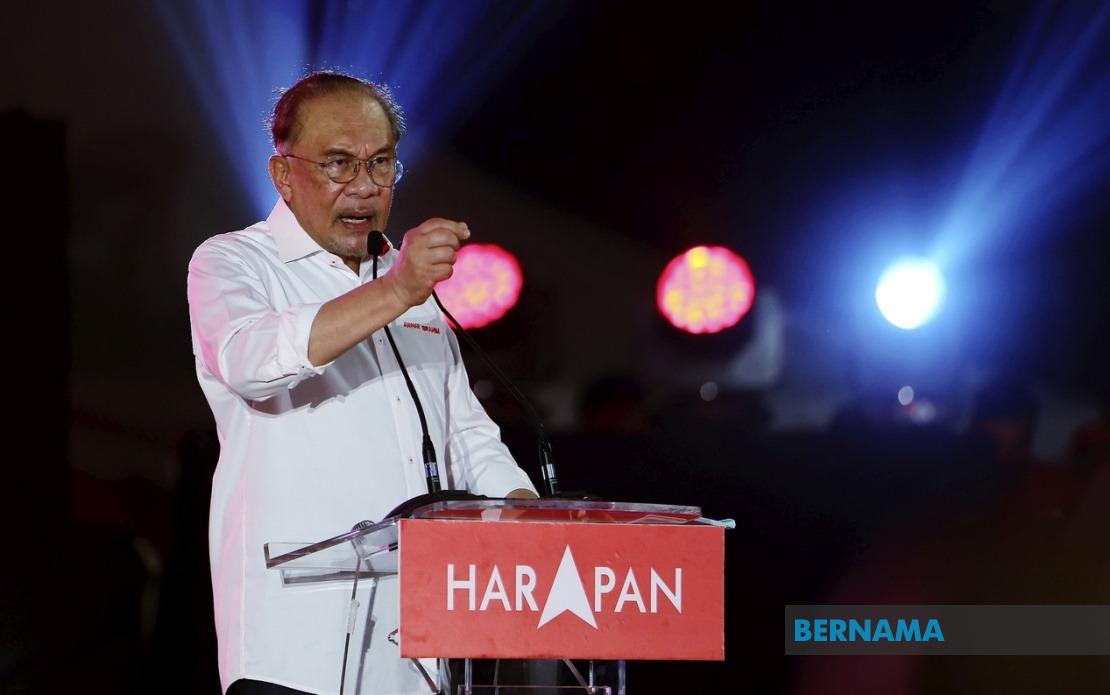
Prime Minister Datuk Seri Anwar Ibrahim has issued a clear directive to all political participants in the 16th Negeri Sembilan State Election to steer clear of inflammatory rhetoric concerning royal institutions and the Federal Constitution. Speaking at the Pakatan Harapan candidate announcement ceremony in Kuala Pilah on July 14, the PH chairman stressed that while electoral competition forms a legitimate part of democratic practice, such contests must remain grounded in responsibility and civility rather than descending into slander or community division.
Anwar's cautionary remarks arrive at a sensitive moment in Malaysia's political calendar, as the Negeri Sembilan contest represents a significant mid-term test of voter sentiment towards the federal government. His emphasis on protecting foundational institutions reflects growing concerns within ruling circles about the potential for electoral campaigns to weaponise constitutional and monarchical sensitivities, matters that historically carry considerable emotional weight in Malaysian politics. The intervention suggests the PH leadership recognises that unguarded campaign rhetoric could undermine the coalition's broader agenda and alienate key voter demographics who place high value on institutional stability.
The Prime Minister articulated a vision of political engagement characterised by substantive debate on governance and development rather than constitutional brinkmanship. "We can engage in political battles, but we cannot spread slander. We can have different views, but let us not undermine the institutions that form the foundation of the country," Anwar stated, effectively drawing a line between permissible policy disagreement and destructive institutional criticism. This formulation appears calculated to distinguish between attacking opponents' track records—a standard feature of election campaigns—and targeting the constitutional architecture itself, which Anwar frames as beyond legitimate contestation.
For Negeri Sembilan specifically, Anwar emphasised that voters deserve leadership characterised by integrity and developmental capacity. The state, he argued, requires a government capable of delivering meaningful progress and cannot afford to fall behind in the broader national development trajectory. This framing positions the election as fundamentally about competence and results delivery rather than ideological positioning or institutional reform, effectively narrowing the acceptable scope of campaign messaging.
The coalition announced 36 candidates featuring a mix of political veterans and newcomers drawn from PKR, DAP, and Amanah. Notably, incumbent Menteri Besar Datuk Seri Aminuddin Harun secured PH endorsement for the Linggi state seat, signalling continuity in PH's state leadership. DAP secretary-general Anthony Loke, a prominent national figure, was fielded for the Chennah state seat, underlining the coalition's determination to field recognisable names and establish strong electoral presence across key constituencies. This candidate composition reflects calculations about balancing demographic representation, geographic spread, and voter appeal.
Anwar's public confidence in Aminuddin's leadership carries strategic weight beyond ceremonial endorsement. By characterising the Menteri Besar as cooperative and accessible to federal-state collaboration, Anwar signals that a continued PH government in Negeri Sembilan will maintain harmonious working relationships with the federal administration, potentially advantageous messaging when emphasising developmental synergies and resource allocation. Such compatibility claims, whether accurate or aspirational, feature prominently in Malaysian campaign narratives where voters weigh not merely which party to support but which leadership combination might deliver concrete benefits.
The presence of senior coalition figures—including Amanah president Datuk Seri Mohamad Sabu and PH Communications Director Datuk Seri Fahmi Fadzil—underscores the national importance the coalition attaches to the Negeri Sembilan contest. State elections in Malaysia, while locally significant, increasingly serve as barometers of federal political health and momentum. A strong PH performance would reinforce the coalition's claims to popular legitimacy following the 2022 federal election, whereas setbacks could embolden opposition narratives about voter erosion.
Anwar's warnings about constitutional and monarchical sensitivities merit particular attention given Malaysia's contemporary political environment. Recent years have witnessed occasional attempts by political actors to mobilise opinion around constitutional interpretation, particularly regarding the powers and prerogatives of state rulers. By explicitly cautioning against such tactics, Anwar stakes out territory as the defender of institutional equilibrium, a positioning that may resonate with centrist and establishment-minded voters who fear destabilising political competition.
The timing of these remarks, delivered weeks before polling day, also suggests an anticipatory strategy. Rather than waiting for opponents to introduce controversial messaging before responding, Anwar establishes normative boundaries in advance, potentially constraining opposition campaign options. Should opposition candidates subsequently raise constitutional or royal institution matters, they risk appearing to violate the standards Anwar publicly articulated, a rhetorical disadvantage in contexts where institutional respect commands broad consensus.
For Malaysian observers and Southeast Asian analysts tracking Malaysia's political evolution, Anwar's statements illuminate the tension between electoral competition and institutional preservation that characterises Westminster-derived democracies operating within constitutional monarchies. The challenge of maintaining vigorous political contestation while protecting revered institutions remains perpetually delicate, and Anwar's intervention reflects ongoing navigation of these crosscurrents.
The Negeri Sembilan election ultimately tests whether PH can consolidate support in a state where the coalition has governed since 2018 while maintaining the institutional guardrails that Anwar emphasises. Success requires simultaneously energising the base through campaigning while constraining electoral rhetoric within bounds that protect constitutional legitimacy—a difficult balance that extends beyond this single state contest to define the broader contours of Malaysian democracy under PH leadership.

