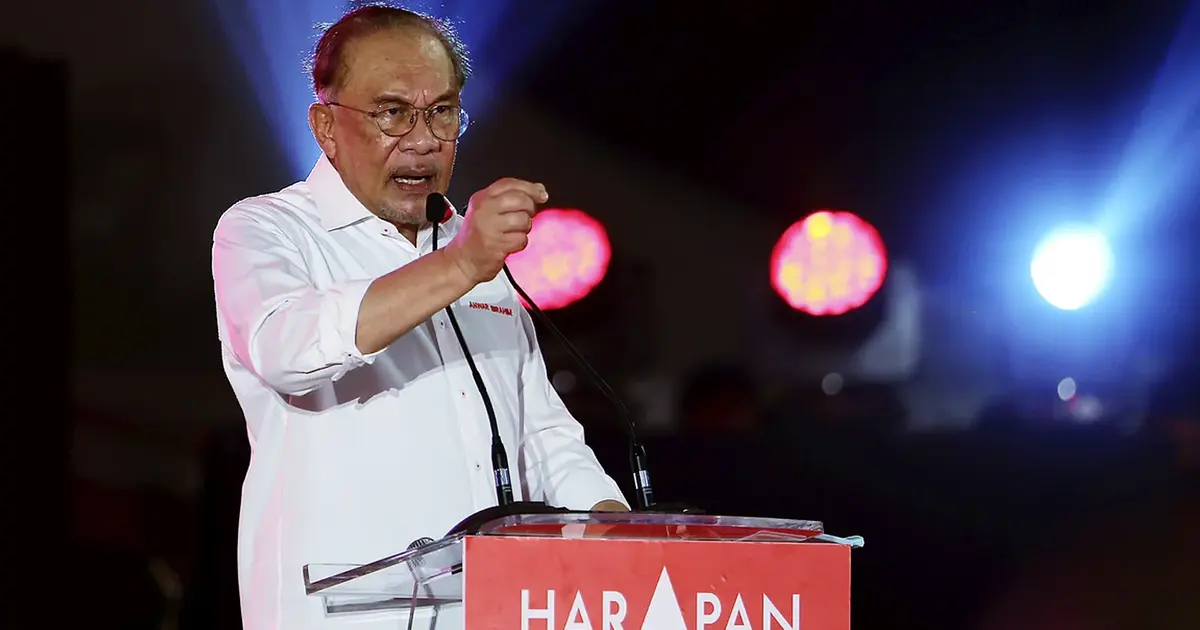
Prime Minister Anwar Ibrahim, speaking in his capacity as Pakatan Harapan chairman, has issued a direct appeal to all political contenders in the Negeri Sembilan state election campaign to maintain clear boundaries between electoral competition and matters pertaining to the state's revered royal institution. The warning reflects growing concerns about how political actors might exploit sensitive constitutional and institutional issues to gain electoral advantage during what is shaping as a closely watched regional contest.
Anwar's cautionary remarks underscore the delicate position Malaysia's royalty occupies within the nation's constitutional framework and political culture. While royal institutions command deep respect across the country's diverse society, they have occasionally become inadvertent focal points during heated electoral periods when politicians seek to mobilise voter sentiment. The Negeri Sembilan palace, in particular, carries historical significance as a constitutional monarchy within Malaysia's federal structure, and its role in state governance has periodically intersected with political developments.
The Pakatan Harapan leadership recognises that the forthcoming Negeri Sembilan election represents a critical test of political maturity for all participating coalitions. By preemptively cautioning against royal politicisation, Anwar is essentially establishing a red line that transcends party affiliations. This approach mirrors international democratic practice where established political actors voluntarily refrain from exploiting sensitive state institutions for short-term electoral gain, thereby preserving institutional integrity across election cycles.
Negeri Sembilan's electoral landscape has historically been characterised by tight competition between major coalitions, making every campaign tactic subject to intense scrutiny. The state's voters comprise a demographic mix that takes constitutional propriety seriously, and any perceived disrespect toward royal prerogatives risks alienating significant voter constituencies. Political analysts have previously observed that campaigns perceived as cavalier toward institutional boundaries tend to generate backlash even among opposition supporters.
Anwar's intervention also carries implicit messaging to coalition partners and rival parties alike. Within Pakatan Harapan, it signals that the ruling alliance will maintain disciplinary standards during the campaign, potentially insulating the government from accusations of opportunism. Simultaneously, it sets expectations for opposition parties, establishing that attempts to weaponise royal issues would invite criticism from established democratic voices including the prime minister himself.
The distinction between legitimate political discourse and inappropriate institutional politicisation remains conceptually important yet practically contested in Malaysian politics. Legitimate debate about governance structures, constitutional interpretations, and the proper exercise of constitutional powers differs fundamentally from attempts to deploy royal imagery or institutional standing as campaign ammunition. Anwar's statement implicitly calls for maintaining this distinction during what will inevitably be a robust and competitive electoral period.
Historically, Malaysian state elections have occasionally witnessed attempts by various actors to frame policy disagreements or political conflicts as issues of royal prerogative or institutional integrity. Such tactics, whether deployed intentionally or carelessly, can damage public confidence in constitutional processes and create unnecessary tensions between political actors and state institutions. Negeri Sembilan's relative stability makes it incumbent upon all parties to preserve rather than undermine this constructive political environment.
The timing of Anwar's warning—coming as election machinery mobilises across the state—demonstrates proactive leadership in establishing norms before campaign rhetoric potentially escalates. By speaking publicly and unambiguously, the prime minister provides political actors across the spectrum with clear guidance while also signalling to voters that responsible stewardship of constitutional processes matters to Malaysia's highest political leadership. This approach prioritises institutional preservation over the fleeting advantages that might accrue from crossing boundaries.
For opposition parties and coalition partners alike, respecting Anwar's implicit appeal offers both principled and pragmatic advantages. Campaigns built exclusively on policy alternatives and governance track records tend to generate more substantive public discourse than those relying on institutional grievances or symbolic provocations. Negeri Sembilan voters, like Malaysian voters generally, increasingly demonstrate preference for candidates and coalitions addressing tangible economic and social concerns rather than engaging in institutional jousting.
The warning also reflects international democratic principles increasingly adopted across Southeast Asian political systems. Established democracies typically feature unwritten conventions where major political actors voluntarily refrain from exploiting state institutions, thereby preserving their legitimacy and public standing across political cycles. As Malaysia continues developing its democratic institutions and practices, such voluntary restraint becomes increasingly important for strengthening rather than weakening constitutional governance.
Looking forward, the extent to which political parties heed Anwar's counsel will serve as an important indicator of Malaysian political maturity. A campaign conducted within institutional boundaries—focused on competing visions for Negeri Sembilan's economic development, service delivery, and social advancement—would demonstrate that the nation's political actors have absorbed critical lessons about preserving institutional integrity even during intense electoral competition. Conversely, any attempts to breach these boundaries would risk public condemnation and potentially alienate voters concerned about constitutional propriety.

