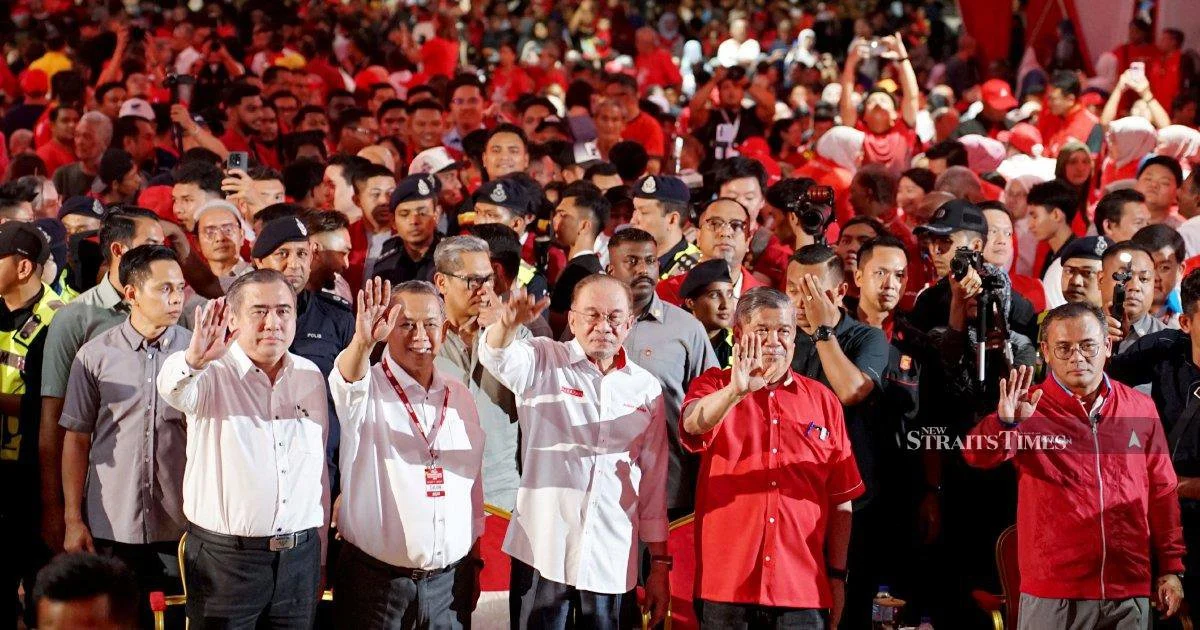
Prime Minister Datuk Seri Anwar Ibrahim has issued a pointed reminder to Malaysia's political establishment that the royal institution must remain insulated from electoral contests, speaking in Kuala Pilah as the Negri Sembilan election campaign enters a critical phase. His remarks underscore a growing tension within Malaysian politics around the boundaries between revering constitutionally recognised symbols and the rough-and-tumble of electoral competition.
The caution appears directed broadly at all contesting parties, though the phrasing suggests particular concern about how some leaders have invoked royal backing or perceived royal sympathy to strengthen their standing with voters. In a federation where the Malay-Muslim majority holds the Duli Yang Maha Mulia in profound reverence, even the appearance of royal alignment can shift electoral sentiment substantially. Anwar's intervention signals that such tactics, should they be occurring, have crossed a line the Prime Minister considers both unwise and inappropriate.
The Negri Sembilan state election has become an arena for testing broader political coalitions and messages ahead of potential larger contests. The state, nestled between Kuala Lumpur and Port Dickson, has long served as a bellwether for national political trends. Recent years have seen shifting alignments as Malaysia's political landscape fragments into competing blocs, each seeking to consolidate voter support through varying appeals. The involvement of royal imagery or legitimacy in such manoeuvring risks transforming venerated institutions into mere campaign props.
Anwar's warning reflects a deeper Malaysian constitutional principle: that the Duli Yang Maha Mulia, while possessed of significant ceremonial and symbolic authority, ought to remain above partisan factionalism. The Constitution positions the institution as a unifying symbol for all citizens regardless of political affiliation. When political leaders attempt to harvest electoral advantage by suggesting or claiming royal endorsement, they essentially invite the monarchy into factional disputes—a territory most constitutional scholars and statesmen regard as potentially corrosive to the institution's standing and independence.
The timing of Anwar's statement carries particular significance. As Prime Minister leading the Pakatan Harapan coalition and President of PKR, he occupies a position where his warnings carry moral weight but also invite scrutiny from opposition voices who might characterise any invocation of royal tradition as selective. His public caution demonstrates an effort to establish neutral ground on the issue before accusations of royal favouritism—in either direction—become election talking points.
Malaysia's recent political history offers cautionary examples of how royal institutions have been drawn into partisan disputes, sometimes with damaging consequences for public confidence in both politics and the monarchy itself. The destabilisation of state governments through defections and the subsequent constitutional crises have occasionally featured debates over royal prerogatives and perceived royal preferences. Such episodes remind observers that once the boundary between constitutional monarchy and electoral politics becomes blurred, restoring clarity becomes extraordinarily difficult.
For voters in Negri Sembilan, Anwar's message serves as a reminder to evaluate candidates and parties on their substantive policy positions and governance records rather than on claims of special royal favour or rumoured royal sentiment. In a state where traditional reverence for the Duli Yang Maha Mulia remains a defining feature of public culture, such neutrality in electoral messaging can elevate political discourse by focusing attention on material concerns—economic development, education, healthcare, and administrative competence—that affect voters' daily lives.
The warning also resonates across Southeast Asia, where questions about the relationship between hereditary institutions and democratic participation remain contested. Malaysia's approach, balancing constitutional monarchy with democratic elections, requires continuous vigilance against the erosion of institutional integrity. Anwar's intervention demonstrates awareness that protecting the monarchy's standing simultaneously protects Malaysia's democratic institutions from the corrosion that arises when power-seeking actors treat all levers of influence—including constitutional ones—as available for tactical deployment.
Beyond Negri Sembilan, the statement carries implications for how Malaysian politics manages cultural and religious symbols more broadly. If the royal institution can be successfully quarantined from electoral weaponisation, the same principle ought to extend to Islam, national unity narratives, and other potent cultural forces. The discipline Anwar advocates becomes a standard against which his own coalition and opponents can be measured in coming months.
The Prime Minister's position also implicitly acknowledges the electoral stakes in Negri Sembilan and the genuine temptation political operators face to deploy every available advantage. By establishing an unambiguous norm against royal invocation in campaigns, Anwar creates a framework within which he can later call out any party—his own allies included—that violates it. Such norm-setting, while sometimes dismissed as rhetorical, functions as a crucial mechanism for containing political competition within bounds that preserve institutional health.
As campaigning continues, observers should watch whether contesting parties accept this framing or whether some attempt to skirt Anwar's boundary by suggesting royal sympathy through implication rather than explicit claim. The true test of his warning lies not merely in its utterance but in whether the Malaysian political class internalises the principle that certain institutions must remain spaces of national unity rather than tools of partisan advantage.

