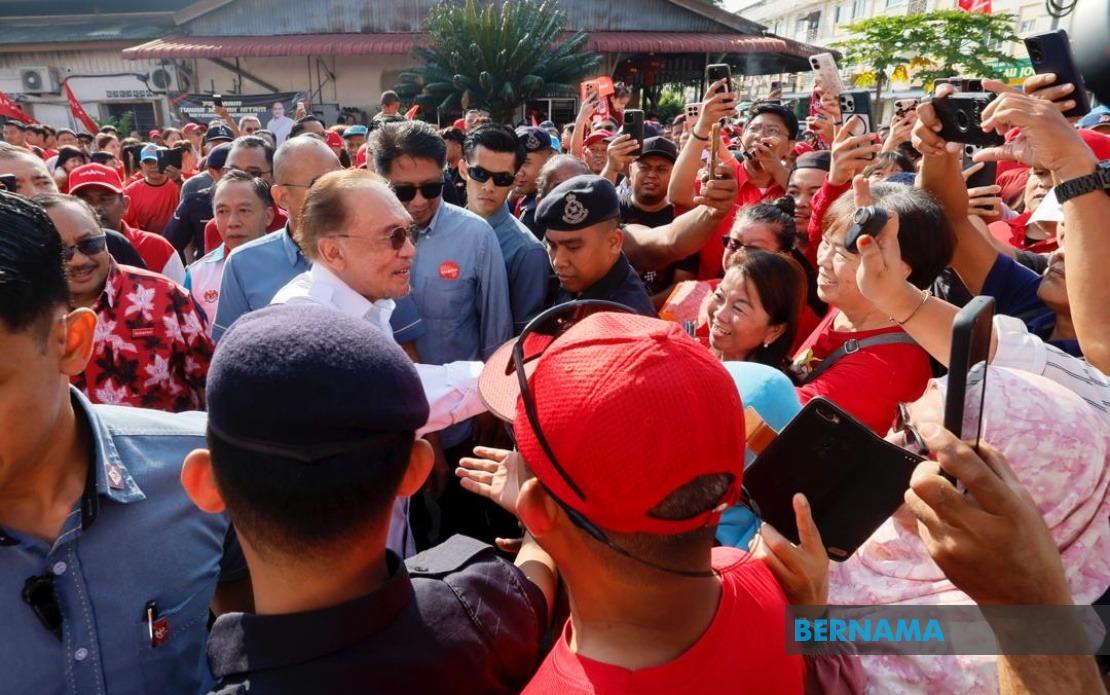
Prime Minister Datuk Seri Anwar Ibrahim's campaign appearance in Johor on the ninth day of the state election drive has delivered a crucial morale lift to the Pakatan Harapan machinery, particularly in the competitive Machap and Layang-Layang constituencies as the coalition races toward the July 11 ballot. The visit to Simpang Renggam, held within the Simpang Renggam parliamentary constituency, demonstrated PH's intensive ground engagement strategy during what party officials describe as a decisive phase of the campaign.
PH's Machap candidate Nur Hafiz Roslan emphasised that Anwar's attendance at the 'PMX Santai Sarapan Bersama Masyarakat' community breakfast programme sent a powerful signal about the coalition's underlying mission. Beyond the ceremonial aspects of campaign politics, Nur Hafiz explained, the Prime Minister's intervention reinforced the message that PH candidates and workers should prioritise substantive service delivery to constituents rather than engaging in divisive political rhetoric. This messaging approach reflects a calculated strategy by Anwar and the PKR leadership to reposition the coalition around pragmatic governance rather than oppositional politics.
During his interactions with candidates and campaign teams, Anwar stressed the importance of diligent work and performing 'amal soleh'—righteous deeds—in all efforts to protect community welfare. This spiritual and ethical framing of political work appeals to Malaysia's largely Muslim-majority electorate while grounding PH's campaign narrative in values-based governance. Nur Hafiz cited the Prime Minister's explicit guidance that PH's presence in these constituencies should centre on service, not creating hostility, a particularly relevant message in Johor where competition between PH and other coalitions remains intense.
Guna Balakrishnan, PH's candidate for the Layang-Layang state seat, echoed similar observations about the energising effect of Anwar's personal endorsement. Guna noted that while local residents had demonstrated encouraging support for PH candidates, sustained outreach efforts remained essential and required careful attention rather than complacency. The candidate indicated that Anwar specifically instructed him that securing an electoral mandate must translate into concrete development initiatives and enhanced community support, setting clear expectations about the relationship between winning votes and delivering tangible results for the constituency.
The attendance of over 1,000 residents at the Simpang Renggam breakfast programme underscored the campaign's ground mobilisation capabilities. The gathering provided constituents direct access to the Prime Minister in an informal, relaxed setting—a deliberate departure from the rigid formality of traditional political events. This accessibility-focused approach aligns with Anwar's broader political brand, which emphasises connection with ordinary Malaysians and horizontal engagement rather than top-down pronouncements from political elites.
For attendees like Chuan Chee Mei, a 48-year-old Simpang Renggam resident, witnessing Anwar's apparent personal commitment to the candidates strengthened family confidence in voting for PH nominees. The direct observation of the Prime Minister's engagement with candidates and community members created what political analysts term 'vicarious validation'—voters gain confidence in candidates through the endorsement and presence of higher-profile political figures. This dynamic proves particularly valuable for state-level candidates who may lack the individual prominence of national politicians.
Noor Takiyudin Salleh, 38, similarly expressed reinforced intent to support PH candidates, highlighting Anwar's approachable demeanour during the programme. The informal atmosphere and substantial crowd turnout—which Noor described as remarkable—generated momentum and visual evidence of community support that can influence voting behaviour among persuadable voters. In Malaysian electoral contexts, where community perception and word-of-mouth communication remain influential, such gatherings create ripple effects beyond those physically present.
The timing of Anwar's campaign intervention matters significantly within the Johor electoral calendar. With polling scheduled for July 11 and early voting occurring on July 7, the Prime Minister's visit occurred during a critical window when final persuasion efforts yield maximum impact. The nine-day marking represents a period when campaign dynamics typically crystallise and undecided voters make final choices. PH's decision to deploy Anwar personally during this phase suggests confidence in the coalition's competitive position while acknowledging that key constituencies require senior-level attention.
The broader Johor state election involves 172 candidates competing for 56 state seats, making it a fragmented contest where strategic deployment of campaign resources becomes crucial. PH's focus on specific constituencies like Machap and Layang-Layang reflects careful targeting of winnable seats where the coalition's messaging about governance and community service carries particular resonance. These constituencies, positioned within Simpang Renggam's parliamentary footprint, represent territories where federal-state political coordination can reinforce electoral messaging.
For Malaysian voters monitoring Johor developments, the campaign dynamics reveal broader patterns about post-2022 political alignment and the consolidation of PH as the primary national coalition. Anwar's visible commitment to state-level candidates signals that the party hierarchy views Johor outcomes as consequential for national political positioning beyond the immediate state-level stakes. The successful mobilisation of over 1,000 attendees at a community event demonstrates organisational capacity that contrasts with some opposition claims about PH's grassroots weakening since the 2022 general election.
The emphasis on service-oriented governance rather than partisan confrontation also reflects lessons PH absorbed from previous electoral cycles. By encouraging candidates to focus on community benefit and ethical conduct rather than aggressive opposition politics, Anwar positions PH as the responsible governing force capable of managing state affairs competently. This strategy acknowledges that Malaysian voters increasingly evaluate coalitions on administrative performance and policy delivery rather than rhetorical appeals alone.
As the countdown to July 11 continues, PH's campaign momentum in Johor will likely depend on whether the energy generated by Anwar's appearance translates into sustained ground operations and ultimately voter turnout. The community breakfast format, while effective for generating atmosphere and media coverage, must be complemented by detailed constituency-level organising to convert sentiment into actual electoral support. The coming days will reveal whether PH's state campaign infrastructure proves capable of converting leadership visits into concrete polling gains across the 56 contested seats.

