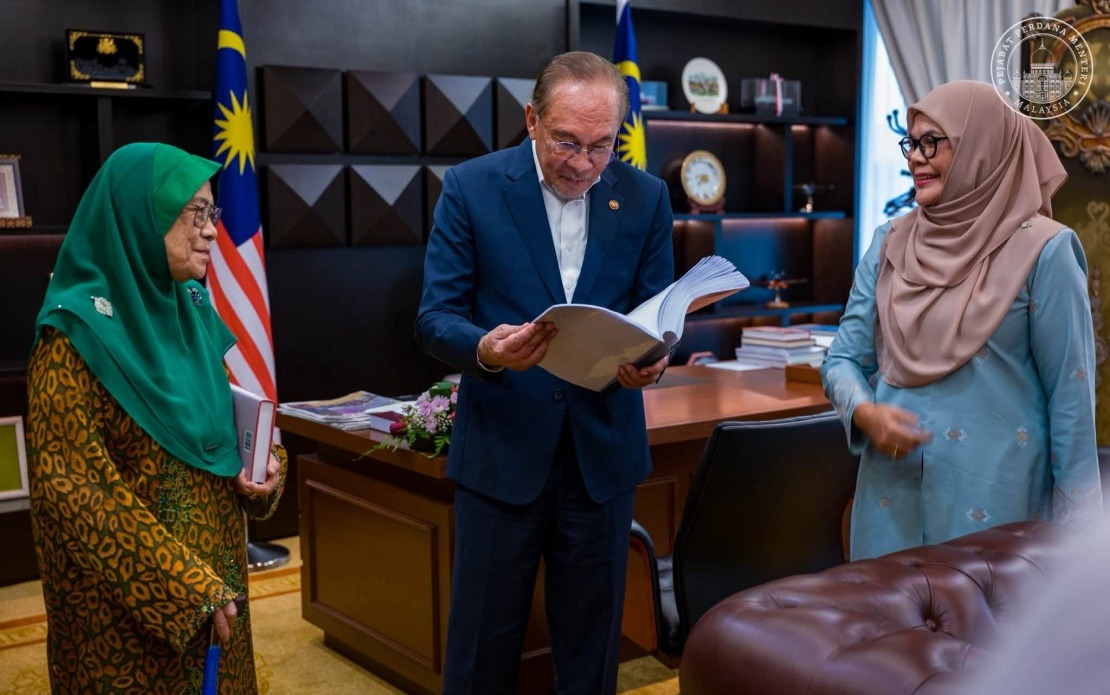
Prime Minister Datuk Seri Anwar Ibrahim has expressed optimism that a newly completed book chronicling his intellectual journey and political worldview will establish itself as a valuable archival resource for coming generations seeking insight into his approach to governance and national development. The publication, authored by Professor Dr Salinah Ja'afar from the Academy of Malay Studies at Universiti Malaya, represents a deliberate effort to systematically capture and preserve the Premier's evolving thoughts on leadership, constitutional reform, and social values that have defined his decades-long career in Malaysian politics.
In a social media statement released on July 1, Anwar disclosed that he had actively participated in the book's development process, reviewing the manuscript in detail and offering substantive feedback to ensure accuracy and completeness. This hands-on involvement underscores the significance he attaches to how his intellectual legacy is documented and transmitted to readers unfamiliar with his complete body of work. The collaborative approach also reflects a broader institutional effort within Malaysian academia to create comprehensive biographical and philosophical records of the nation's contemporary political leaders while they remain active in public service.
The scholarly credentials underpinning this project carry considerable weight within Malaysian intellectual circles. Professor Emeritus Datuk Dr Nik Safiah Abdul Karim, a distinguished language specialist and former academic leader, assumed the role of academic adviser throughout the book's conception and execution. Her involvement signals that the publication aspires to meet rigorous scholarly standards rather than functioning merely as a political memoir or public relations exercise. This distinction matters significantly in Malaysian academia, where peer-reviewed works carry greater legitimacy than unvetted political narratives.
Anwar participated in exclusive interviews conducted by both Salinah and Nik Safiah, providing them direct access to elaborate on his positions and the reasoning underlying his policy preferences. These recorded conversations enabled the authors to weave together Anwar's own articulations of his ideas with contextual analysis, creating a more nuanced portrait than would emerge from secondary sources alone. The interview methodology ensures that readers encounter his arguments in his own voice rather than through purely interpretative lenses, enhancing the book's value as a primary historical document.
The Premier emphasized in his statement that the book aims to comprehensively document the ideas, perspectives, and intellectual formations that have shaped his approach to governance. He attributed much of his worldview to accumulated life experiences and extensive scholarly reading across multiple disciplines and traditions. This framing positions the book not as a narrow political tract but as an exploration of how personal development, intellectual exposure, and lived experience converge to produce a coherent political philosophy. Such contextualization helps explain the consistency observers have noted in Anwar's public positions across several decades and multiple political configurations.
Anwar articulated his hope that future generations, particularly students of political science, public administration, and Malaysian studies, will consult this volume when seeking to understand contemporary approaches to nation-building. The emphasis on nation-building rather than partisan political advantage suggests Anwar views the book's intended audience as extending beyond his own political coalition to include scholars, policy analysts, and citizens interested in constitutional development and institutional reform. This universalizing framing aligns with his consistent public positioning as an advocate for systemic change rather than mere electoral victory.
The focus on personal values development constitutes another significant dimension of the book's stated purpose. By documenting how Anwar conceptualizes the relationship between individual ethical formation and effective governance, the publication addresses a persistent debate within Malaysian political discourse about whether leaders can or should serve as moral exemplars. The inclusion of this thematic element suggests the authors and the Premier recognize growing public interest in questions of leadership integrity and the philosophical foundations underlying policy decisions that affect millions of citizens.
The scholarly apparatus surrounding this project reflects a broader Malaysian institutional trend toward creating contemporary historical records while key political figures remain accessible for verification and elaboration. Rather than waiting for posthumous biographies written by outside observers, this approach allows leaders to participate actively in shaping how their legacies are initially documented. For Malaysian readers and regional observers monitoring the country's political evolution, such works provide valuable primary material for understanding how contemporary leaders articulate their vision and the intellectual traditions informing their governance approach.
Anwar's gratitude toward both authors underscores his appreciation for the considerable scholarly labour required to synthesize complex political ideas into coherent narrative form. Translating decades of speeches, policy decisions, constitutional advocacy, and philosophical reflection into a single accessible volume demands editorial judgment about what constitutes essential material and how to organize conceptual content for maximum clarity. The authors' willingness to undertake this substantial project, coupled with the Premier's commitment to participate fully, suggests both parties view the endeavour as contributing meaningfully to Malaysian public discourse and historical documentation.
For Southeast Asian observers tracking Malaysia's political trajectory and constitutional development, this book will likely become a frequently cited reference when scholars examine early twenty-first century efforts to reform institutional structures and address questions of democratic governance. The publication arrives at a moment when Malaysia continues grappling with fundamental questions about the separation of powers, the role of traditional institutions, and the balance between federal and state authority. Anwar's documented thinking on these enduring constitutional questions will provide later analysts valuable insight into how contemporary leaders approached these challenges and what intellectual resources they drew upon when formulating responses.

