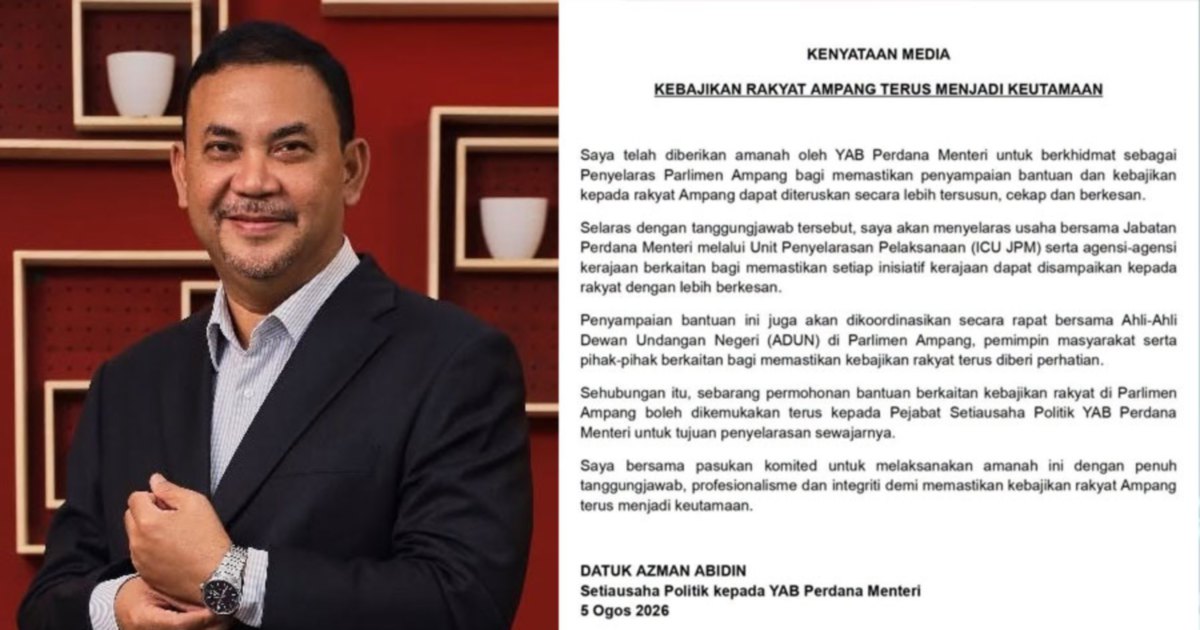
The Prime Minister's office has moved to establish fresh administrative oversight in the Ampang constituency by appointing one of Datuk Seri Anwar Ibrahim's political secretaries as parliamentary coordinator, following decisive action taken against PKR lawmaker Rodziah Ismail over her suspension from the MyKhas allocation system.
The timing of the appointment underscores the broader governance implications when an elected representative loses financial authority over constituency development resources. MyKhas, the digital platform through which Malaysian lawmakers manage federal allocations for local projects and community welfare schemes, represents a crucial administrative tool that directly affects a parliamentarian's ability to serve constituents. By suspending Rodziah Ismail's access to this system, the party has effectively removed her capacity to approve and disburse funds for community initiatives within the Ampang parliamentary district.
The deployment of a PMO-aligned political secretary to assume the coordinator role signals a deliberate restructuring of power dynamics within the Ampang political landscape. Rather than leaving a vacuum in constituency operations, the appointment reflects the government's preference for direct oversight through trusted figures within Anwar Ibrahim's immediate political circle. This approach carries implications for how factional tensions within PKR are managed at the ground level, particularly given that Ampang remains a strategically important urban constituency in the Klang Valley region.
For Malaysian constituents, such administrative changes can have tangible consequences. Constituency coordinators typically oversee welfare assistance applications, facilitate community engagement with the federal government, and help prioritize local development projects. When these functions shift from an elected MP to an appointed political operative, the question of accountability and responsiveness to local needs becomes more complex. Constituents lose direct recourse to their elected representative for resource allocation, and decisions may be filtered through additional bureaucratic layers aligned with central party interests rather than local preferences.
The suspension of Rodziah Ismail's MyKhas access appears connected to internal PKR dynamics and party discipline mechanisms. PKR, as the leading coalition partner under Anwar Ibrahim's premiership, has faced recurring questions about cohesion among its parliamentary members. Such suspensions typically follow allegations of disloyalty, failure to support government positions, or breach of party protocol. The measure suggests that the party leadership views functional control over constituency resources as a lever to enforce compliance and discourage dissent.
From a broader institutional perspective, this situation illustrates the tension between electoral representation and executive control within Malaysia's Westminster-influenced democratic system. While MPs retain their parliamentary seats and constitutional prerogatives, their practical effectiveness in serving constituents can be curtailed through administrative mechanisms that fall outside formal legislative procedures. The MyKhas platform, though designed as a neutral infrastructure tool, becomes a potential instrument of party management rather than purely a service delivery mechanism.
The Ampang appointment also reflects patterns visible across Malaysian politics in recent years, wherein political offices proliferate and authority becomes distributed among multiple stakeholders within constituencies. Beyond the elected MP, there are now political secretaries, coordinators, and other appointed officials, sometimes creating parallel power structures. This layering can lead to confusion about responsibility and accountability when constituents seek assistance or when funding decisions require explanation.
For PKR specifically, this move represents a continuation of Anwar Ibrahim's centralized approach to party governance since assuming the prime ministerial office. By ensuring that key constituencies have trusted political operatives managing critical functions, the leadership reduces its dependence on the loyalty of individual MPs. This strategy has both stabilizing and destabilizing effects: it reduces the risk of parliamentary defections or embarrassing public statements, but it also potentially alienates backbench members who may feel marginalized or subject to arbitrary restrictions on their authority.
The implications extend to Malaysian federalism and regional governance. Ampang, located within Selangor, sits at the intersection of federal and state jurisdictions. A weakened MP, constrained in resource allocation, may struggle to coordinate effectively with state-level representatives or to champion constituents' interests in federal-state negotiations over development priorities. This could ultimately disadvantage residents if coordination failures delay community projects or create gaps in service delivery.
From the perspective of government accountability, the suspension raises questions about transparency and due process. Constituents are entitled to know why their MP has been restricted from accessing standard government systems and what formal grounds justify such restrictions. Public communication about the reasons behind such actions remains limited, leaving room for speculation and eroding public confidence in institutional fairness.
Looking ahead, the situation in Ampang may serve as a precedent for how other potentially troublesome MPs are managed administratively without resorting to expulsion or more dramatic confrontations. It demonstrates a sophisticated use of party machinery to consolidate control while preserving surface-level institutional legitimacy. Whether this approach ultimately strengthens governance or deepens internal party fractures will depend on how constituents and other MPs perceive the fairness and necessity of such measures.
For Malaysia's democratic development, this episode underscores the need for clearer institutional frameworks governing how party discipline intersects with an MP's core functions. As administrative tools like MyKhas become more central to constituency operations, explicit safeguards protecting MPs' ability to serve their constituents regardless of internal party status become increasingly important. Without such protections, the risk grows that party management concerns override the fundamental representative relationship between elected officials and their voters.

