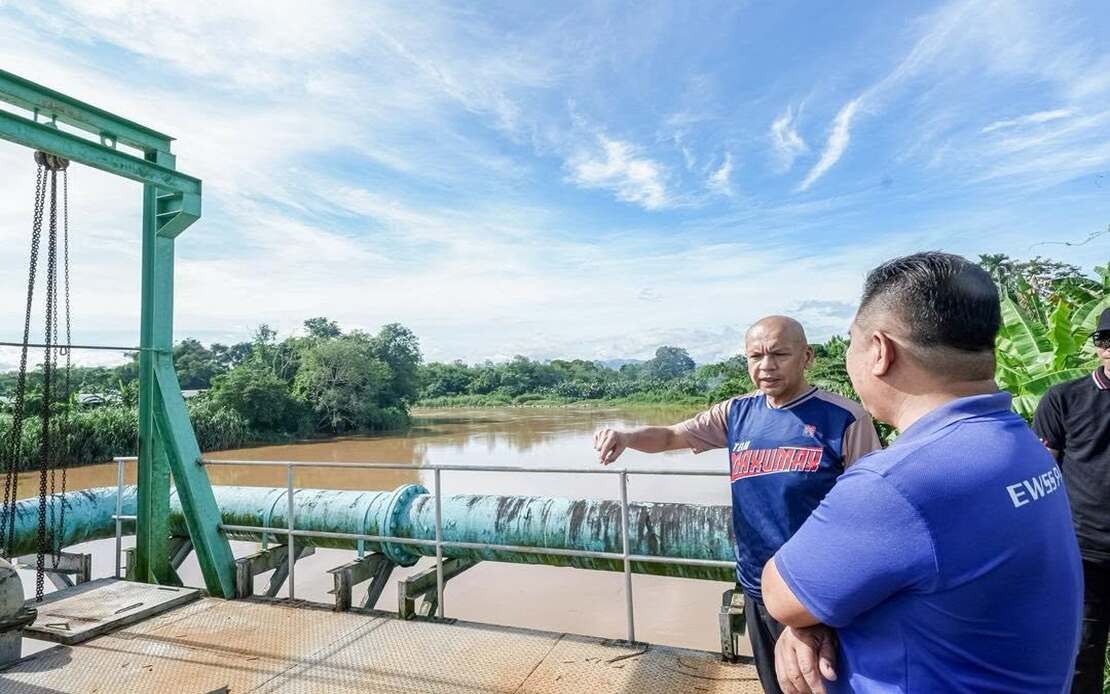
Datuk Armizan Mohd Ali, the federal Domestic Trade and Cost of Living Minister and Member of Parliament for Papar, conducted an on-site inspection of the district's water supply stabilization initiatives on June 19, part of a broader effort to monitor progress on long-term infrastructure enhancements aimed at resolving chronic shortages affecting residents across the region.
The ministerial visit came several days after a dedicated planning session held on June 15 to assess implementation timelines for multiple water supply projects. This hands-on approach reflects growing recognition among federal officials that direct field observation is essential for understanding operational constraints and ensuring that remedial measures translate effectively into sustained service improvements for local communities grappling with irregular water availability.
Two significant infrastructure projects are currently advancing in Papar. The first involves a substantial upgrade to the Kogopon Water Treatment Plant, which will nearly double its daily processing capacity from 40 million litres to 80 million litres. Simultaneously, engineers are enhancing the Kampung Kabang water intake facility. Together, these complementary upgrades are designed to expand the overall system's throughput and operational resilience as demand from growing residential and commercial sectors continues climbing.
These capacity enhancements address long-standing supply pressures that have constrained the district's development prospects. Papar, like many areas across Sabah and broader Southeast Asia, has experienced demand outpacing existing infrastructure, creating cycles of water rationing and service interruptions that affect households and small businesses. By nearly doubling treatment capacity at Kogopon, authorities are attempting a structural solution rather than relying solely on demand management measures.
During his inspection, Armizan also examined operational conditions at the EWSS Plant and the JETAMA Limbahau facility, both of which had experienced disruptions in recent days due to raw water quality complications. The underlying technical issue involves elevated turbidity—measured in nephelometric turbidity units (NTU)—which indicates suspended sediment and organic particles making raw water unsuitable for standard treatment processes without preliminary clarification stages.
When raw water turbidity levels exceed acceptable thresholds, treatment plant operators face a difficult choice: process water that may compromise final quality and risk consumer safety, or temporarily halt operations until source water conditions improve. Both the EWSS and JETAMA Limbahau plants elected to shut down temporarily, a prudent decision but one that inevitably exacerbates supply shortages for downstream consumers already accustomed to irregular service.
These turbidity episodes likely stem from recent heavy rainfall, which is common across Sabah's monsoon-influenced climate. Intense precipitation dislodges topsoil and organic material into water bodies, increasing sediment loads that overwhelm conventional treatment. Such seasonally predictable challenges underline why long-term infrastructure investment—including upgraded intake structures like the Kampung Kabang project—remains critical. Modern intake designs can better shield raw water from runoff and sedimentation, reducing turbidity fluctuations and improving treatment plant reliability.
Armizan's emphasis on direct field monitoring reflects an important management principle increasingly recognized within Malaysian government circles: statistical reports and facility data, while essential, cannot fully capture the operational realities that frontline staff navigate daily. Physical inspection allows ministers to identify systemic bottlenecks, understand workforce constraints, and observe how theoretical capacity translates into actual service delivery under real-world conditions.
For Papar residents, these inspection visits signal federal acknowledgment of their water security challenges, though tangible relief remains months away as the Kogopon upgrade and Kampung Kabang intake work progress through design, procurement, and construction phases. The timeline for these projects remains unclear from available statements, but critical infrastructure in Malaysia typically requires 12 to 24 months from commencement to operational status.
The situation in Papar mirrors challenges across Malaysia's smaller towns and district centres, where aging or undersized water infrastructure struggles to serve population growth and economic activity. Unlike major metropolitan areas with centralized utility management and substantial capital budgets, smaller districts often lack integrated planning frameworks that anticipate demand surges years in advance. Papar's predicament—simultaneously managing immediate turbidity disruptions while implementing longer-term capacity expansion—encapsulates this tension.
Efforts to stabilize Papar's water supply also carry implications for broader Sabah development. Water security is fundamental to attracting manufacturing investment, supporting agricultural expansion, and enabling residential development. Districts perceived as having chronic water shortages face competitive disadvantages relative to areas with secure, reliable supply. Investments like the Kogopon upgrade therefore serve economic diversification objectives alongside immediate consumer welfare.
Moving forward, success will depend not only on completing the planned infrastructure upgrades but also on establishing routine maintenance protocols and developing contingency systems for managing raw water quality fluctuations. The turbidity incidents revealed this week highlight how dependent treatment systems remain on source water stability. Complementary investments in catchment protection, regular monitoring infrastructure, and rapid-response protocols could mitigate future disruptions while the major expansion projects proceed.

