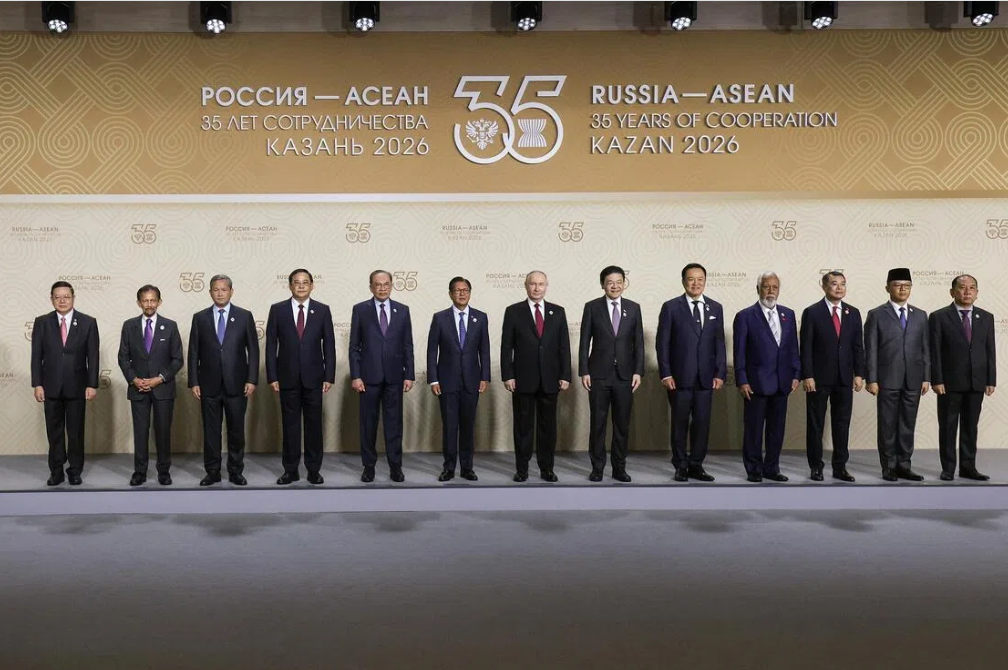
Asean and Russia have committed to deepening cooperation across multiple strategic areas, with both sides adopting a comprehensive framework to guide their partnership over the next five years. The Asean-Russia Commemorative Summit (ARCS), convened in Kazan during June 17-18, provided the occasion for this renewed affirmation of ties, with Russian President Vladimir Putin hosting the diplomatic gathering that brought together Asean leadership to mark three and a half decades of diplomatic relations and three decades of formal dialogue partnership.
Three major documents emerged from the summit to cement the bilateral agenda. The Kazan Declaration serves as the foundational agreement, evaluating the trajectory of Asean-Russia relations since their establishment and establishing priorities for the years ahead. Alongside this, a Joint Statement on Cultural Cooperation commits both sides to expanding people-to-people exchanges and deepening cultural understanding. Most significantly, the Asean-Russia Comprehensive Plan of Action (2026–2030) provides a detailed roadmap for practical collaboration across diverse sectors, translating political commitments into actionable initiatives that will shape engagement through the remainder of the decade.
The summit's agenda encompasses areas of profound importance to regional stability and prosperity. Maritime cooperation stands as a priority, reflecting the critical role of sea lanes in Asean's economic lifelines and international commerce. Trade and investment frameworks received emphasis, acknowledging that economic interdependence strengthens diplomatic relations and creates mutual incentives for stability. Energy cooperation was addressed, relevant given Asean's diverse energy needs and Russia's significant hydrocarbon resources. Connectivity initiatives feature prominently, recognising that infrastructure and transportation links facilitate regional integration. Security cooperation, cultural exchanges, and educational partnerships complete the comprehensive agenda, addressing both tangible security concerns and the softer dimensions of bilateral relations that build lasting understanding.
Singapore's Prime Minister Lawrence Wong, speaking on behalf of Asean, articulated a nuanced approach to the partnership that balances pragmatic cooperation with principled positions on global governance. Wong emphasised that Asean and Russia should identify convergence points while acknowledging that differences exist on certain international matters. This calibrated stance reflects Asean's traditional approach to balancing relationships with major powers, particularly given Russia's complex position in the current geopolitical environment following its invasion of Ukraine. Wong specifically praised Russia's support for Asean Centrality, the principle that regional institutions should serve as the driving force for regional affairs rather than great powers imposing solutions from outside.
The Prime Minister highlighted Russia's longstanding participation in Asean-led mechanisms, particularly the Asean Regional Forum (ARF) and the East Asia Summit (EAS), both instrumental in fostering dialogue among regional and major powers. Wong signalled Singapore's expectation of Russia's continued engagement with these platforms, announcing that the Philippines will host these meetings later in 2024 before Singapore assumes the rotational Asean Chairmanship for 2027, when it will convene these same forums. This succession of hosting duties underscores the importance both Asean and Russia attach to sustaining dialogue channels despite broader international disagreements.
Beyond diplomatic architecture, Wong identified concrete areas where Asean-Russia cooperation could yield tangible benefits. Disaster management emerged as one such area, particularly relevant for Asean given the region's vulnerability to typhoons, floods, and earthquakes. The scourge of drugs trafficking, a persistent regional challenge affecting multiple Asean nations, represents another domain where coordinated efforts could strengthen law enforcement and public health outcomes. Wong also emphasised the importance of strengthening people-to-people connections through educational and cultural initiatives, noting that Russian officials regularly participate in civil service training programmes across Asean member states, including Singapore. These interpersonal links form the foundation upon which broader strategic partnerships rest.
Wong articulated Asean's commitment to the rules-based international order, a theme that carries particular weight given regional anxieties about great power competition and potential disruption of existing frameworks. He stressed that in an increasingly unpredictable geopolitical environment, adherence to international law becomes more critical rather than less. This emphasis reflects Asean's conviction that smaller states depend fundamentally on the predictability that legal frameworks and established norms provide. Wong specifically referenced Asean's advocacy for unimpeded freedom of navigation through crucial international waterways, a position directly aligned with the United Nations Convention on the Law of the Sea. This commitment extends to multiple contemporary conflicts, with Wong noting that Asean has consistently called for parties in various disputes to exercise restraint, return to dialogue, and pursue peaceful resolution in accordance with international legal principles.
On specific regional flashpoints, Wong indicated Singapore's welcome for the peace agreement between the United States and Iran, expressing hope that such diplomatic breakthroughs might lead to sustained de-escalation and reopening of the Strait of Hormuz, through which enormous volumes of global trade pass. Regarding Ukraine, Wong explained that Singapore's position derives not from alignment with either party but from consistent commitment to principles of sovereignty and territorial integrity that apply universally. Singapore has maintained diplomatic efforts supporting ceasefire negotiations while calling for outcomes grounded in international law and the UN Charter. This principled neutrality coexists with Singapore's earlier imposition of sanctions on Russia following the 2022 invasion, sanctions that remain in effect, demonstrating the complexity of balancing engagement with principled positions.
Wong's bilateral meeting with President Putin, held at Russia's request, provided an opportunity for direct dialogue on bilateral relations and broader regional and international developments. In remarks shared on social media, Wong emphasised that the meeting underscored the value of dialogue and engagement even when countries diverge on significant issues. He reiterated Singapore's valuation of its longstanding relationships with Russia and the Russian people, reaffirming the intention to identify and pursue cooperation opportunities in areas of mutual interest. This pragmatic approach reflects Singapore's historical strategy of maintaining ties with major powers while retaining strategic autonomy and principled positions.
Additionally, Wong met with Rustam Minnikhanov, the Rais of the Republic of Tatarstan, highlighting the depth of Singapore's engagement with Russia's constituent regions. Singaporean-Tatarstan relations carry historical significance, traceable to then-Minister Mentor Lee Kuan Yew's visit to Tatarstan in 2007. Wong and Minnikhanov discussed cooperation spanning cultural, educational, and people-to-people dimensions, demonstrating Singapore's multi-level engagement strategy with Russia at both federal and regional levels. These regional connections provide alternative channels for maintaining cooperation even when bilateral relations between national governments face constraints.
The summit itself carries symbolic weight beyond its immediate outputs. By hosting Asean at the highest level, President Putin signalled Russia's commitment to maintaining relevance in Asian affairs despite broader international isolation resulting from the Ukraine conflict. For Asean, the summit demonstrated the bloc's capacity to engage with Russia on constructive terms while maintaining its principled positions on international law and regional stability. The documents adopted provide structure for practical cooperation in non-politicised domains, allowing both sides to demonstrate the positive dimensions of their relationship. For Malaysia and other Asean members, the summit outcomes suggest continued opportunities for engagement with Russia in sectors like trade, energy, and education, even as the regional bloc navigates a complex geopolitical landscape.
Looking forward, the 2026–2030 Comprehensive Plan of Action will test both Asean and Russia's commitment to sustained cooperation amid an uncertain international environment. Implementation will require institutional mechanisms, financial commitment, and political will from both sides. The framework's success will also depend on Asean's ability to maintain unity and Russia's capacity to commit resources to regional engagement despite other strategic preoccupations. For Malaysia and the broader region, these agreements represent attempts to preserve diplomatic relationships and economic cooperation while managing the significant differences that characterise contemporary great power competition, a balancing act that will define Asean's foreign policy trajectory in the years ahead.

