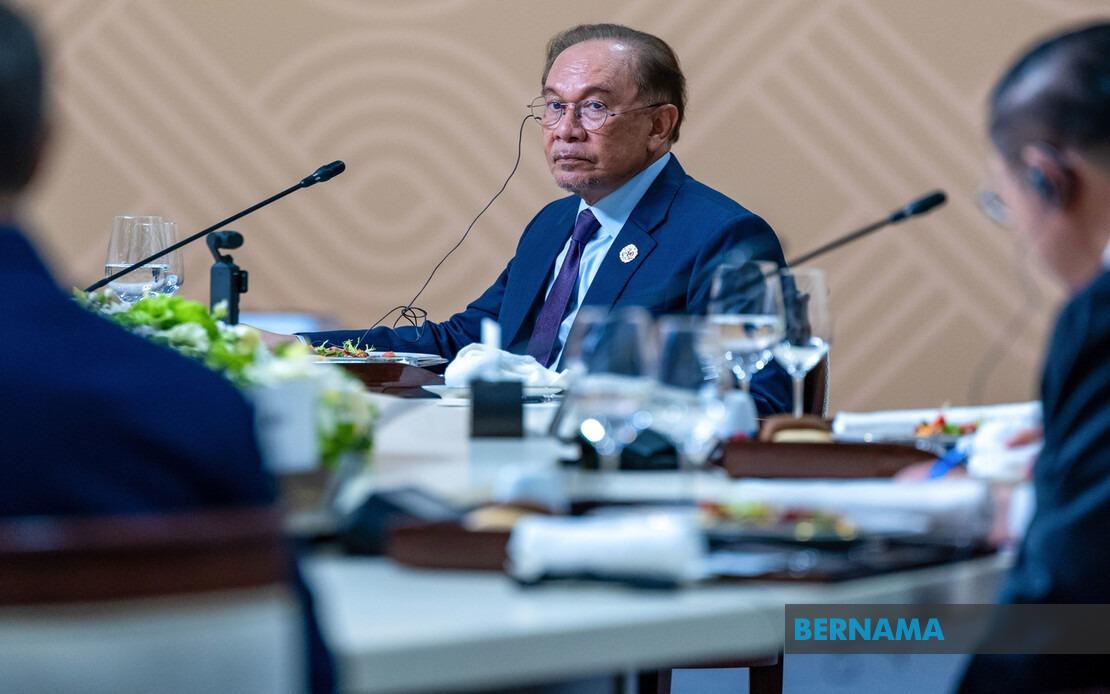
Prime Minister Datuk Seri Anwar Ibrahim has called on ASEAN and the Shanghai Cooperation Organisation to harness their collective strength in tackling transnational crime and energy challenges, arguing that regional security and prosperity depend on coordinated action across borders. Speaking during an ASEAN-Russia working lunch in Kazan on June 18, the Malaysian leader emphasised that both organisations possess the institutional machinery and political will needed to make meaningful headway against problems that individual nations cannot solve alone.
The foundation for deeper cooperation already exists, Anwar noted, pointing to a 2005 memorandum of understanding that has long established avenues for collaborative work. This accord covers counter-terrorism initiatives, drug trafficking prevention, money laundering suppression, and dual-track cooperation in economic, financial and energy sectors. Yet despite these frameworks being in place for nearly two decades, Anwar suggested that progress has remained incremental. He advocated for a sharper strategic focus that identifies specific, measurable goals achievable within defined timescales rather than pursuing overly broad agendas that dilute resources and political attention.
The most pressing concern for Anwar centres on contemporary forms of organised crime that have transcended traditional law enforcement capabilities. Online fraud schemes, illicit financial flows and human trafficking networks operate with sophistication and speed that routinely outpace governmental responses designed for conventional criminal activities. The borderless nature of digital crime means that perpetrators can operate from one jurisdiction while victimising residents across multiple countries, often exploiting regulatory gaps and inadequate intelligence sharing. Anwar stressed that ASEAN and SCO member states stand to gain substantially from establishing intelligence-sharing protocols and investing in capacity-building programmes that would enable police and financial authorities to respond with greater effectiveness and speed.
On the energy front, Anwar highlighted the strategic advantage of bringing together the SCO's major fossil fuel producers and renewable technology specialists under a coordinated framework. The organisation encompasses significant oil and gas exporters alongside nations developing expertise in hydroelectric systems and alternative energy innovation. This concentration of technical knowledge and resource wealth creates opportunities for practical collaboration on energy security—ensuring stable supplies while managing geopolitical vulnerabilities—and facilitating the transition toward cleaner energy sources without compromising economic development or energy affordability.
Malaysia's own perspective on energy cooperation reflects pragmatism about regional development priorities, Anwar explained. Rather than pursuing ideological positions on energy transitions, his government emphasises technology-driven solutions that enhance efficiency, improve grid resilience, and integrate renewable sources while maintaining reliable baseload power. The Malaysian approach encompasses liquefied natural gas infrastructure, gas pipeline development, renewable energy integration and best-practice knowledge exchange on operational safety and system reliability. This framing allows nations at different stages of development to participate without facing pressure to adopt uniform timelines for energy transformation.
Beyond security and energy, Anwar identified the Eurasian Economic Union as a complementary partner deserving renewed attention from ASEAN. The two regional blocs already maintain formal frameworks for engagement, yet commercial cooperation remains underdeveloped relative to potential. He advocated for systematic efforts to build business confidence and expand trade and investment flows, starting with initiatives that facilitate regular meetings between private sector representatives from both sides. Business communities should be encouraged to participate in major economic forums hosted across the region, including dialogues held alongside the Eastern Economic Forum and St Petersburg International Economic Forum.
Smaller enterprises face particular barriers when attempting to access opportunities in distant markets, according to Anwar's analysis. Businesses in developing economies often lack the capital to undertake market research, navigate regulatory frameworks, or acquire cutting-edge technology independently. ASEAN and the EAEU should therefore collaborate on creating support mechanisms that grant smaller firms realistic market access, transfer requisite technologies and provide training in their application. This targeted approach could unlock entrepreneurial energy currently trapped by information asymmetries and resource constraints.
Emerging domains represent a third frontier for ASEAN-EAEU cooperation that Anwar identified as increasingly salient. The digital economy, artificial intelligence applications, cybersecurity protocols and food security—all interconnected challenges in an era of rapid technological change—require coordinated regional responses. No single nation possesses sufficient expertise or resources to master these domains unilaterally, yet regional consortiums can aggregate capabilities and establish standards that benefit all participants. Pursuing joint initiatives in these areas would position both blocs as forward-looking partnerships rather than legacy institutions focused solely on traditional cooperation mechanisms.
Anwar's comments reflect Malaysia's broader diplomatic positioning within multilateral architecture spanning both Southeast and Eurasian regions. As the current ASEAN chair, Malaysia occupies a unique role mediating between regional perspectives and external partners. The Kazan summit itself represents this bridging function, bringing together ASEAN's ten members with Russia and SCO participants for substantive dialogue on shared challenges. By framing cooperation in terms of practical, achievable outcomes rather than grand strategic ambitions, Anwar has sketched a roadmap that could command consensus among nations with divergent interests and capabilities.
The timing of these remarks carries significance given evolving geopolitical tensions and competing great-power interests in Asia-Pacific and Eurasian regions. For Southeast Asian nations balancing relationships with multiple power centres, forums like the ASEAN-Russia Commemorative Summit—which concludes on June 18—offer opportunities to demonstrate independent agency in pursuing partnerships based on concrete mutual benefit rather than strategic alignment. Malaysia's emphasis on functional cooperation areas rather than security bloc formation reflects the preferences of ASEAN nations seeking flexibility in external relations.
Implementing Anwar's vision faces substantial practical obstacles. Intelligence sharing in counter-terrorism and organised crime requires building trust between security establishments with different operational cultures and legal frameworks. Energy cooperation demands navigating price volatility, competing commercial interests among producers, and the long investment timescales that energy infrastructure requires. Private sector engagement depends on building confidence among businesses already embedded in established supply chains and trading relationships. Yet the framework Anwar outlined provides a starting point for incremental progress that could yield tangible benefits without requiring transformative shifts in national policies or strategic orientation.

