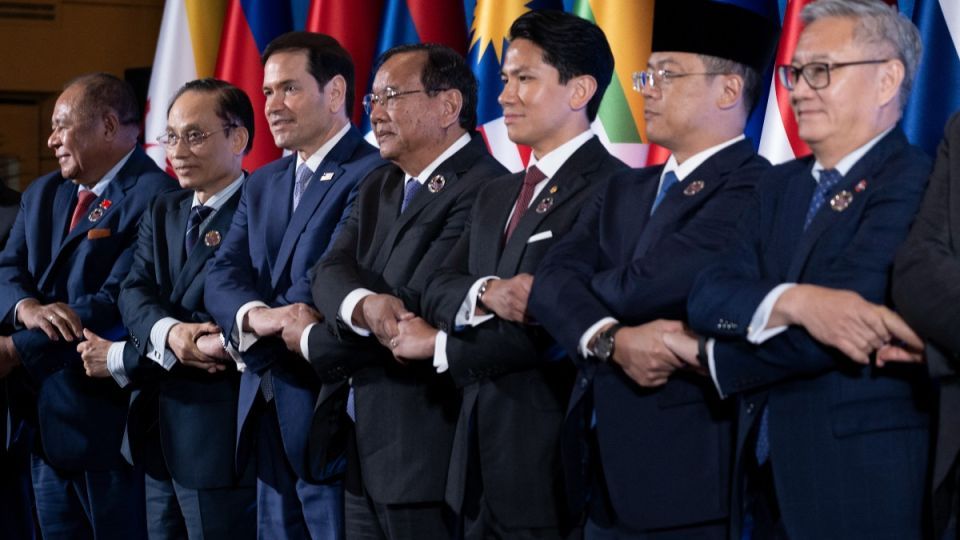
The Association of Southeast Asian Nations has moved to centre the economic fallout from the Middle East conflict at the heart of its security agenda, with foreign ministers meeting in Manila calling Thursday for the restoration of unimpeded passage through one of the world's most critical shipping routes. The intervention, delivered during the 59th Asean Foreign Ministers' Meeting, reflects mounting anxiety across the region that the protracted hostilities are inflicting tangible damage on Southeast Asia's economy despite the crisis occurring thousands of kilometres away.
The joint communiqué, issued after ministerial sessions that consumed the better part of a week, invoked international maritime law to demand that all parties respect the principles governing safe navigation. Specifically, ministers grounded their appeal in the 1982 UN Convention on the Law of the Sea, emphasising that vessels and aircraft must be permitted continuous and safe passage through the Strait of Hormuz without interference. This framing signals Asean's preference for legal and diplomatic channels rather than military intervention, reflecting the bloc's traditional approach to regional disputes, though the rhetorical weight of the statement underscores genuine alarm about the trajectory of the conflict.
The economic dimensions of the Middle East crisis have loomed large throughout this week's diplomatic marathon in Manila. The conflict has triggered ripple effects across multiple sectors critical to Southeast Asian prosperity: crude oil and liquefied natural gas prices have spiked, disrupting energy security; fertiliser supplies have tightened, threatening agricultural productivity across a region heavily dependent on food exports; and global supply chains have fractured, impeding manufacturing and trade flows that Southeast Asia relies upon for growth. These cascading consequences emerged as a persistent theme across every major gathering, from Tuesday's opening sessions through Thursday's East Asia Summit and Asean Regional Forum proceedings, suggesting that regional leaders view the Middle East instability not as a distant geopolitical abstraction but as a direct threat to prosperity.
Indonesia, represented by Foreign Minister Sugiono at the talks, used the occasion to push an ambitious agenda for institutional reform within Asean's security mechanisms. His intervention reflected frustration that longstanding dialogue forums have failed to produce proportionate diplomatic returns. Sugiono argued forcefully that the Asean Regional Forum, established in 1994 primarily as a confidence-building venue, has become intellectually and operationally stale, capable of convening rivals but incapable of shaping outcomes. He called for the forum to graduate from decades of talking shops to embracing concrete preventive diplomacy, joint military exercises, capacity-building initiatives, and enhanced early-warning systems that could detect and head off conflicts before escalation becomes inevitable.
The Indonesian delegation's push for revitalisation of Asean mechanisms sits uncomfortably alongside the bloc's persistent struggles with its own agenda items. The South China Sea remains a chronic flashpoint, with recent confrontations near Second Thomas Shoal between Chinese and Philippine vessels demonstrating that tensions remain volatile despite years of negotiation. Philippine Foreign Minister Theresa P. Lazaro confirmed that these latest incidents featured prominently in discussions around the long-awaited Code of Conduct, which Asean and China have targeted for completion this year but which has eluded final agreement for over a decade. The overlay of the Middle East crisis onto these existing security challenges has compressed Asean's diplomatic bandwidth, forcing ministers to juggle multiple existential concerns simultaneously.
At the East Asia Summit convening 18 nations, Lazaro sounded a note of exhortation, urging Asean and its partners to maintain cohesion precisely because the international environment had become more fractious and unpredictable. Her remarks gestured toward the broader strategic anxieties animating Southeast Asian capitals: the United States and China remain locked in structural competition; Russia's actions in Ukraine have demonstrated the fragility of international law; and now the Middle East conflagration has added another zone of instability. For Malaysia and other Southeast Asian economies heavily dependent on maritime trade and energy imports, these overlapping crises create a sense of strategic vulnerability.
Sugiono's interventions throughout Thursday's talks articulated a philosophy of practical cooperation over rhetorical posturing. He contended that the era of dialogue pursued merely for its own sake has expired, asserting that geopolitical crises increasingly transcend geographical boundaries and demand tangible cooperative responses. This framing implicitly critiques the leisurely pace of institutional evolution within Asean structures, suggesting that the bloc risks irrelevance if it continues operating according to procedural frameworks designed for a less volatile world. The appeal for enhanced toolkits and accelerated decision-making resonates particularly with Malaysian policymakers accustomed to navigating regional tensions while managing narrow economic margins.
On Palestine and the Middle East more broadly, Indonesia framed the conflict through a rules-based order lens, warning that selective application of international law ultimately protects no state and undermines global stability. Sugiono reiterated Indonesia's longstanding position favouring a two-state solution and called for an immediate ceasefire, unimpeded humanitarian access, and a durable political settlement. This articulation reflects Indonesia's role as the Muslim-majority world's third-largest democracy and its attempt to position Asean as an honest broker capable of transcending Western versus non-Western positioning on Middle Eastern affairs. For Malaysian observers, Indonesia's invocation of equal application of international law carries particular resonance given Malaysia's own experiences challenging great power interventionism.
The timing of these ministerial meetings assumes heightened significance given that they precede the bloc's Leaders' Summit in November, where strategic direction for the coming years will be charted. The convergence of multiple security crises—the Middle East conflict, South China Sea tensions, Myanmar's humanitarian catastrophe, and great power competition—presents a stress test for Asean Centrality, the principle ostensibly guiding the bloc's approach to regional diplomacy. Whether the meetings in Manila translate rhetorical commitment to institutional reform and practical cooperation into actual changes to how Asean mechanisms function will determine whether the bloc can meaningfully influence regional outcomes or merely document challenges in communiqués.
For Malaysia specifically, the Hormuz shipping safety issue carries direct implications. As a significant exporter of petroleum products and a nation whose economy depends critically on uninterrupted maritime trade, disruptions to Strait of Hormuz transits would impose immediate costs. Malaysian port facilities at Klang and Port Klang already operate under pressure from rising congestion; additional shipping route uncertainties would compound logistical challenges. The Asean position, while appropriately grounded in international law, represents a collective diplomatic voice that carries more weight than any single Southeast Asian nation could muster independently, underscoring the practical value of bloc coordination despite institutional limitations.
The communiqué's emphasis on the 1982 Law of the Sea Convention reflects Asean's investment in rules-based frameworks for resolving maritime disputes, a preference born partly from the region's experience with contested territorial claims. By invoking universal legal principles rather than great power interests, Asean positions itself as guardian of international norms against selective enforcement. Whether this rhetorical stance translates into material impact on Middle East actors remains questionable, but the act of formal statement signals to regional populations and trading partners that Asean takes seriously the economic consequences of distant conflicts and stands ready to advocate for stability in global commons affecting Southeast Asian interests.

