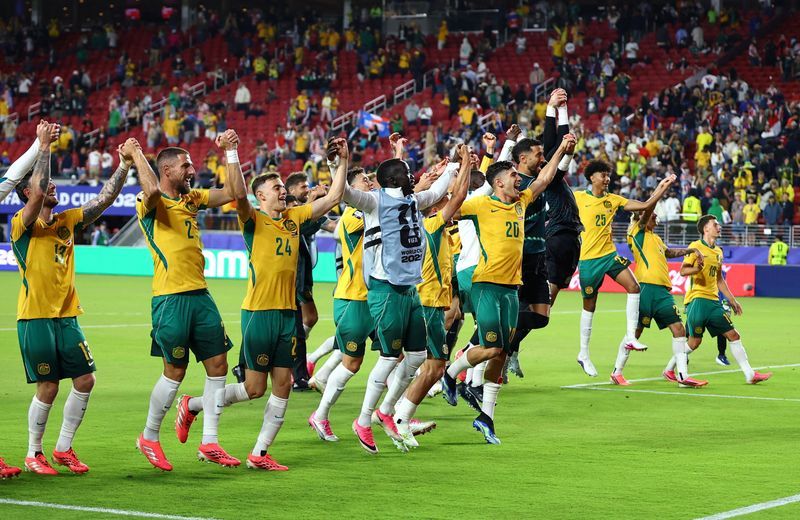
Australia has booked a place in the World Cup's knockout round following a tightly contested scoreless match against Paraguay in Santa Clara, California on Thursday. The Socceroos' progression marks their third appearance in the round of 32, a return to the tournament's latter stages four years after their last 16 campaign in Qatar. The encounter at the San Francisco Bay Area Stadium proved to be a gruelling, competitive affair that showcased defensive solidity but lacked cutting edge in the final third, ultimately working in Australia's favour as they secured a second-place finish in Group D behind tournament co-hosts the United States.
Manager Tony Popovic orchestrated a significant reshuffling of his starting lineup, introducing six fresh faces in a tactical gambit that signalled his side's intent to take the initiative. The inclusion of livewire winger Nestory Irankunda and forward Cristian Volpato represented a deliberate shift towards attacking football, while Jordan Bos was repositioned from left back to right back following an injury to Jacob Italiano. This restructuring reflected Popovic's confidence in Australia's prospects despite the stakes surrounding qualification, demonstrating a willingness to pursue victory rather than settle for a point.
Australia dominated the opening exchanges, constructing several dangerous opportunities through their right flank where Bos and Volpato combined to trouble Paraguay's defence. In the early stages, Volpato picked out Jackson Irvine in a promising position at the edge of the penalty box, though Irvine's angled effort flew directly at Paraguay goalkeeper Orlando Gill. The home side pressed consistently, with both Bos and Volpato forcing saves from the Paraguayan custodian as the first half progressed, yet none of these chances translated into the breakthrough Australia required.
Paraguay's first-half performance was decidedly muted, managing just a solitary attempt at goal as they struggled against Australia's early pressure. Coach Gustavo Alfaro responded to this imbalance by introducing Mauricio, a Brazilian-born attacker, at the interval—a substitution that would invigorate the South American side's attacking endeavours. Within five minutes of the restart, Mauricio tested the Australia goalkeeper with a speculative long-range effort, signalling Paraguay's determination to push forward and force a positive result.
As the match progressed, Paraguay gradually seized the initiative in midfield through the dynamism of Julio Enciso, whose energetic running and keen positioning repeatedly threatened Australia's defensive organisation. The Paraguayan attacker created space and danger through his intelligent movement, presenting his teammates with genuine opportunities to break the deadlock. Enciso came closest to finding the back of the net in the 82nd minute when he unleashed a low shot that whistled agonisingly wide of the left post, a moment that encapsulated Paraguay's growing threat as they searched for the goal that might preserve their qualification hopes.
Australia's defensive resilience became increasingly important as Paraguay mounted pressure in the closing stages, with goalkeeper Joe Bos providing the final barrier against the South Americans' advancing waves of attack. Bos demonstrated composure and authority during these tense periods, ensuring that Popovic's defensive scheme remained intact despite Paraguay's territorial dominance in the latter stages. The Socceroos' ability to weather this pressure and maintain their clean sheet underscored their qualification—a triumph of organisation and disciplined defending rather than flair and attacking brilliance.
The match reached its climax with both sides exchanging opportunities in end-to-end fashion. In the 89th minute, Bos delivered a moment that briefly electrified the Australia support when he burst forward from defence, surging past two Paraguayan defenders and firing a shot that curled narrowly past the far post. Minutes later, Mauricio fashioned a half-chance on the edge of Australia's penalty area but his tame attempt lacked the venom required to trouble the goalkeeper. These final exchanges illustrated the desperation creeping into Paraguay's approach while demonstrating Australia's capacity to launch counter-attacks even under siege.
The goalless outcome leaves Paraguay in an anxious predicament regarding their advancement prospects. With four points accumulated, the 2010 quarter-finalists sit precariously positioned as they await the outcomes of remaining Group D fixtures, hoping that their points total proves sufficient to secure one of the eight available berths allocated for the best-performing third-placed teams. Their World Cup fate now rests in the hands of other nations and results yet to unfold, a position that underscores the competitive equilibrium established throughout the tournament's group stage.
Meanwhile, Australia's progression provides clarity for tournament organisers planning the knockout bracket. The Socceroos will face the second-placed qualifier from Group G, a section that remains genuinely open before Friday's final matches when Egypt confront Iran and Belgium encounter New Zealand. These remaining fixtures will determine Australia's opponent in the Round of 32, setting up a fixture list that could pit them against any of several potential challengers. For the Southeast Asian football audience, Australia's advancement represents a significant achievement for the region's representative in world football's premier competition, demonstrating the continent's growing competitive capability on the global stage.

