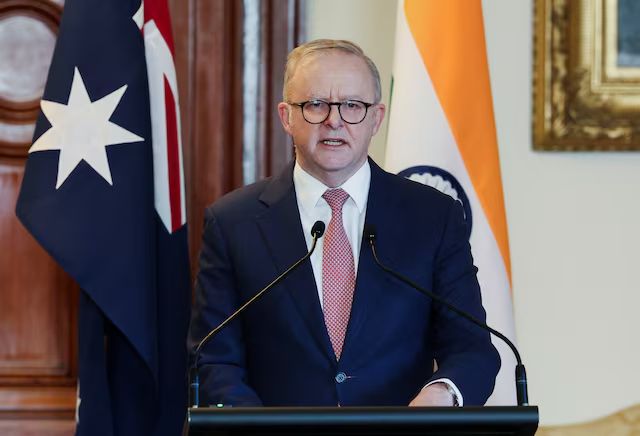
Australia's Prime Minister Anthony Albanese has pledged to directly confront the Trump administration over fresh tariffs Washington imposed this week on dozens of trading partners, including Australia. Speaking on Sunday, Albanese made clear that elevating the tariff dispute with U.S. President Donald Trump would become a priority across all channels of the bilateral relationship, marking an early test of ties between the two traditional allies under the new American administration.
The United States rolled out sweeping tariff measures on Friday, targeting 60 trading partners with duties ranging from 10% to 12.5%, justified on grounds that these nations have insufficiently policed the manufacture and trade of goods produced through forced labour. The action came as a temporary 10% global tariff that Trump had previously implemented reached its expiration date, with the forced labour justification serving as the basis for the more targeted version. Australia joined a substantial cohort of 37 nations subject to a 12.5% tariff rate, while 17 others faced a 10% levy and five countries encountered a mixed arrangement of duties.
Canberra's response has been unequivocal in rejecting the tariff structure. The Labor government under Albanese has characterised the measures as unjustified and has signalled its determination to pursue their withdrawal through sustained engagement with Washington. Rather than accepting the tariffs as a fait accompli, the Australian government has framed them as a problem to be solved through diplomatic channels, reflecting confidence in the strength of the Australia-U.S. relationship and Albanese's belief that reasoned argument can prevail.
When directly asked whether he would broach the tariff issue with Trump, Albanese responded with an unqualified affirmation, stating "absolutely" in televised remarks. The Prime Minister indicated that the matter would be escalated across every level of Australia-U.S. relations, noting that such representations had already commenced. This multilayered approach suggests that conversations are occurring not only at the prime ministerial and presidential level but also through trade officials, diplomatic channels, and potentially parliamentary discussions, creating multiple pressure points for American reconsideration.
Albanese's defence of Australia's position centred on the nation's robust modern slavery provisions and enforcement mechanisms. The Prime Minister argued that Australia already maintains stringent standards for identifying and preventing goods made through forced labour from entering supply chains, and that the government is actively strengthening these safeguards. He specifically highlighted ongoing efforts to enhance supply chain scrutiny and noted that Australia is establishing substantial financial penalties and fines to deter non-compliance, suggesting that the forced labour allegation—the stated rationale for the tariffs—does not accurately reflect Australia's actual performance on this issue.
The tariff dispute reflects growing tensions under the Trump administration's protectionist trade agenda, which has prioritized unilateral action over multilateral negotiation. For Australia, a country deeply integrated into global supply chains and dependent on trade for economic growth, the 12.5% tariff represents a significant threat to key export sectors including agricultural products, minerals, and manufactured goods. The tariffs risk disrupting established commercial relationships and raising costs for Australian exporters competing in the American market.
Albanese has previously emphasised his government's commitment to "free and fair trade" in dealings with the United States, and this principle appears to be guiding his response to the current dispute. The rhetorical framing matters, as it positions Australia as defending established rules-based trading norms rather than simply complaining about American protectionism. This approach may resonate with aspects of the Trump administration concerned with legitimacy and reciprocity, even if that administration's fundamental orientation remains protectionist.
The timing of this confrontation is significant given that Albanese's center-left Labor government secured a landslide election victory last year, strengthening his domestic political position and his capacity to sustain a prolonged negotiation with Washington. During an earlier call with Trump following the election, Albanese had already elevated tariffs as a key concern, indicating that this is not an unexpected development but rather an ongoing area of friction. The fact that the dispute has intensified rather than resolved suggests that initial diplomatic exchanges have not yielded satisfactory outcomes from the Australian perspective.
For Southeast Asian countries and other trading nations similarly affected by the tariff regime, Australia's firm pushback may carry broader implications. As a developed, Western-aligned nation with significant diplomatic weight and a close security partnership with the United States, Australia's willingness to challenge Trump's trade policies could embolden other nations to mount their own challenges or coordinate collective responses. Conversely, should Australia struggle to secure meaningful concessions, it may signal to the region that even privileged trading partners lack leverage to shift American protectionist measures.
The dispute also underscores a fundamental tension in Australia's foreign policy: balancing its economic interests, which favour open trade, with its security alliance with the United States, which remains foundational to its strategic posture in the Indo-Pacific. Managing this relationship requires Albanese to push back firmly enough to protect Australian exporters and maintain credibility at home, while avoiding escalation that could strain the broader alliance relationship. The Prime Minister's repeated emphasis on raising the issue "at every level" suggests an attempt to calibrate pressure—sustained and multilayered, but ostensibly collaborative rather than confrontational.
The outcome of this engagement will likely influence how Australia and other like-minded trading nations approach future Trump administration trade policies. Whether Albanese's diplomatic strategy succeeds in rolling back or modifying the tariffs remains uncertain, but his commitment to pursue the matter reflects the economic stakes involved for Australia and the determination of his government to defend its trading interests despite the asymmetrical power dynamics inherent in dealing with the world's largest economy.

