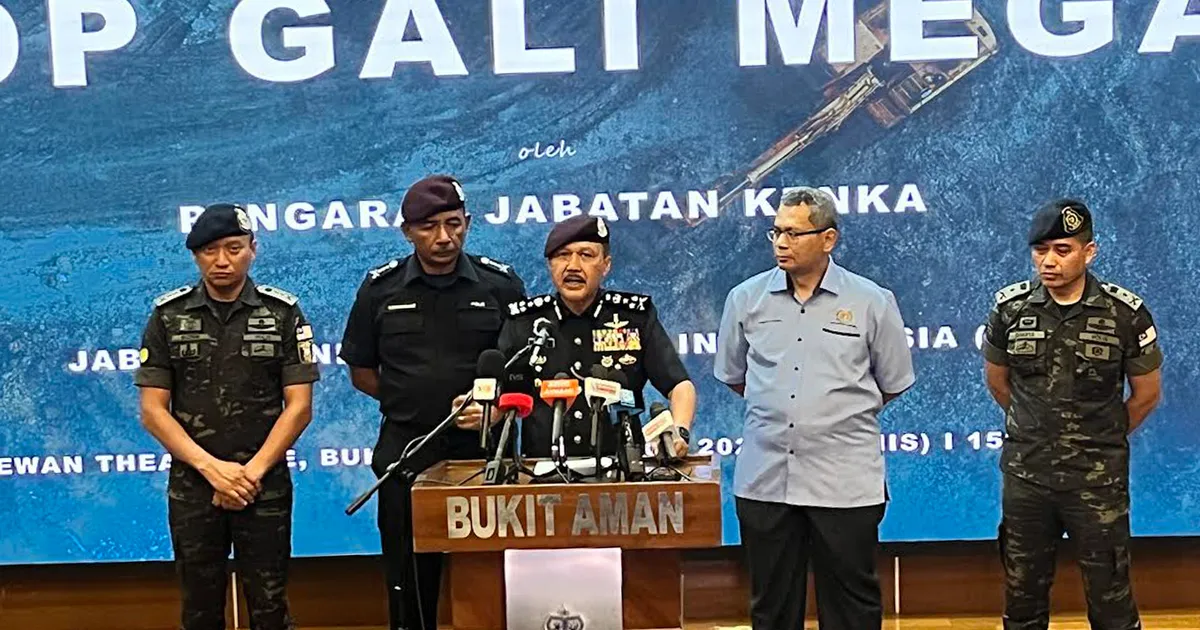
Malaysian law enforcement has dealt a substantial blow to illegal mining operations across the country, arresting 99 individuals and seizing assets worth RM119 million in a concentrated enforcement action spanning August 19 to 23. The five-day operation represents one of the more comprehensive crackdowns on unlicensed extraction activities in recent years, signalling renewed commitment from authorities to combat the persistent problem of unregulated resource extraction that has plagued the nation's mining sector.
During the coordinated effort, enforcement teams recovered approximately 33,000 tonnes of natural resources that had been illegally extracted or stockpiled. The confiscated materials encompassed a diverse range of commodities commonly targeted by illegal miners, including coal, quarry stone, earth, and sand, with the recovered raw materials alone valued at RM21 million. The seizure of such substantial quantities underscores the scale at which illegal operations have been functioning, often with sophisticated logistics networks enabling the movement and sale of mined materials through informal channels that circumvent regulatory oversight.
The distinction between the total asset value of RM119 million and the RM21 million valuation of seized raw materials suggests authorities also confiscated significant equipment, machinery, vehicles, and financial assets connected to the illegal mining networks. This broader asset seizure strategy addresses the economic infrastructure sustaining these operations, targeting not merely the extracted materials but the capital investment and operational capacity that enable ongoing illegal activities. Such comprehensive asset recovery aims to disrupt the financial viability of mining networks, making illegal extraction economically unviable for perpetrators.
Illegal mining represents a persistent challenge across Malaysia and the Southeast Asian region more broadly. The activities generate substantial unregulated revenue for criminal networks while simultaneously depleting natural resources, degrading landscapes, and circumventing tax obligations that should benefit state governments and the federal government. In Malaysia's context, mining jurisdictions span multiple states, with enforcement requiring coordination between federal agencies, state authorities, and local enforcement bodies—a complexity that illegal operators have historically exploited to evade detection and prosecution.
The environmental consequences of illegal mining extend beyond simple resource depletion. Unregulated extraction disrupts soil integrity, contaminates water sources, and destabilises landscapes, creating long-term ecological damage that persists long after mining activity ceases. Communities adjacent to illegal mining sites frequently experience degraded living conditions, including polluted water supplies and air quality concerns from dust and equipment emissions. The social costs, though difficult to quantify in financial terms, compound the economic losses from resource theft and lost tax revenues.
Malaysia's formal mining sector operates under licensing frameworks that impose environmental remediation obligations, safety standards, and revenue-sharing arrangements with host governments. Illegal operations sidestep these requirements entirely, creating unfair competitive advantages while undermining legitimate mining enterprises that comply with regulations and contribute to government coffers. The crackdown therefore benefits not only national resource management but also the regulatory integrity of Malaysia's licensed mining industry, which competes directly against unscrupulous operators unburdened by compliance costs.
The August operation reflects evolving enforcement tactics that move beyond simply arresting individuals to systematically dismantling operational capacity. By recovering equipment and vehicles alongside arresting personnel, authorities target the structural sustainability of illegal networks. The confiscation of RM119 million in total assets represents capital removal from criminal networks, disrupting reinvestment cycles and deterring future participation in mining-related crimes through demonstrated financial consequences for perpetrators.
Coordination among enforcement agencies appears central to the operation's success. The simultaneous execution across multiple locations within a five-day window suggests intelligence gathering, inter-agency planning, and resource pooling that exceeds capabilities of individual departments. Such integrated approaches, when sustained and regularized, create cumulative pressure on illegal mining networks that gradually shrink operational space and increase the risk profile for would-be participants.
The broader context involves Malaysia's efforts to strengthen governance of its extractive industries. Environmental and governance concerns have attracted increasing international scrutiny of Malaysia's mining practices, with international investors and trading partners monitoring compliance with environmental standards. Demonstrable enforcement action against illegal mining bolsters Malaysia's credibility in claiming effective regulatory oversight, supporting both environmental commitments and business confidence in Malaysia's formal mining sector.
For Malaysian readers, the implications extend to property values in mining-affected regions, water security in extraction-adjacent communities, and the broader health of ecosystems supporting agriculture and fisheries. Regions historically impacted by illegal mining stand to benefit from reduced ongoing extraction pressure, though remediation of already-damaged landscapes remains a long-term challenge requiring sustained investment and environmental restoration programmes.
The sustainability of such enforcement operations depends on continued resource allocation and political will. Illegal mining networks adapt and reconstitute following enforcement actions, requiring persistent, systematic pressure rather than episodic crackdowns. The success of the August operation will ultimately be measured not by the immediate arrests and seizures, but by whether it catalyzes lasting changes in illegal mining prevalence and whether enforcement momentum can be maintained through subsequent months and years.

