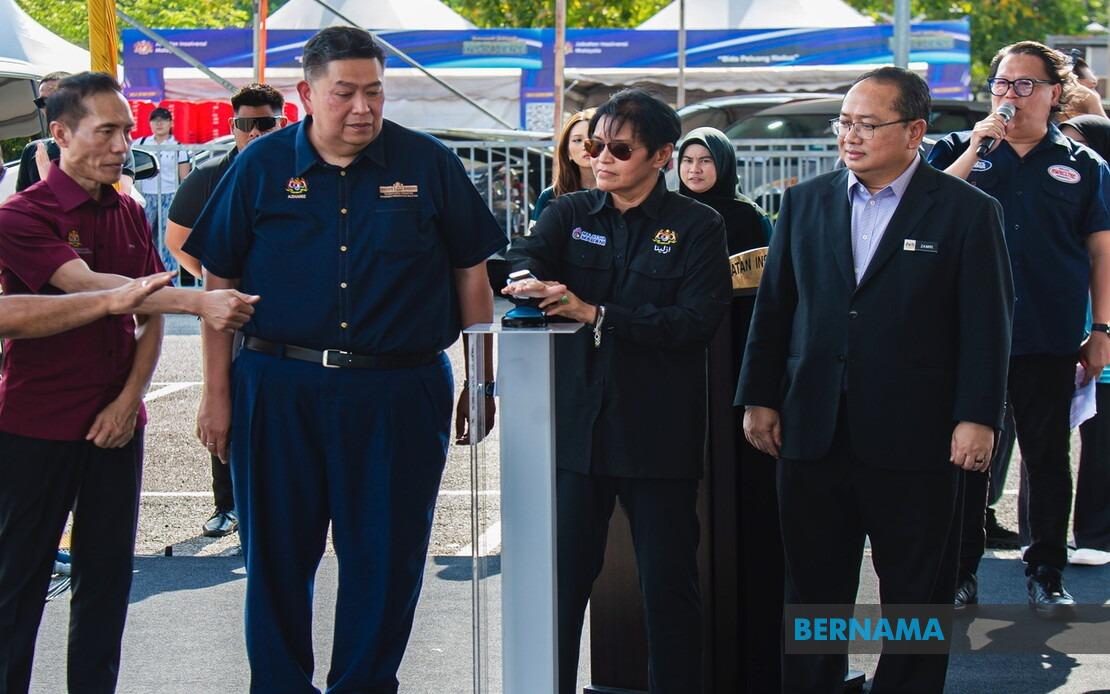
With the Johor state election set to unfold across multiple stages this week, the ruling Barisan Nasional coalition is making a focused pitch centred on governmental stability and seamless service delivery. Speaking in Putrajaya on June 26, UMNO information chief Datuk Seri Azalina Othman Said articulated the party's core campaign message: that voters should prioritize candidates capable of maintaining continuity with the state administration rather than fragmenting support across competing political entities.
Azalina's remarks underscore a strategic calculation by BN that favours incumbency in state-level contests. While she acknowledged the constitutional entitlement of all political parties to field candidates, she framed the election as fundamentally a choice about governance efficiency rather than broader political realignment. Her emphasis on the "state level" distinction carries weight in Malaysian politics, where federal and state governments may operate under different coalitions—a reality that complicates service delivery when institutional priorities diverge.
The minister, who holds the portfolio of Minister in the Prime Minister's Department (Law and Institutional Reform), grounded her argument in the practical mechanics of local administration. She specifically cited village heads and village development committees as examples of grassroots structures that depend heavily on vertical coordination with the state government. This invocation of local governance architecture reflects a genuine administrative concern: when local authorities and state bodies operate under opposing political management, bureaucratic friction can delay project implementation, complicate funding flows, and ultimately diminish the quality of services reaching rural and semi-rural communities.
In the Malaysian context, where state governments wield considerable authority over land, agriculture, and local infrastructure, the continuity argument carries particular resonance. Johor, as one of the nation's largest and most developed states, generates substantial revenue from timber, agriculture, and manufacturing—sectors where state-level policies directly influence local outcomes. Voters in agricultural districts and secondary towns might reasonably worry that political discontinuity could disrupt investment pipeline or delay infrastructure projects if a new state administration prioritizes different constituencies.
However, the continuity framing also reflects broader anxieties within BN about electoral momentum. The coalition's performance in recent national and state contests has been uneven, with younger voters and urban constituencies increasingly willing to experiment with alternative political arrangements. By grounding the campaign in administrative pragmatism rather than party ideology, Azalina's pitch attempts to neutralize emotional or protest voting while appealing to voter self-interest—a strategy that acknowledges underlying dissatisfaction while trying to redirect it toward instrumental concerns.
The timing of her remarks, delivered while officiating the Insolvency Second Chance Policy Roadshow Carnival 2026, suggests BN is attempting to couple electoral messaging with tangible policy deliverables. The insolvency initiative targets vulnerable households and entrepreneurs facing financial distress, positioning BN as a government attentive to bread-and-butter concerns. This alignment of campaign messaging with policy action is deliberate: it allows candidates to point to concrete government programmes when knocking on doors, converting abstract arguments about continuity into evidence of BN's responsiveness.
The electoral timeline provides BN limited time to consolidate its positioning. With the Johor State Legislative Assembly dissolved on June 1, nomination day set for June 27, early voting on July 7, and polling day on July 11, the campaign window spans roughly two weeks. This compressed schedule favours the incumbent coalition, which enjoys institutional advantages including media access, government machinery, and the ability to time announcements strategically. Challengers, by contrast, must build campaign infrastructure and name recognition in a shortened timeframe, particularly challenging in a state with 26 state seats and sprawling rural constituencies.
For Malaysia's broader political ecosystem, the Johor election carries significance beyond state boundaries. Johor remains demographically and economically pivotal, home to over 4 million people and representing roughly 13 percent of the national electorate. A decisive BN victory would reinforce the coalition's post-2018 recovery narrative and demonstrate that voters remain persuadable by administrative competence arguments. Conversely, substantial losses would signal that even in traditionally BN-friendly heartland states, voter appetite for political change remains robust, potentially reshaping calculations ahead of the next federal election.
The challenge for Azalina and BN messaging is that the continuity argument, while administratively sound, may resonate unevenly across Johor's diverse constituencies. Urban voters in Johor Bahru, Kluang, and other developed areas may prioritize different concerns—affordability, infrastructure quality, and anti-corruption measures—over abstract continuity. Meanwhile, rural constituencies dependent on government contracts, land policies, and agricultural support may indeed value the certainty that continuous BN administration provides. Ultimately, the election outcome will reveal whether BN's pragmatic appeal to administrative stability proves sufficient to retain voter confidence in an era of rising political experimentation.
The 16th Johor state election thus represents both a test of BN's electoral durability and a window into evolving voter preferences across Malaysia. Whether continuity and administrative pragmatism triumph over alternative political offerings will offer crucial insights for both the ruling coalition and opposition parties as they prepare for future contests.

