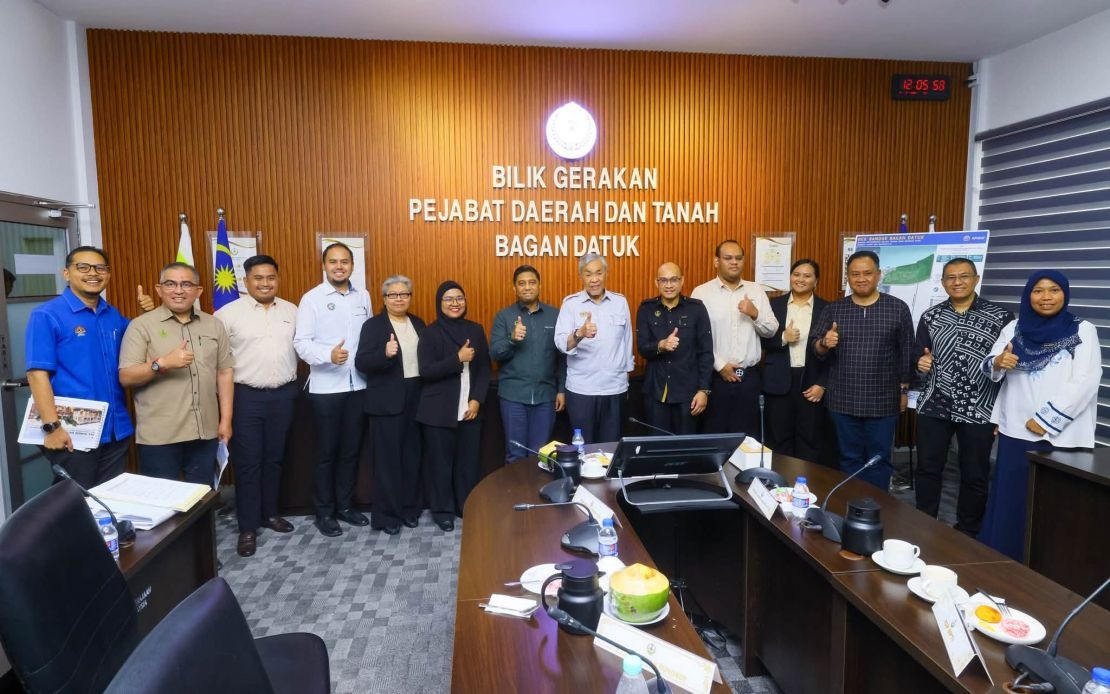
Deputy Prime Minister Datuk Seri Dr Ahmad Zahid Hamidi has articulated a comprehensive development vision for Bagan Datuk, his parliamentary constituency in Perak, positioning the district as a future administrative centre that balances planned urbanisation with livability and economic competitiveness. Speaking in Ipoh on August 14, Zahid emphasised that the constituency possessed substantial untapped potential that could be harnessed through coordinated stakeholder efforts and strategic planning aligned with community aspirations.
Zahid's remarks came following a formal presentation he attended regarding the Bagan Datuk special area plan, known locally as the RKK, conducted jointly by the Teluk Intan Municipal Council, Bagan Datuk District authorities, the Land Office, and engaged urban planning consultants. This collaborative engagement signals an intensified push toward formalising development frameworks for the district, moving beyond aspirational statements towards concrete planning instruments that can guide infrastructure investment and land-use decisions over the medium to long term.
The Deputy Prime Minister framed his commitment to Bagan Datuk's development not merely as a political obligation but as a personal mission stemming from his deep roots in the constituency. By presenting himself as a native son invested in the district's trajectory, Zahid sought to establish credibility and demonstrate that any forthcoming initiatives would reflect genuine understanding of local needs rather than top-down impositions by federal authorities disconnected from ground realities.
Zahid's articulated vision encompasses multiple interconnected dimensions of urban development. The administrative town concept suggests modernised governance infrastructure and services, implying improved municipal facilities, efficient public administration buildings, and enhanced civic amenities. The emphasis on livability underscores attention to quality-of-life factors—residential comfort, green spaces, and community-oriented design rather than purely commercial or industrial development. Competitiveness indicates aspirations for economic vibrancy, suggesting plans to attract investment and create employment opportunities that would retain talent within the district rather than seeing young professionals migrate to larger urban centres.
The reference to development "in a park" carries particular significance for Malaysian urban planning discourse, echoing garden city principles that have gained traction across Southeast Asian municipalities seeking to balance growth with environmental conservation and aesthetic quality. This conceptual framing suggests planners are considering integrated landscape architecture alongside functional infrastructure, potentially addressing concerns among both urban environmentalists and residents fatigued by concrete-heavy development patterns common across the region.
For Bagan Datuk residents, the outlined plans represent potential transformation of economic and social prospects. Improved infrastructure typically catalyses business activity, attracts professional services, and enhances property values. Better facilities could improve healthcare access, educational opportunities, and recreational amenities that currently may require travel to larger centres like Ipoh or Kuala Lumpur. The administrative town status could also generate sustained employment in government and associated service sectors, providing stable income opportunities.
However, such development trajectories require careful management to avoid pitfalls common across Malaysian urban expansion. Rapid growth without adequate planning has historically strained existing infrastructure, displaced vulnerable communities, and inflated property costs beyond local affordability thresholds. The emphasis on community needs in Zahid's framing suggests awareness of these risks, though implementation will ultimately determine whether consultation translates into substantive community benefit or becomes mere procedural formality.
The special area plan process itself represents a methodical approach to development governance. Such plans typically establish zoning frameworks, infrastructure requirements, environmental standards, and phasing schedules spanning multiple years or decades. By investing in this planning exercise, authorities signal intent to coordinate fragmented decisions and prevent chaotic, speculative development. For investors considering the region, formalised plans reduce uncertainty and enhance confidence in long-term viability.
Zahid's role as both Deputy Prime Minister and Bagan Datuk's parliamentary representative positions him uniquely to facilitate development at multiple bureaucratic levels. His involvement with the special area plan presentation underscores this dual leverage—he can influence federal resource allocation while remaining attuned to constituency-level perspectives. This positioning could accelerate development timelines compared to constituencies represented by backbench parliamentarians with limited ministerial influence.
The development vision also carries broader implications for Perak state, which has historically received less federal investment attention compared to corridor development concentrated in Selangor, Kuala Lumpur, and Johor. Elevated focus on Bagan Datuk could signal a shift toward more geographically distributed development patterns, potentially benefiting peripheral regions across Peninsular Malaysia that face relative economic stagnation and demographic decline through youth out-migration.
Regionally, the Bagan Datuk case reflects wider Southeast Asian urban development trends prioritising integrated planning, livability metrics, and administrative efficiency as cities compete for investment and talent. The emphasis on planned, distinctive development rather than uncontrolled sprawl aligns with best-practice principles increasingly adopted across the region's growing metropolitan areas.
Zahid concluded his remarks with a commitment to sustained effort toward realising the development vision, framing future progress as collective responsibility among government agencies, local authorities, and community stakeholders. Whether the special area plan translates into tangible projects within realistic timeframes will substantially determine the credibility of these pronouncements and the tangible benefits accruing to Bagan Datuk residents and businesses over coming years.

