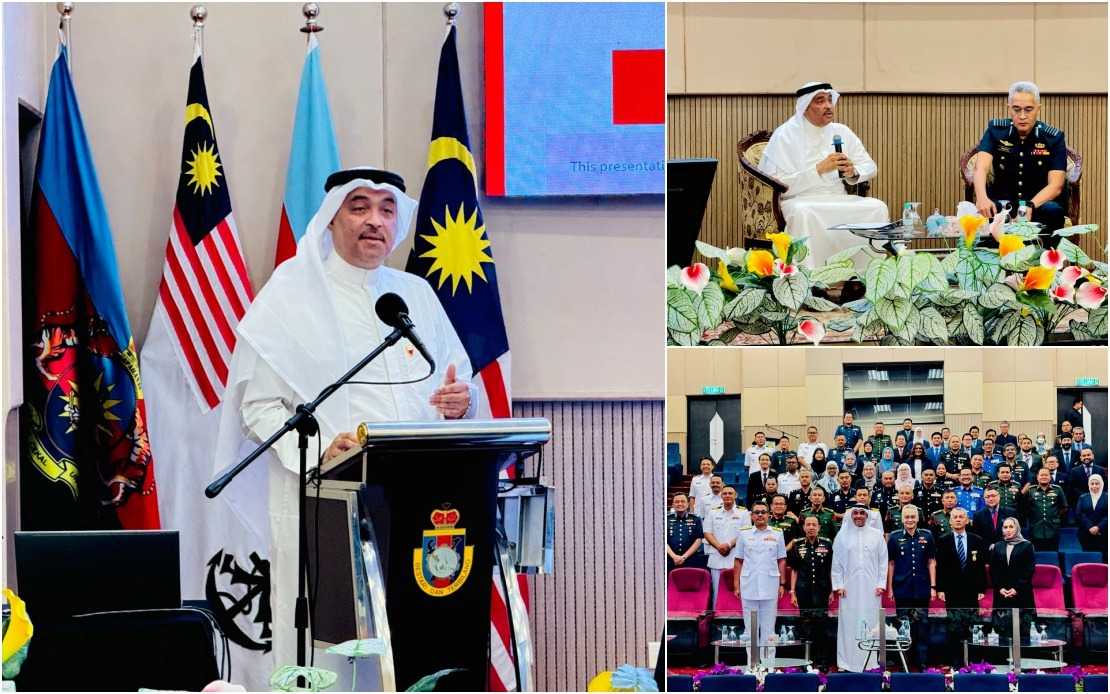
The relationship between Bahrain and Malaysia is entering a more robust phase, with both Gulf and Southeast Asian powers signalling deeper engagement across defence, diplomacy and commercial interests. Speaking at the National Resilience College in Putrajaya, Bahrain's Ambassador to Malaysia Dr Waleed Khalifa Al Manea underscored the strengthening bonds between the two nations, framing the partnership as essential to addressing contemporary regional challenges that extend far beyond their immediate geographic boundaries.
The ambassador attributed the momentum to sustained leadership commitment at the highest levels. The close working relationship between His Majesty King Hamad bin Isa Al Khalifa of Bahrain and His Majesty Sultan Ibrahim of Malaysia has created diplomatic space for officials to pursue concrete cooperation initiatives. Equally significant is the drive from their respective prime ministers—His Royal Highness Prince Salman bin Hamad Al Khalifa in Bahrain and Datuk Seri Anwar Ibrahim in Malaysia—who have prioritised bilateral coordination across numerous policy domains. This institutional support from top leadership demonstrates that the partnership extends beyond ceremonial gestures into substantive government action.
One symbolic yet consequential expression of this deepening relationship emerged through Bahrain's decision to host the 2026 Formula 1 Gulf Air Bahrain Grand Prix in Malaysia. Beyond the sporting spectacle, this arrangement reveals how the two nations are identifying opportunities to interweave their public profiles and create platforms for cultural and economic exchange. Such high-visibility events serve diplomatic purposes, building public awareness of bilateral ties while generating economic activity and tourism revenue for both countries.
The lecture Al Manea delivered focused on Bahrain's strategic vision for regional stability in an increasingly complex security environment. The Kingdom has adopted what officials describe as a comprehensive approach that balances several competing imperatives: safeguarding national sovereignty, protecting civilian populations, documenting factual records of security incidents, and advancing diplomatic solutions through multilateral coordination. This framework reflects Bahrain's position as a small Gulf state navigating larger power dynamics while maintaining its commitment to rules-based international order.
The timing and content of Al Manea's remarks carry particular salience for Malaysia and the broader ASEAN region. Bahrain has faced repeated ballistic and drone attacks attributed to Iranian forces, targeting not only military installations but also civilian infrastructure and commercial shipping lanes. These incidents have reverberated throughout global supply chains and energy markets, affecting economies far removed from the Gulf itself. For Malaysia, a significant maritime trading nation heavily dependent on freedom of navigation through international waterways, the instability represents a direct economic threat. Disruptions to shipping, increased insurance costs for vessels transiting contested waters, and the potential for energy price volatility all carry measurable consequences for Malaysian importers, manufacturers and consumers.
During Bahrain's presidency of the United Nations Security Council in April, the kingdom mounted diplomatic efforts to codify international protections for maritime navigation and critical infrastructure. These initiatives reflected recognition that regional security threats possess global dimensions requiring coordinated international responses. Malaysia's co-sponsorship of UN Security Council Resolution 2817 demonstrated alignment with Bahrain's approach, affirming principles of state sovereignty, civilian protection and the imperative to cease attacks on commercial and civilian targets. For Malaysia, supporting such resolutions represents both principled commitment to international law and pragmatic interest in preserving the stability of global trade routes.
The venue selected for Al Manea's presentation—the National Resilience College, a component of the Malaysian National Defence Studies Centre—underscores the security dimension of Bahrain-Malaysia engagement. The attendance of senior military commanders, police leadership, maritime enforcement officials, members of Parliament and defence academics indicates Malaysia's institutional investment in understanding Gulf security dynamics. This suggests Malaysian policymakers recognise that developments in West Asia warrant serious study and strategic attention from Southeast Asian defence and security establishments.
Bahrain's comprehensive approach to regional challenges combines hard security measures with diplomatic engagement and institutional cooperation. The kingdom has neither pursued unilateral militarisation nor abandoned firm responses to attacks on its territory and civilians. Instead, it has sought to build international coalitions supporting freedom of navigation, documented accountability for attacks, and diplomatic channels for de-escalation. This balanced posture likely resonates with Malaysia's own strategic preferences, as Malaysian policymakers generally favour multilateral solutions to security problems and remain cautious about regional militarisation spirals.
The implications for Malaysia extend beyond immediate bilateral relations with Bahrain to encompass broader considerations about ASEAN's approach to extra-regional security matters. As ASEAN navigates competition among major powers and manages divergent interests among member states regarding external engagement, individual countries like Malaysia continue pursuing selective partnerships that advance national interests in stability and prosperity. The Bahrain partnership represents one thread in Malaysia's broader tapestry of international relationships, contributing to its position as a moderate voice engaging across diverse geopolitical contexts.
Looking forward, the deepening partnership appears poised for expansion across multiple dimensions. Commercial opportunities in sectors ranging from energy to technology to finance could develop alongside defence cooperation and diplomatic coordination. The challenge for both nations will involve translating rhetorical commitments into concrete institutional mechanisms that survive leadership transitions and withstand inevitable fluctuations in regional circumstances. Establishing regular high-level exchanges, formalising working groups on shared challenges, and creating people-to-people connections through educational and cultural programmes would help embed the partnership in structures less vulnerable to political shifts.

