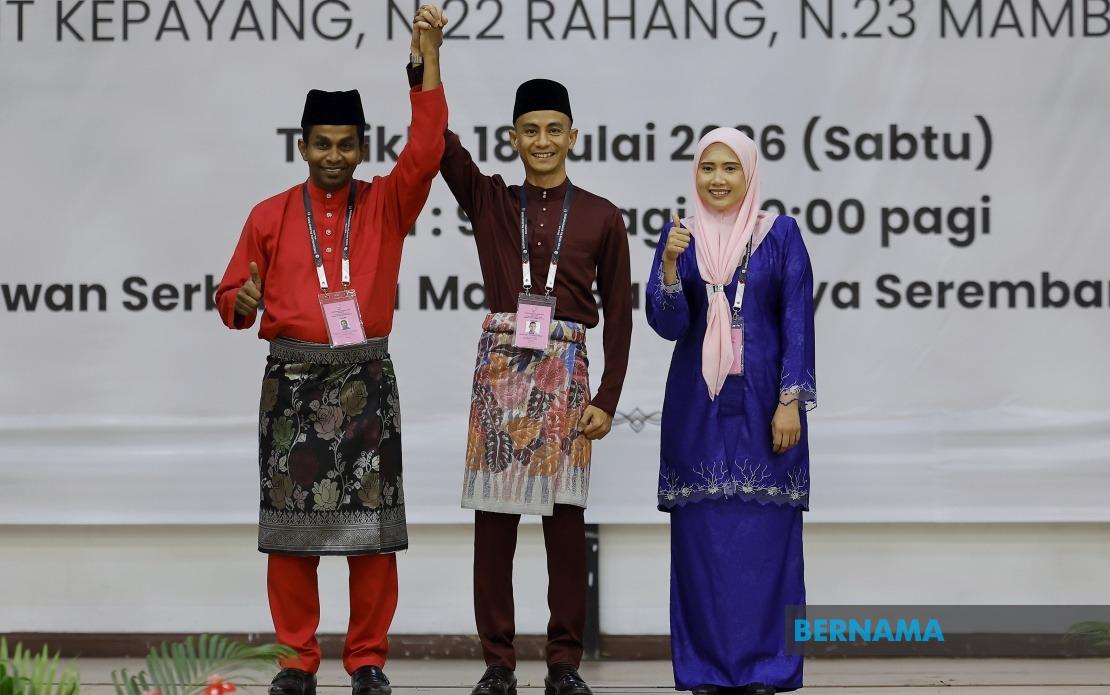
Datuk Ahmad Faez Abdul Razak made his electoral debut as Pakatan Harapan's PKR candidate for the Labu state seat in the 16th Negeri Sembilan state election, framing his candidacy as a critical opportunity to reclaim the constituency for the coalition. Speaking in Seremban after nomination proceedings concluded, the property developer expressed a mixture of enthusiasm and apprehension about contesting for the first time, though he projected confidence in reversing the seat's recent loss to Bersatu.
Ahmad Faez's campaign is anchored on nearly three years of grassroots engagement across the Labu constituency, during which he claims to have witnessed growing public backing for his candidacy. This ground-level presence forms the foundation of his argument that sufficient momentum exists to overcome the incumbent's 1,640-vote margin from the 2023 state election. His emphasis on prolonged community interaction signals a deliberate strategy to counter questions about his political inexperience by showcasing sustained commitment to local concerns.
The candidate's professional credentials as a developer form the centrepiece of his value proposition to voters. Ahmad Faez argues that his industry experience uniquely positions him to navigate the tension between capitalizing on Labu's economic potential and protecting established residents' quality of life. This positioning directly addresses a central challenge facing the constituency: the need to harness development opportunities without displacing communities or degrading their living standards. His framing suggests that technical expertise in property and planning, rather than purely political acumen, constitutes the decisive qualification for managing the seat's trajectory.
Labu's inclusion within the Malaysia Vision Valley development corridor—a sprawling project encompassing 11,000 to 12,000 hectares designated for industrial and residential expansion—defines the constituency's economic outlook and political stakes. Ahmad Faez acknowledges the corridor's promise to generate local employment and investment, positioning it as potentially transformative for residents' economic prospects. However, he simultaneously cautions that unfettered development uncoupled from community safeguards risks destabilizing the social fabric and eroding the wellbeing residents currently enjoy, a nuanced message designed to appeal across the constituency's demographic spectrum.
Central to Ahmad Faez's manifesto is the establishment of dedicated youth facilities, specifically a community centre and recreational hub. He characterizes these amenities as presently absent from Labu despite the constituency's rapid expansion, identifying a tangible gap in public provision that resonates with younger voters and families. This commitment reflects broader patterns in Malaysian electoral politics whereby candidates translate infrastructural deficits into campaign platforms, offering concrete deliverables as evidence of their attentiveness to constituent needs. The youth focus also aligns with demographic trends in fast-growing constituencies where population expansion often outpaces public service provision.
The regulatory environment surrounding Labu's development trajectory frames Ahmad Faez's broader strategic positioning. By emphasizing alignment between state-level government initiatives and federal policies, he signals continuity between Negeri Sembilan's current administration and a potential PH provincial government, suggesting that voting for his candidacy represents a choice to maintain institutional coherence rather than introduce destabilizing uncertainty. This argument carries particular weight given Bersatu's control of the seat following the 2023 election, which created an apparent mismatch between state-level PH governance and Labu's local representation.
The three-cornered contest Ahmad Faez faces pits him against incumbent Mohamad Hanifah Abu Baker of Bersatu and Barisan Nasional's Siti Nur Umaira Hasim. Mohamad Hanifah's 2023 victory over PH-PKR's Datuk Ismail Ahmad by a margin of 1,640 votes from a total pool of 10,021 voters suggests the seat remains genuinely competitive despite the incumbent's demonstrated electoral appeal. Ahmad Faez's candidacy signals PH's determination to recover the seat rather than cede it to either Bersatu or an increasingly assertive BN challenge, reflecting broader coalition dynamics where seat recovery becomes symbolic of political momentum and organizational capability.
The Labu constituency encompasses 32,884 registered voters as of May 31, 2026, a substantial electorate that encompasses both ordinary citizens and police personnel with their spouses. This voter base's size and composition demand comprehensive campaigning that addresses concerns across both civilian and security communities. Ahmad Faez's property development background may resonate with homeowning voters concerned about Labu's trajectory but could require careful handling with security personnel mindful of estate stability and residential quality.
Election Commission scheduling places early voting on July 28 and the main polling day on August 1, compressing the formal campaign period into a tight window. For Ahmad Faez, this accelerated timeline underscores the importance of his claimed pre-existing grassroots network, which theoretically provides organizational infrastructure already activated before the official campaign commences. His near three-year engagement with residents represents an implicit advantage during the condensed formal campaign phase when candidate visibility and voter mobilization intensity dramatically.
The broader context of Negeri Sembilan state politics frames Labu's significance beyond the constituency itself. As one of the fastest-growing state constituencies within the state, Labu's development trajectory and electoral outcome carry implications for broader regional planning, infrastructure provision, and the balance between economic expansion and community preservation. Ahmad Faez's emphasis on managed growth reflects awareness that Labu's voters increasingly comprise families drawn to the constituency by economic opportunity but concerned about preserving liveability and amenities.
The Labu contest exemplifies contemporary Malaysian electoral dynamics wherein technical expertise and professional credentials increasingly compete with traditional party loyalty and patronage networks for voter consideration. Ahmad Faez's strategy of anchoring his candidacy in property development experience and community-driven development planning represents an attempt to transcend conventional partisan positioning and appeal to voters on grounds of demonstrated capability. Whether this framing proves sufficient to overcome Mohamad Hanifah's incumbent advantage remains uncertain, but Ahmad Faez's approach signals evolving expectations that candidates, regardless of electoral experience, must articulate substantive visions for their constituencies' futures.

