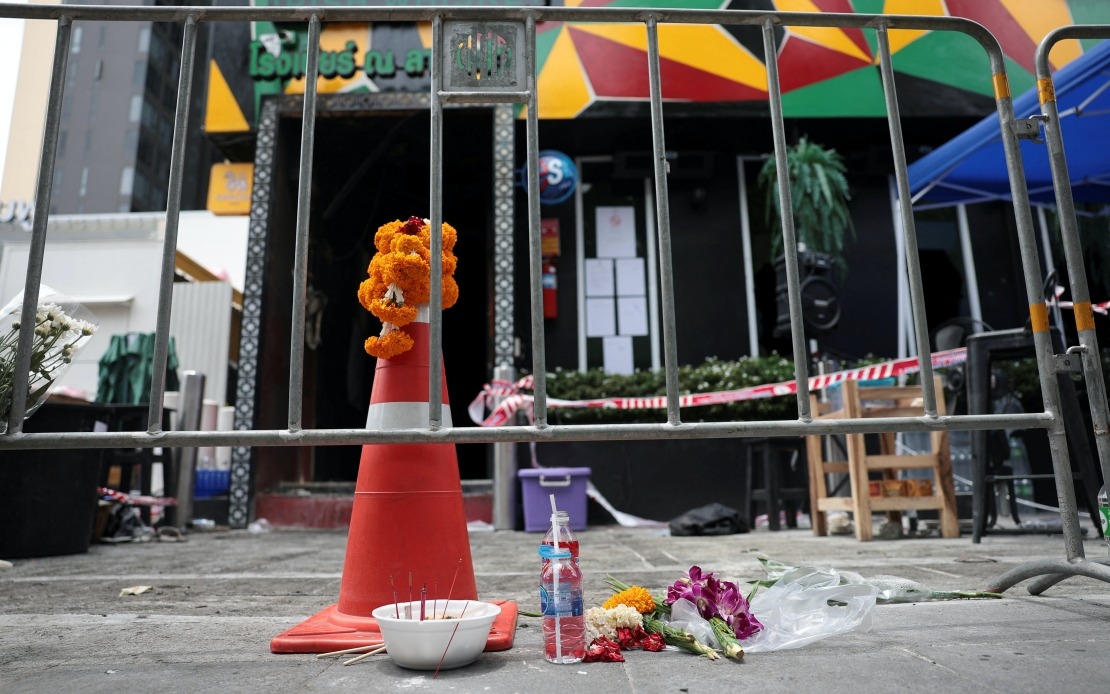
The death toll from Monday's catastrophic fire at an entertainment venue in Bangkok's Lat Phrao district stemmed from toxic gas poisoning rather than thermal injuries, according to findings released by Thai law enforcement on Thursday. Metropolitan Police Bureau Commissioner Police Lieutenant General Sayam Boonsom revealed that forensic examination of the victims' remains confirmed inhalation of carbon monoxide and cyanide as the cause of death across all 33 fatalities. The discovery fundamentally reframes the tragedy, pointing to suffocation rather than flame exposure as the lethal mechanism.
The presence of both carbon monoxide and cyanide in victims' bodies indicates a compound toxic environment inside the venue during the blaze. These gases function by disrupting oxygen absorption at the cellular level, rendering tissues unable to utilize available oxygen in the bloodstream. Death from such inhalation can occur within minutes, leaving occupants with minimal time to escape or seek help. The rapid onset of these compounds explains the high casualty count and why rescue efforts, despite swift response, recovered so many victims in advanced states of incapacity.
Investigators have pivoted toward identifying the origins of these toxic emissions and the structural and operational failures that allowed them to accumulate unchecked. Preliminary assessment focuses on three primary areas: potential electrical malfunctions that ignited the fire, unauthorized structural modifications that altered the building's fire safety characteristics, and breached emergency exit protocols. The blocking or obstruction of evacuation routes emerges as a particularly significant factor, as it would have prevented rapid egress and forced occupants to remain longer in the increasingly contaminated environment.
The forensic examination of the scene has been completed, though the broader criminal investigation continues to expand in scope. Police have identified multiple potential breaches of law that may result in charges, ranging from negligence causing death and injury to unauthorized building alterations and reckless fire causation. Additionally, authorities are examining whether the venue operated beyond the parameters of its entertainment license or violated regulations governing such establishments. This multi-pronged legal approach suggests investigators believe culpability may extend across several parties rather than attributing the disaster to a single factor.
Witness testimony has become central to reconstructing the sequence of events and establishing accountability. Police have already conducted interviews with more than 106 individuals connected to the incident, including staff, patrons, emergency responders, and nearby residents. These accounts will be crucial in determining whether safety protocols were deliberately ignored, inadequately implemented, or simply nonexistent. The sheer number of interviews reflects the complexity of the investigation and the multiple angles through which authorities are examining the disaster.
The human toll remains substantial despite some improvement in survivor outcomes. As of Thursday, 14 injured persons remained in intensive care units, though 44 others had already been discharged from medical facilities. The initial count of over 70 injured suggests many sustained injuries ranging from moderate to severe, including respiratory trauma, smoke inhalation complications, and burn wounds incurred during the chaotic evacuation. The ongoing medical needs of critically ill patients underscore the severity of conditions inside the burning structure.
For Malaysian observers, the Bangkok incident carries instructive implications regarding entertainment venue safety standards across Southeast Asia. Malaysia's own nightclub and bar industry operates under regulatory frameworks that require regular safety inspections, maintained emergency exits, and staff training in evacuation procedures. However, enforcement consistency varies across different jurisdictions and establishment types, with smaller or less formal venues sometimes operating with minimal oversight. The Bangkok disaster demonstrates how quickly inadequate safety infrastructure can transform a routine evening into mass tragedy.
The role of unauthorized building modifications in facilitating the catastrophe warrants particular attention in the Malaysian context. Such alterations frequently occur when venue operators seek to maximize floor space, improve aesthetics, or reduce operational costs by removing or blocking emergency exits, installing non-compliant materials, or failing to maintain proper ventilation systems. Building inspectors and fire safety officials across Malaysia should view the Bangkok case as a urgent reminder of the necessity for rigorous compliance verification and meaningful penalties for violations.
The investigation's focus on potential license violations and operations exceeding permitted scope also raises questions about regulatory accountability. If the Bangkok establishment operated as a venue type different from its licensed classification, this would represent a fundamental breach of municipal governance. Malaysian local authorities managing similar entertainment districts must ensure that periodic audits and surprise inspections confirm venues operate within their designated parameters. The consequences of lax oversight, as Bangkok demonstrates vividly, extend far beyond administrative inconvenience to encompass public safety and loss of life.
Police statements indicate that charging decisions remain pending while investigations continue to mature. The complexity of establishing individual culpability across multiple potential negligent parties—from building owners to managers to municipal inspectors—will challenge prosecutors in constructing viable cases. Malaysian legal practitioners and policymakers should monitor how Thai courts ultimately adjudicate this matter, as it may set precedent for how regional jurisdictions approach corporate and individual liability in mass casualty incidents stemming from safety negligence.
The tragedy also highlights the critical importance of fire suppression systems and their proper maintenance. While the investigation has not yet detailed whether the venue possessed functional sprinkler systems or fire suppression equipment, the inability to contain or extinguish the blaze quickly enough to prevent toxic gas accumulation suggests possible equipment failures. Malaysian venues should conduct comprehensive audits of their fire suppression infrastructure and ensure that staff receive regular training in deployment protocols.
Beyond regulatory and operational lessons, the Bangkok fire underscores the vulnerability of crowded commercial spaces to rapid escalation of danger when safety fundamentals are compromised. The concentration of patrons in a single venue shortly after midnight, combined with exits that could not be accessed, created a perfect condition for mass casualties. Malaysia's growing nightlife economy in major urban centers mirrors Bangkok's entertainment landscape, making the comparative risk assessment particularly relevant for local venue operators, regulators, and concerned citizens.

