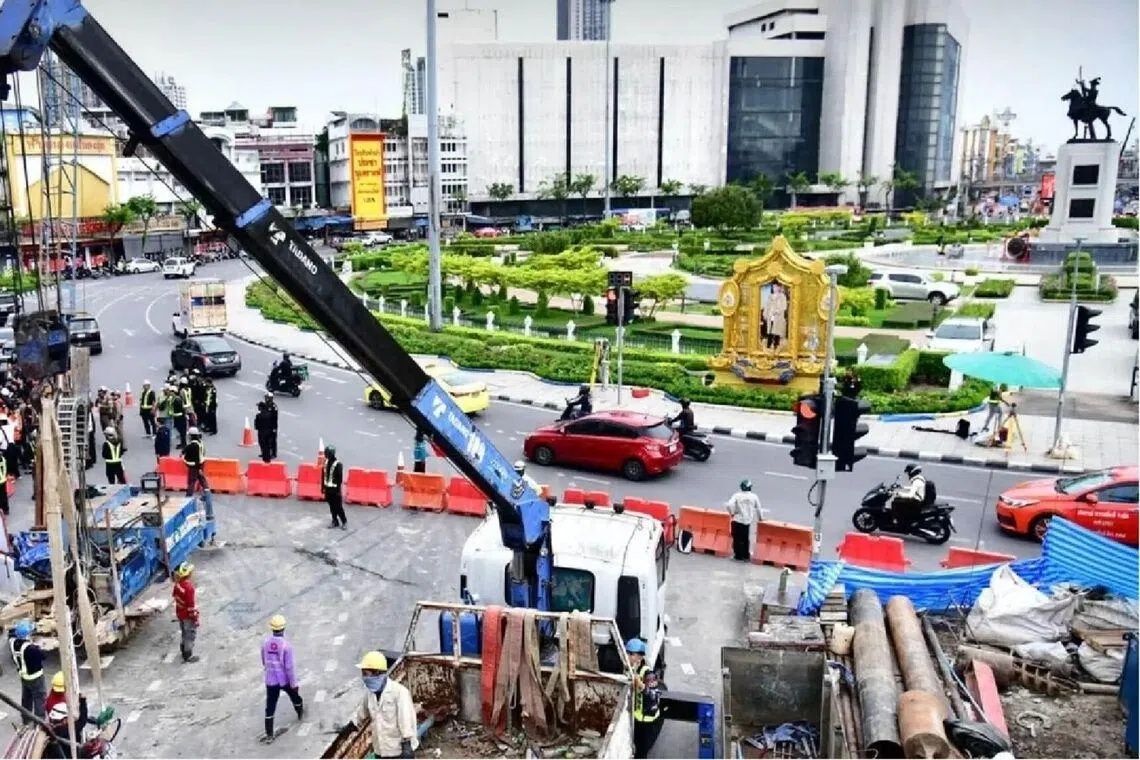
The discovery of water seeping into a drainage sump during Purple Line subway construction has forced Bangkok authorities to evacuate around 60 people from nearby commercial buildings and seal off a major thoroughfare in the Wongwian Yai area. The underground breach allowed soil to flow into the tunnel structure, triggering ground subsidence that created visible cracks in the road surface above and heightened concerns about the structural integrity of neighbouring buildings. The incident underscores ongoing challenges facing Bangkok's ambitious mass transit expansion, which has already encountered significant technical difficulties in recent years.
Water entering the sump at the lowest point of the southbound Purple Line construction tunnel initiated a cascade of problems beneath street level. The influx destabilised surrounding soil, causing it to migrate downward into the underground cavity. This displacement manifested above ground as a depression in Prajadhipok Road, creating cracks and subsidence that posed an immediate risk to the three commercial buildings situated within 30 metres of the affected area. The evacuation, coordinated by the Bangkok Metropolitan Administration and the Mass Rapid Transit Authority of Thailand, prioritised resident safety while contractors assessed the full extent of underground damage.
Bangkok governor Chadchart Sittipunt surveyed the incident site on July 9, accompanied by deputy governor Wisanu Subsompon and deputy permanent secretary Kanokwan Iamlim. Officials reported encouraging initial findings, noting that water levels in the tunnel and the rate of ground subsidence appeared to be stabilising. However, this assessment came with a critical caveat: continuous round-the-clock monitoring would continue indefinitely until engineers confirmed the area's structural integrity. The cautious optimism reflected the unpredictability of subsurface engineering failures, which can resume unexpectedly if underlying conditions deteriorate.
Approximately 60 residents from the three at-risk commercial buildings have been relocated to temporary accommodation, primarily hotel facilities, with expectations they will remain displaced for roughly one week. The Mass Rapid Transit Authority's contractor has accepted financial responsibility for accommodation costs, compensation payments, and other associated expenses during the evacuation period. Authorities have indicated they will only permit residents to return once comprehensive structural assessments confirm the buildings and surrounding infrastructure meet safety standards. This cautious timeline reflects the technical complexity of evaluating damage to foundations and structural elements potentially weakened by soil movement.
To enhance real-time surveillance of structural stability, the Department of Disaster Prevention and Mitigation deployed two Rescue Guardian monitoring units to buildings within approximately 30 metres of the road cracks. These sophisticated sensor systems measure building tilt and movement continuously, transmitting data to a centralised monitoring platform that automatically alerts officials if abnormal structural shifts occur. The technology represents a significant upgrade in disaster response capacity, enabling authorities to detect dangerous changes that might otherwise go unnoticed until catastrophic failure became imminent. This proactive monitoring approach aligns with international best practices for managing geotechnical hazards in urban environments.
Engineers from Thailand's national Urban Search and Rescue team joined the inspection effort to evaluate neighbouring structures and validate the adequacy of emergency response procedures. The Department of Disaster Prevention and Mitigation deployed generators, lighting systems, and specialised equipment to support continuous overnight operations. Rescue foundations and volunteer organisations were placed on standby to provide emergency medical assistance or patient evacuation if needed. A forward command centre established near the subsidence point coordinated activities among the Bangkok Metropolitan Administration, the Mass Rapid Transit Authority, the contractor, district authorities, police units, and emergency response teams, creating a unified operational structure for the crisis response.
The immediate technical priority centres on sealing the water leak and preventing additional soil from being drawn into the tunnel structure. Engineers are employing continuous monitoring instruments to track the road surface, soil movement, water seepage rates, and the structural condition of nearby buildings. Reducing traffic vibration represents a secondary but important objective, prompting authorities to close all outbound lanes of Prajadhipok Road over approximately 200 metres between the Ban Khaek intersection and the King Taksin the Great Monument at Wongwian Yai. Two inbound lanes have been temporarily converted to accommodate outbound traffic, with motorists advised to utilise alternative routes including Itsaraphap, Lat Ya, and Somdet Chao Phraya roads.
This subsidence incident mirrors an earlier collapse near Vajira Hospital along the same Purple Line alignment, though construction at the current site is being managed by a different contractor. The recurrence of serious geotechnical problems along the same transit corridor raises questions about overall project management, geological risk assessment, and whether lessons from previous failures were adequately implemented. These parallel incidents occurring within the same subway line suggest systemic issues that extend beyond individual contractor performance, potentially implicating project design, site investigation adequacy, or supervisory oversight by the Mass Rapid Transit Authority.
The closure creates significant traffic disruptions in an area already constrained by proximity to major schools including Suankularb Wittayalai School and Suksanari School. Governor Chadchart indicated that Bangkok may implement traffic mitigation measures similar to those deployed following the Vajira Hospital subsidence, potentially including expanded school shuttle services to reduce parental vehicle movements through the congested area. The morning and afternoon school transit periods will likely experience severe congestion, affecting thousands of commuters and students utilising this corridor. Authorities have cautioned that additional traffic arrangements will be announced once engineers determine the necessary duration of road closures.
The Bangkok Metropolitan Administration and the Department of Disaster Prevention and Mitigation have made explicit that all restrictions will remain in place until comprehensive engineering evaluations confirm that buildings, roads, and surrounding infrastructure pose no public safety hazard. This stringent standard reflects heightened awareness of cascading failures in urban geotechnical incidents, where initial stabilisation can mask underlying structural compromises that manifest as delayed collapses. The cautious approach demonstrates that Bangkok's authorities have absorbed lessons from previous transit-related disasters and are prioritising systematic verification over expedited reopening that might expose residents and commuters to unacceptable residual risk.

