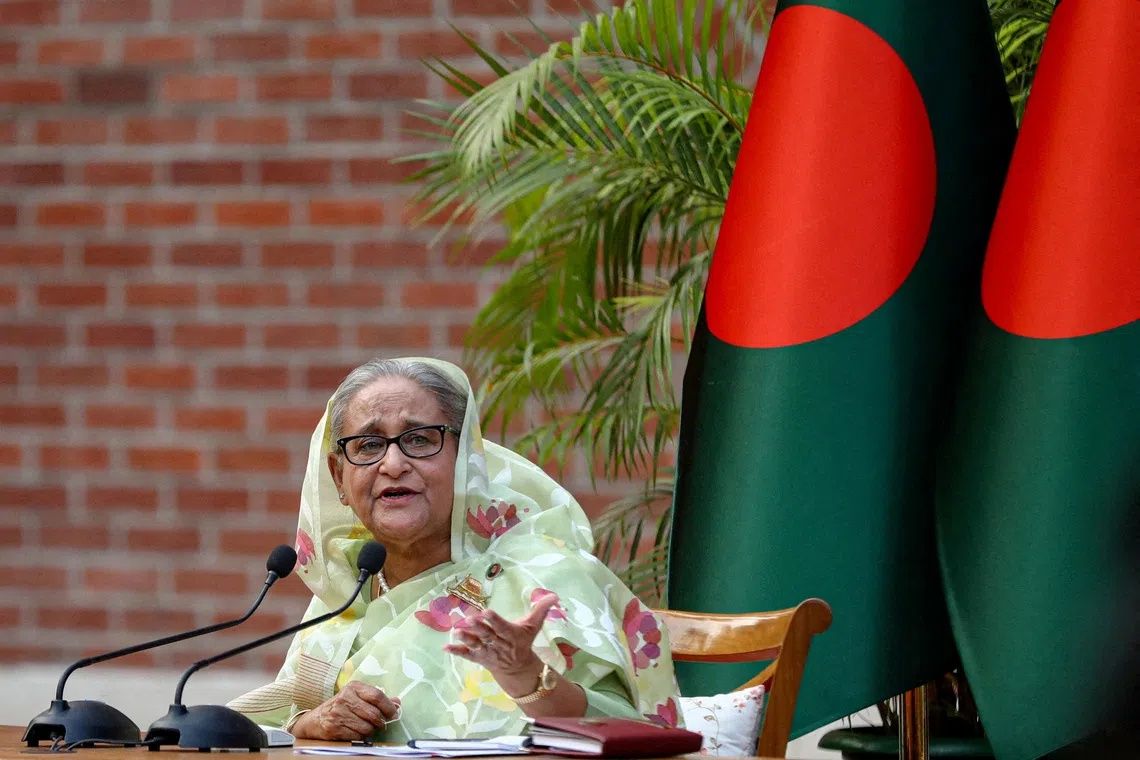
Bangladesh has formally requested clarification from India regarding its official position on allowing exiled former prime minister Sheikh Hasina to participate in a planned virtual speech from New Delhi, signalling concern that such activities could undermine the momentum of recently improving bilateral relations between the neighbouring countries.
The diplomatic inquiry represents Dhaka's first public response to Hasina's scheduled appearance at an event organised by the Foreign Correspondents' Club of South Asia on August 5, which marks the second anniversary of the student-led uprising that toppled her government in August 2024. The timing of the address, coinciding with this significant political anniversary, appears to have heightened sensitivity in Dhaka about the implications of permitting such political activities from Indian territory.
Bangladesh's State Minister for Foreign Affairs Shama Obaed Islam articulated the government's position during a Monday briefing, emphasising that while Dhaka remains committed to advancing relations with India through a forward-looking approach, the country expects clarity on New Delhi's stance regarding political activities by fugitives operating from Indian soil. Islam stressed that allowing Hasina and other Awami League leaders to make political statements from India could jeopardise the positive trajectory both nations have been attempting to establish since the transition to the interim government led by Tarique Rahman following February's elections.
The situation remains complex given Hasina's current status in India. She has resided in the country since fleeing Bangladesh in August 2024, and Dhaka has actively pursued her extradition despite India not yet acceding to these requests. The legal complications surrounding her case have intensified, with Hasina receiving a death sentence in absentia in 2025 for crimes against humanity linked to the brutal crackdown during her final months in office, which international observers estimated resulted in approximately 1,400 deaths. Hasina has consistently dismissed this verdict as legally invalid and without foundation.
Addressing the planned August 5 event, Islam indicated that while the Foreign Correspondents' Club gathering is not a government-organised function, Bangladesh views it as a matter requiring diplomatic engagement if India does not take corrective action. The FCCSA confirmed that Hasina, now 78 years old, will participate remotely alongside her son Sajeeb Wazed Joy and other speakers, though the club has not yet publicly responded to concerns raised by Bangladesh's government.
Islam revealed that Bangladesh has repeatedly communicated its objections to India regarding Hasina and other senior Awami League figures engaging in political discourse from Indian territory. She noted that India had previously indicated its expectation that individuals fleeing their home countries would refrain from pursuing political activities whilst on Indian soil—a position Dhaka is now attempting to reinforce through formal diplomatic channels.
The underlying tension reflects the delicate balancing act required in South Asian diplomacy. India has hosted Hasina for nearly a year, and the decision to permit or restrict her speech could carry significant diplomatic consequences. A move to block her appearance might be perceived as endorsing Bangladesh's judicial processes, whilst allowing the speech could be interpreted as providing a platform for a fugitive facing serious accusations. India's foreign ministry has not yet issued a public statement addressing Bangladesh's concerns.
The broader context of India-Bangladesh relations has been notably strained since Hasina's ouster. The mass uprising that unseated her government reflected deep public discontent with her administration's governance and alleged authoritarianism. Since then, Bangladesh has transitioned to an interim arrangement intended to stabilise the country and prepare for democratic elections. However, Hasina's continued presence in India and her stated intention to return home in December add another layer of uncertainty to regional stability.
Hasina has indicated her determination to eventually return to Bangladesh, telling international media outlets that she anticipates coming home in December. This announcement itself has complicated matters, as it suggests she may not remain indefinitely in exile whilst facing multiple legal charges at home. Her return could reignite political tensions that have only begun to settle following the dramatic political upheaval of 2024.
For Malaysian and broader Southeast Asian observers, this situation illustrates the persistent challenges faced by the region's democracies in managing transitions of power and the diplomatic complications that arise when senior political figures flee to neighbouring countries. The precedent established in how India and Bangladesh handle this matter may influence how other regional states approach similar situations in future.
The August 5 speech, if permitted, will serve as a platform for Hasina to address supporters and international audiences regarding her perspective on recent Bangladesh events. Whether India ultimately allows this address to proceed will signal important messages not only to Bangladesh but also to other nations in South Asia about how India balances concerns of neighbouring governments with its own policies on political asylum and free expression. As diplomatic channels remain active between Dhaka and New Delhi, both sides will likely seek a resolution that avoids further damage to their relationship whilst respecting their respective positions on governance and international law.

