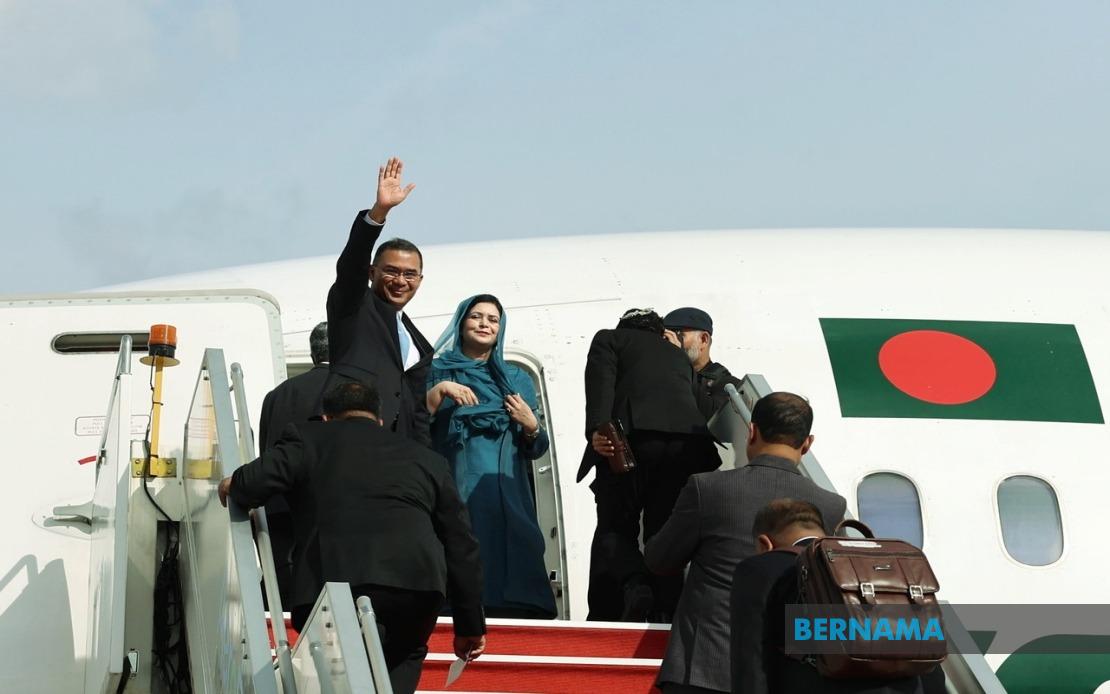
Bangladesh Prime Minister Tarique Rahman departed Malaysia on Saturday evening, bringing his inaugural bilateral overseas visit since taking office in February 2026 to a close. The Bangladeshi leader and his delegation boarded a special aircraft at Kuala Lumpur International Airport at 5 pm, following a formal ceremonial send-off that included a guard of honour from the First Battalion of the Royal Ranger Regiment. Minister in the Prime Minister's Department (Religious Affairs) Dr Zulkifli Hasan attended the departure ceremony to bid farewell to Tarique, his spouse Dr Zubaida Rahman, and members of the official delegation.
During his two-day stay in Malaysia, Tarique engaged in substantive bilateral discussions with Prime Minister Datuk Seri Anwar Ibrahim at the Perdana Putra Complex, reflecting the strategic importance both nations place on their relationship. The talks ranged broadly across regional and international concerns, signalling a deepening alignment between Dhaka and Kuala Lumpur on matters extending beyond purely economic considerations. For Bangladesh, a relatively younger nation in regional diplomacy compared to Malaysia's established standing in Southeast Asia, such engagement at the highest levels underscores its growing assertiveness in shaping regional affairs and securing partnerships with key economies.
The bilateral meeting yielded concrete results in several critical domains. Malaysia and Bangladesh committed to pursuing a fast-track free trade agreement to invigorate economic ties, with particular emphasis on energy cooperation and the expanding halal industry. Beyond trade mechanics, both leaders identified human resource management, semiconductor development, agriculture and education as priority areas for collaborative advancement. This diversified approach reflects recognition that modern economic partnerships must transcend traditional commodity exchanges and encompass emerging sectors where both nations can leverage complementary strengths and capabilities.
Three formal agreements were executed during the visit, formalising the nations' intentions. A Memorandum of Understanding on Cultural Cooperation was signed alongside two Exchanges of Notes addressing Counter-Terrorism Research and Investment Promotion and Facilitation. These instruments, particularly the counter-terrorism research framework, carry significant weight for regional stability given both nations' vulnerabilities to extremist threats and transnational criminal networks operating across South and Southeast Asia.
Bangladesh's aspirations for deeper regional integration featured prominently in discussions. Tarique reiterated his country's bid to attain ASEAN Sectoral Dialogue Partner status, a stepping stone toward fuller institutional participation in Southeast Asian affairs. Additionally, Bangladesh expressed keen interest in acceding to the Regional Comprehensive Economic Partnership, the sprawling trade bloc linking ten ASEAN members with China, Japan, South Korea, Australia and New Zealand. Malaysian support for these objectives could prove decisive given Kuala Lumpur's influence within ASEAN circles and as an RCEP member state.
The two leaders discovered substantial common ground on pressing global issues, particularly regarding the Palestinian-Israeli conflict and the humanitarian catastrophe unfolding in Gaza. Both nations shared concerns about regional tensions in the Persian Gulf and around Iran, and underscored their commitment to securing durable peace frameworks in these unstable zones. Such alignment on international affairs, while not uncommon among developing nations, gains particular significance given Malaysia's elevated profile in global Muslim affairs and Bangladesh's position as the world's third-largest Muslim-majority nation by population.
A particularly noteworthy commitment involved tackling the protracted Rohingya refugee crisis through ASEAN-led mechanisms. Malaysia and Bangladesh jointly affirmed their determination to find lasting solutions through dialogue with Myanmar, demonstrating diplomatic patience despite the extraordinary strain hosting 1.2 million and 900,000 Rohingya refugees respectively has imposed on their respective societies. This shared responsibility potentially positions both countries as key brokers in any eventual repatriation or permanent settlement arrangements for this displaced population.
Commercially, the Malaysia-Bangladesh relationship has grown substantially in recent years. During 2025, bilateral trade reached RM12.18 billion, with Malaysian exports dominating at RM10.08 billion, predominantly comprising petroleum products that remain central to Bangladesh's energy security needs. Bangladeshi exports to Malaysia totalled RM2.10 billion, predominantly textile and apparel goods that showcase the country's established manufacturing credentials. Bangladesh ranked as Malaysia's 28th-largest global trading partner overall, but crucially occupied the second position in South Asian trade after India, reflecting the subcontinent's significance to Malaysian commercial interests.
The visit's timing carries geopolitical undertones worth noting. That Tarique chose Malaysia as the destination for his first bilateral visit abroad signals the premium he places on Southeast Asian engagement and perhaps reflects Bangladesh's strategic reorientation toward the region during a period of domestic transition and international repositioning. The subsequent journey to China, a nation with which Bangladesh maintains substantial economic and strategic ties, suggests a sophisticated diplomatic choreography aimed at balancing relationships across Asia's major powers.
For Malaysian policymakers, the visit reinforces the nation's role as a bridge between South Asia and Southeast Asia, hosting a growing number of bilateral engagements with South Asian counterparts seeking to diversify partnerships and expand regional influence. Bangladesh's demonstrated interest in free trade mechanisms and ASEAN integration aligns with Malaysia's broader vision of a prosperous, stable and closely integrated Asian region, even as both nations navigate complex challenges ranging from terrorism to refugee crises that demand sustained cooperation and resources.

