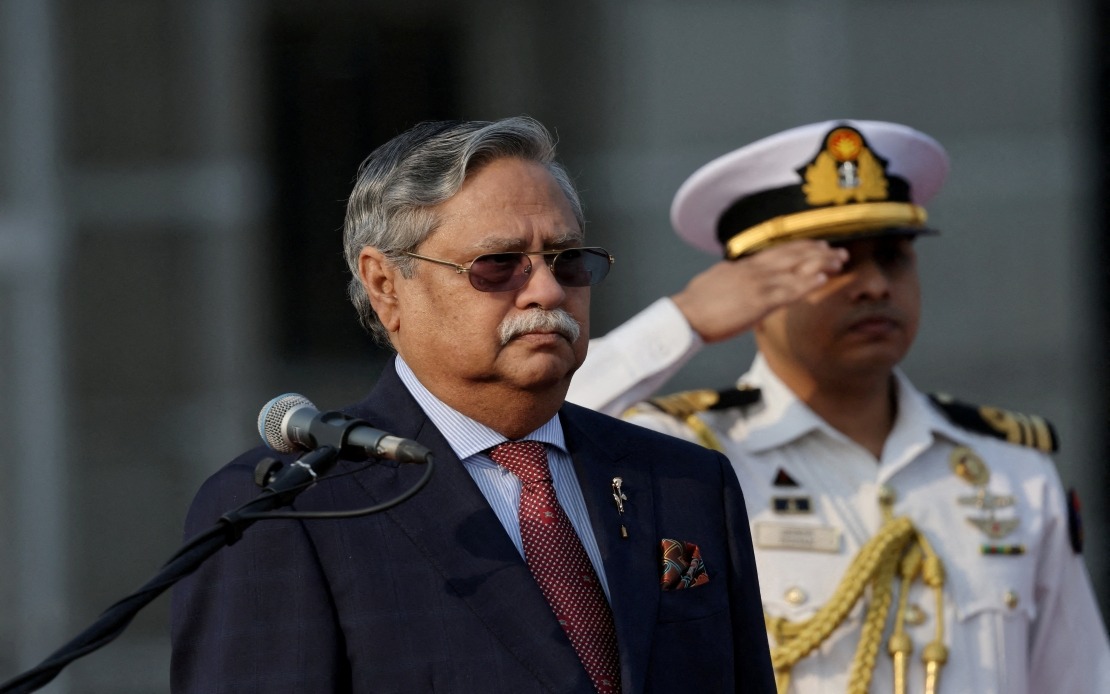
Bangladesh President Mohammed Shahabuddin announced his resignation on Friday, citing serious health concerns that have rendered him unable to discharge the responsibilities inherent to his constitutional office. The 76-year-old leader submitted his formal resignation letter to Parliament Speaker Hafiz Uddin Ahmed, bringing an abrupt end to his tenure that had been scheduled to run until April 2028. Ahmed confirmed his acceptance of the resignation, triggering the formal constitutional procedures for presidential succession in the South Asian nation.
Shahabuddin's departure marks a significant political development in Bangladesh, arriving amid intensifying pressure from opposition factions demanding his stepping aside. The resignation crystallizes ongoing tensions within the country's political establishment following the dramatic upheaval of 2024, when a student-led uprising unseated the longstanding Awami League administration and forced former Prime Minister Sheikh Hasina to flee across the border to India. The timing underscores the fluid and contested nature of contemporary Bangladeshi politics, where the relationship between constitutional offices and the distribution of actual power remains contested.
Under Bangladesh's constitutional framework, the 76-year-old president's departure triggers a predetermined sequence of events. Parliament Speaker Hafiz Uddin Ahmed will assume the role of interim president pending the election of a permanent successor. Constitutional provisions mandate that a new presidential election must take place within ninety days, creating a compressed timeline for Bangladesh's political actors to navigate the transition. This arrangement reflects standard protocols designed to prevent extended periods of contested or interim leadership, though the rapid timeframe has nonetheless produced uncertainty about the direction of policy during the interregnum.
The path to Shahabuddin's resignation was paved by controversy surrounding his medical treatment abroad. Media reports documented that the president had engaged in telephone communications with Sheikh Hasina while undertaking medical consultations in the United Kingdom during May of this year. These communications sparked considerable speculation about the ongoing influence of Bangladesh's exiled former leader and raised questions about whether the sitting president maintained unsuitable connections to the toppled administration. For many observers, the reports symbolized the lingering complications arising from Hasina's abrupt departure and the incomplete resolution of tensions between successive political regimes.
Sheikh Hasina's trajectory illustrates the turbulent political currents that have buffeted Bangladesh in recent years. Leading the Awami League, Hasina commanded governmental power until the eruption of youth-driven demonstrations fundamentally altered the political landscape during the summer of 2024. Following her ousting, she relocated to India, where courts have imposed a capital sentence related to civilian casualties that occurred during her administration. Hasina has publicly indicated her intention to return to Bangladesh later in the current year, creating a complex backdrop for the succession process, as unresolved questions about accountability and transitional justice remain at the forefront of national discourse.
The constitutional mechanism for selecting Bangladesh's presidency vests this authority directly in the parliamentary membership. This arrangement fundamentally shapes the character of presidential elections, effectively making them exercises in legislative consensus-building rather than popular democratic contests. The Bangladesh Nationalist Party, which currently commands a parliamentary majority, consequently possesses decisive influence over the selection of Shahabuddin's successor. Political observers anticipate that the ruling party will be in a position to secure the election of its preferred candidate, barring unforeseen coalition disruptions or shifts in the parliamentary composition.
Shahabuddin's tenure as the nation's 22nd president commenced in April 2023, positioned within the institutional framework of the Awami League government then led by Hasina. His appointment reflected the prevailing political configuration at that moment, and his five-year mandate represented a standard term designed to extend well into the following decade. However, the seismic political changes that transpired in the summer of 2024 rendered the original assumptions underlying his presidency obsolete. The student-led uprising that dislodged Hasina created an entirely new political reality, leaving the chief executive—initially appointed under the deposed regime—in an increasingly untenable position vis-à-vis the ascendant Bangladesh Nationalist Party administration.
The precipitous timing of Shahabuddin's departure—occurring barely thirty months into an originally conceived five-year term—reflects the depth of strain emanating from Bangladesh's political realignment. His resignation effectively represents an acknowledgment, whether explicit or implicit, that his position had become compromised by his prior appointment under Hasina's administration. The formal justification invoking health considerations provides constitutional propriety to what many analysts understand as a political necessity. The episode demonstrates how rapidly institutional arrangements can become untenable when the underlying balance of political forces undergoes fundamental transformation.
The succession process will unfold against the backdrop of ongoing questions about Bangladesh's trajectory in the aftermath of the 2024 upheaval. The Bangladesh Nationalist Party government has consolidated control over institutional mechanisms while the fate of the deposed Awami League remains contested. The selection of a new president will offer insights into the party's conception of its long-term project and its strategy for managing the institutional dimensions of political authority. Additionally, the compressed ninety-day timeline for conducting the presidential election means that the parliamentary machinery must mobilize rapidly to conduct what, despite its procedural simplicity, represents a constitutionally significant transition.

