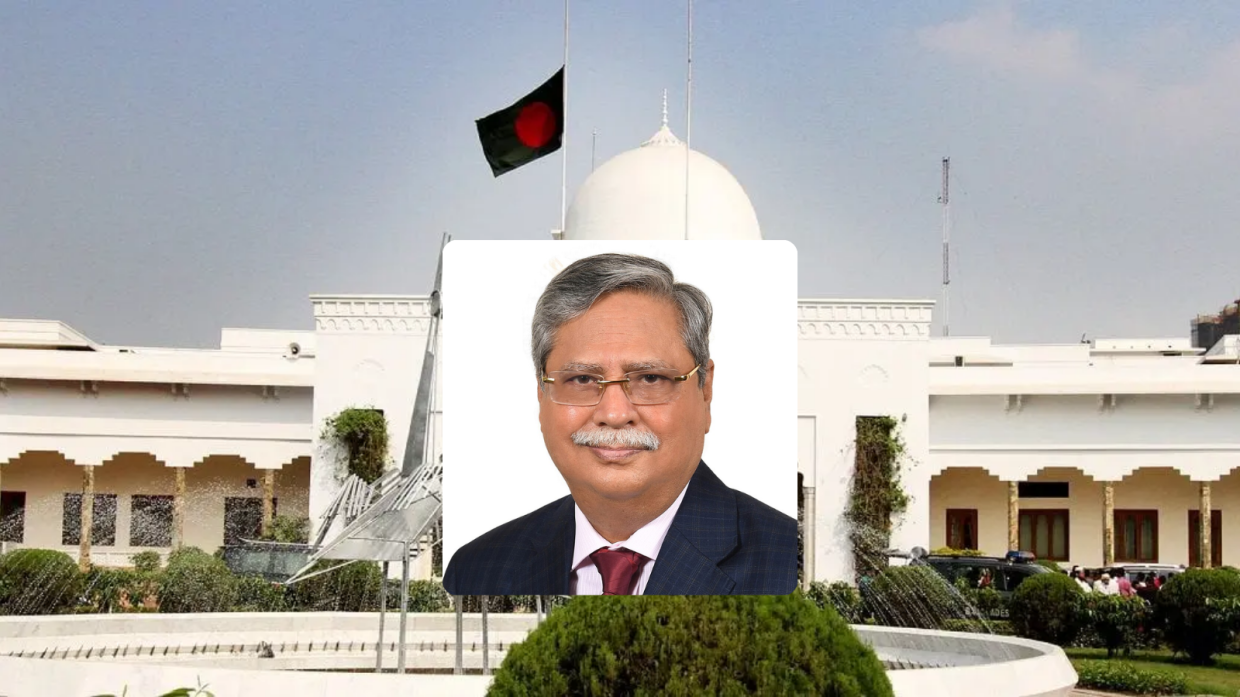
President Mohammed Shahabuddin appears set to step down from his position within days, according to multiple sources briefed on Bangladesh's evolving political landscape. The anticipated resignation marks a significant turning point in Dhaka's turbulent political trajectory, as the government signals its intent to cleanse state institutions of figures connected to the pre-uprising order that collapsed in dramatic fashion last year. Shahabuddin, who assumed the presidency in April 2023, remains the sole holder of a top constitutional office from the period preceding the July 2024 mass uprising—a distinction that has increasingly become a political liability in the eyes of the current administration.
The momentum toward his departure has accelerated in recent weeks, driven by what government sources describe as a complex set of concerns rather than any single incident. Central to the growing tension is the reported May phone conversation between Shahabuddin and former Prime Minister Sheikh Hasina, who has been residing in exile in India since fleeing Bangladesh during last year's upheaval. Shahabuddin travelled to London on May 9 for medical treatment and returned on May 18, during which time the conversation allegedly took place. Intelligence agencies subsequently became aware of the communication, triggering what sources characterised as a message to Shahabuddin suggesting he consider stepping aside from his constitutional role.
However, a senior Bangladesh Nationalist Party leader indicated that the telephone exchange alone does not explain the pressure mounting on the president. Instead, the situation reflects deeper anxieties within the government about efforts to reconstitute the Awami League, the party that dominated Bangladesh politics before its dramatic collapse. These concerns intensified markedly following Hasina's announcement in early July that she intends to return to Bangladesh in December, potentially surrendering to face a death sentence that has been imposed in absentia. Hasina and other senior Awami League figures have indicated plans to come back from their Indian sanctuary around that timeframe, a development that has galvanised the current administration's determination to consolidate control over state institutions.
The government's alarm extends to intelligence reports suggesting that some Awami League operatives remaining inside Bangladesh are attempting to reorganise the party structure despite the ban on its activities. Prime Minister Tarique Rahman moved to address this concern directly during a Cabinet meeting on July 17, issuing explicit directions to relevant authorities to intensify their campaign against the Awami League alongside its affiliated student and youth wings. This crackdown represents a calculated effort to prevent any resurgence of the party infrastructure before the critical December period when Hasina has signalled her intention to return.
In this volatile context, Shahabuddin's continued presence in the highest constitutional office has become increasingly untenable from the government's perspective. A senior government source characterised his departure as a natural and inevitable development, emphasising that his retention in the presidency was no longer considered strategically prudent. The source further indicated that the administration had grown concerned about reports suggesting the president was attempting to reestablish old professional contacts—a signal that officials interpreted as problematic given his connections to the pre-uprising political establishment. The government's position reflects a broader conviction that maintaining continuity with figures from the previous era undermines the legitimacy of the current order and poses potential risks to stability.
Shahabuddin's own statements have signalled his awareness of this shifting terrain. During December 2025, while serving under the interim government led by Muhammad Yunus, he had already indicated his intention to step down midway through his term following February's parliamentary elections, expressing that he felt humiliated by aspects of his treatment under that arrangement. When the BNP-led government subsequently assumed office, Shahabuddin appeared to adopt a more flexible posture, suggesting in a newspaper interview on February 24 that he would remain in office if the administration desired his continuation but would depart voluntarily if the government preferred his resignation. This deferential stance appears to have satisfied no one, with current government sources viewing even his conditional retention as unacceptable.
The constitutional mechanics of any presidential transition have been clearly established. Should Shahabuddin resign, the speaker of Parliament would assume the role of acting president pending the election of a successor through established parliamentary procedures. Yet sources indicated that no final determination has been made regarding the precise timing of his departure or the identity of his potential replacement, suggesting that internal discussions within the government remain ongoing. A source close to Bangabhaban, the presidential residence, suggested that a decision could materialise within one or two days, noting that the president had a scheduled meeting planned for July 29 with the non-resident ambassadors of four countries—an engagement that may take on heightened significance depending on imminent developments.
For Malaysia and the broader Southeast Asian region, these developments in Bangladesh carry implications worth monitoring. Bangladesh's periodic political instability has historically created ripple effects across South Asia and occasionally beyond, affecting remittance flows, regional security dynamics, and the functioning of regional institutions. The Hasina situation is particularly sensitive given that her exile in India raises questions about bilateral India-Bangladesh relations and the durability of political arrangements when key figures lack domestic legitimacy. Shahabuddin's anticipated resignation, while perhaps advancing near-term stability by removing a contested figure, may also signal that Bangladesh's political transition remains incomplete and potentially volatile heading into the critical December period when Hasina indicates she will return.
The renewal of political tensions around the Awami League's potential resurgence also underscores the fragility of the post-July 2024 settlement. Rather than representing a consolidation of democratic stability, the intensifying pressure on state institutions and continuing bans on political parties suggest that Bangladesh remains locked in a process of negotiation over the fundamental terms of its political order. For regional observers, the Bangladesh situation illustrates how mass uprisings can inaugurate periods of extended uncertainty rather than swift resolution, particularly when key figures retain significant constituencies and external sanctuary. The coming months, leading toward Hasina's stated return and beyond, will prove critical in determining whether the current administration can fashion a durable political settlement or whether Bangladesh faces further cycles of tension and institutional upheaval.

