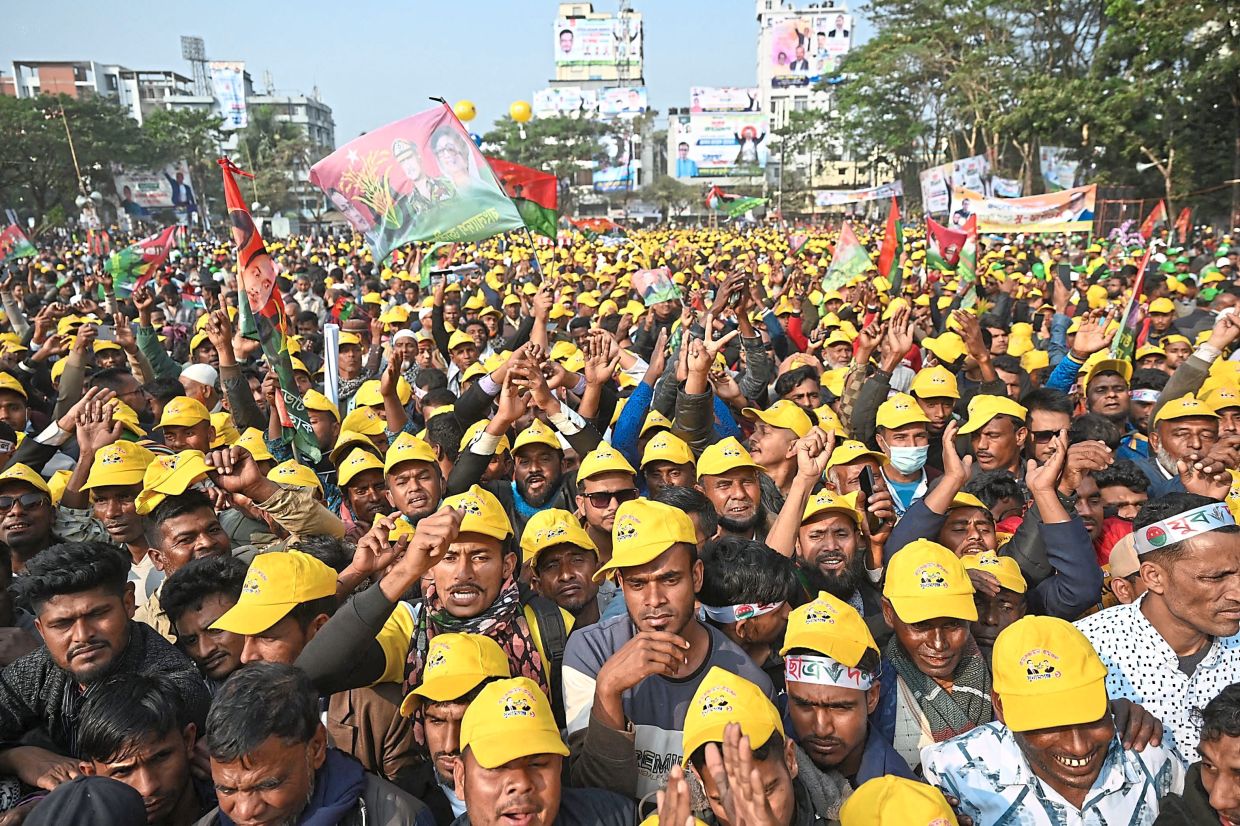
Bangladesh is preparing to install a new head of state this Thursday when parliament convenes to elect Mirza Fakhrul Islam Alamgir as the nation's 23rd president. The 78-year-old secretary general of the Bangladesh Nationalist Party (BNP), who also serves as local government minister, is widely expected to secure the five-year position with overwhelming support from the ruling coalition. Alamgir's ascension to this largely ceremonial role marks another significant transition in Bangladesh's tumultuous political landscape, coming less than two years after a popular uprising toppled the previous government and reshaped the country's power dynamics.
When Alamgir addressed reporters on Tuesday, he expressed humble gratitude at the prospect of the presidency, attributing his likely elevation to divine blessing and party support rather than personal ambition. His measured response reflected the understated approach typical of candidates navigating Bangladesh's fractious political culture, where appearances of humility can matter as much as capability. He reaffirmed his commitment to remaining connected with ordinary citizens even after assuming the highest ceremonial office, signalling continuity with the BNP's grassroots positioning during the years it operated from the political margins.
The BNP's dominance in the current political order stems directly from its crushing victory in February's general elections, the first conducted following the 2024 revolution that forced Sheikh Hasina from power. Those elections, held under Prime Minister Tarique Rahman's leadership, delivered the ruling party a landslide that reflected public appetite for change after Hasina's increasingly authoritarian tenure. The electoral outcome has effectively consolidated BNP control over both the executive and ceremonial branches of government, extending the party's influence across Bangladesh's state apparatus during this critical reconstruction period.
Alamgir's predecessor, Mohammed Shahabuddin, vacated the presidency in July after serving less than a year of his term. Shahabuddin, a septuagenarian who had maintained close ties to Hasina, resigned citing health concerns, though observers widely understood the resignation as a consequence of mounting pressure to distance the state from the former prime minister's discredited administration. His departure came as Bangladesh sought to move beyond the divisions and recriminations of the Hasina era, symbolically clearing the way for fresh leadership untainted by association with the previous regime's disputed legacy.
The historical context surrounding Hasina's downfall remains significant for understanding Alamgir's impending election. The former prime minister, now sheltering in India, has refused to return to Bangladesh to face trial on crimes against humanity charges, for which she was convicted in absentia and sentenced to death last November. International human rights organisations documented extensive allegations of abuses during her administration, including extrajudicial killings of political opponents, systematic suppression of opposition movements, manipulation of the judicial system, and electoral irregularities that undermined democratic credibility. These documented failures of governance created the conditions for the popular movement that ultimately swept Hasina from office.
Although Alamgir's election appears assured given BNP's parliamentary dominance, he faces nominal competition from Oli Ahmed, the opposition alliance's preferred candidate. The opposition coalition, comprising eleven parties and led by the Islamist Jamaat-e-Islami, has put forward Ahmed as a symbolic challenger, though voting patterns in Bangladesh's parliament render a BNP victory virtually certain. The afternoon poll, scheduled to commence around 2pm local time, will formalise what political observers have already determined through the mechanics of parliamentary mathematics.
Alamgir's political trajectory provides insight into the resilience required to survive and ultimately thrive within Bangladesh's volatile democratic environment. Born in January 1948, he first entered the political arena as a university student during the 1969 uprising against Pakistani military rule—a pivotal moment in the nationalist movement that culminated in Bangladesh's independence struggle two years later. This foundational experience in opposition to authoritarian control shaped his political identity and would later inform his resistance to Hasina's increasingly autocratic governance model.
Following university, Alamgir pursued an academic career in economics before transitioning into government service and electoral politics. His ministerial experience encompassed diverse portfolios including agriculture, aviation, and tourism, demonstrating administrative breadth across multiple sectors. However, his political prominence derived less from these technocratic roles than from his leadership of BNP during the protracted period when the party languished in opposition. When BNP chief Khaleda Zia faced imprisonment and her son Tarique Rahman operated from exile, Alamgir assumed crucial responsibility for maintaining party organisation and political visibility through circumstances that tested organisational cohesion.
During Hasina's tenure, Alamgir personally experienced the authoritarian mechanisms that would eventually trigger the 2024 uprising. He endured multiple arrests on charges he consistently characterised as politically motivated retaliation, reflecting the weaponisation of the legal system that human rights advocates condemned. These experiences provided Alamgir with direct knowledge of the governance failures that precipitated Hasina's downfall, and they may inform his approach to the presidency during a period when Bangladesh navigates the delicate transition from revolutionary moment to institutional consolidation.
Almgir's personal background reflects stability uncommon among Bangladesh's senior politicians. He is married to Rahat Ara Begum, a retired financial administrator, and they have two daughters. This family structure, relatively conventional by the standards of Bangladesh's political elite, provides a foundation of domestic stability as he prepares to assume ceremonial state duties during a turbulent period of national reconstruction.
For Malaysia and other Southeast Asian observers, Alamgir's elevation illustrates the regional pattern of post-revolutionary transitions, where new leaders must navigate the competing demands of accountability for past abuses, reconciliation across fractured political constituencies, and restoration of institutional legitimacy. Bangladesh's unfolding political settlement will influence how regional democracies manage comparable crises of governance and public confidence, making the trajectory of this transition consequential beyond Bangladesh's borders.
The presidential election represents another formal step in consolidating the BNP's authority following the February electoral victory. Yet Alamgir inherits an office that, while ceremonial, carries symbolic weight in Bangladesh's constitutional framework. His commitment to maintaining connections with ordinary citizens suggests an intention to deploy the presidency as a platform for national reconciliation and institutional renewal—a significant undertaking given the polarisation and trauma accumulated during Hasina's administration.

