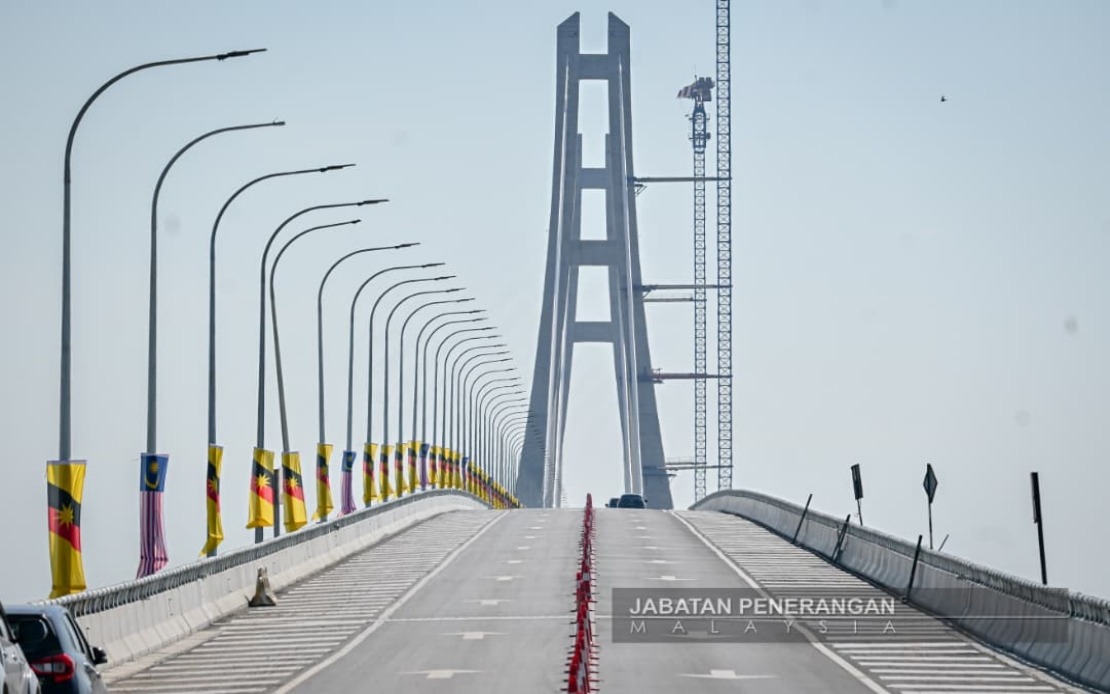
Sarawak has entered a transformative phase with the official opening of the Batang Lupar 1 Bridge, an engineering landmark that Premier Tan Sri Abang Johari Tun Openg described as pivotal to the state's economic trajectory. The 4.844-kilometre crossing, constructed at a cost of RM848.75 million, symbolises the completion of long-awaited connectivity for rural communities that have historically struggled with isolation and safety concerns. The bridge's inauguration represents not merely the conclusion of a construction project, but the fulfilment of years of community advocacy for safer, more reliable transportation infrastructure across Sarawak's southern coastal region.
The completion addresses a critical vulnerability that had characterised daily life in the coastal districts of Sebuyau, Betong, Sri Aman and Samarahan. Prior to the bridge's opening, residents and commercial operators depended entirely on the Sebuyau-Triso ferry service to traverse the Batang Lupar River—a waterway notorious for treacherous conditions at its mouth. The Premier highlighted that this dependence had resulted in numerous tragic incidents caused by unpredictable tidal surges, strong winds and rough seas, dangers that had prompted sustained demands from local elected representatives for alternative infrastructure solutions. The bridge's existence now eliminates these hazards entirely, replacing an unreliable transportation method with modern, weather-resistant infrastructure.
Deputy Premier Datuk Amar Douglas Uggah Embas, who also heads the state's Ministry of Infrastructure and Port Development, underscored the practical benefits of the new crossing. Where ferry journeys previously consumed up to an hour under normal conditions and faced frequent disruptions during adverse weather, vehicles can now traverse the bridge in minutes regardless of climatic variations. This reliability transformation extends beyond convenience; it fundamentally alters the economic feasibility of commercial operations in these districts. Agricultural producers, small manufacturers and retailers can now operate with predictable supply chain timelines, substantially reducing the costs and uncertainties that had previously constrained business development throughout the region.
The Batang Lupar 1 Bridge functions as the centrepiece of the broader Sarawak Second Trunk Road initiative, an ambitious coastal development strategy valued at RM3.21 billion that remains under active construction. This expansive programme aims to establish a modern, integrated highway network that capitalises on the state's coastal geography and resource endowments. The bridge's completion represents a crucial milestone in a sequenced development approach designed to culminate in full completion by 2030. Each component of this multi-year programme contributes cumulatively toward establishing Sarawak as a regionally integrated economic hub, connecting previously fragmented communities into cohesive commercial zones.
Perhaps most significantly for regional Malaysian observers, the STRR project promises to fundamentally reshape travel patterns and commercial flows across Peninsular Malaysia's eastern maritime corridor. Upon full completion, the coastal road network will reduce the driving distance between Kuching and Sibu from 396 kilometres to merely 252 kilometres—a reduction of 144 kilometres that translates directly into lower transportation costs, reduced delivery timeframes and enhanced commercial competitiveness for Sarawak-based enterprises. This distance compression creates practical advantages for logistics operators, manufacturers seeking supply chain efficiency and businesses considering relocation to Malaysia's largest state. The cumulative effect positions Sarawak's coastal region as increasingly accessible to regional markets and investment capital.
The bridge's recognition by the Malaysia Book of Records as the longest bridge spanning a river in Malaysia adds symbolic weight to the achievement. Megat Faris Hussein Megat Muzaffar Shah, representing MBOR, presented the official certification acknowledging this engineering distinction. This recognition, while perhaps secondary to the infrastructure's functional utility, nonetheless establishes the Batang Lupar 1 Bridge as a nationally significant engineering accomplishment and visible symbol of Sarawak's capacity to execute major infrastructure projects. For Southeast Asian investors and observers monitoring Malaysia's development trajectory, such achievements signal state-level capability in managing large-scale, technically complex construction programmes.
The economic implications of improved coastal connectivity extend across multiple sectors. Agricultural producers in the rural hinterland can now reliably transport produce to urban markets and processing facilities, potentially increasing farming productivity and rural incomes. Manufacturing enterprises can situate operations in these previously remote districts while maintaining efficient connections to regional distribution networks. Tourism operators gain access to previously isolated communities and natural attractions, creating opportunities for sustainable economic diversification. Additionally, the bridge facilitates improved public service delivery, enabling healthcare workers, educators and administrative officials to serve coastal populations more effectively.
From a broader Malaysian perspective, the Batang Lupar 1 Bridge exemplifies how targeted infrastructure investment can address persistent regional imbalances. Sarawak's vast territory and dispersed population have historically created connectivity challenges that limited economic development potential in coastal and interior regions. Strategic bridge construction, combined with coordinated road network expansion, directly counteracts these geographic constraints. The project demonstrates the state government's commitment to ensuring that rural and semi-urban communities participate equitably in economic growth rather than remaining economically marginalised by geographic isolation.
The transition from ferry dependence to bridge crossing also carries important implications for regional development equity. Communities that historically experienced periodic isolation due to weather conditions or ferry service disruptions can now participate more fully in regional commerce and professional mobility. Students can access distant educational institutions more readily, healthcare-seeking individuals can reach major medical facilities without weather-induced delays, and business leaders can conduct regional commerce with greater certainty and efficiency. These seemingly technical improvements in transportation accessibility represent substantive enhancements to quality of life and economic opportunity for thousands of Sarawakian families.
Looking forward, the Batang Lupar 1 Bridge's opening establishes momentum for completion of remaining STRR components scheduled through 2030. Investment decisions by private enterprises will increasingly reflect Sarawak's improving infrastructure foundation, potentially accelerating economic diversification beyond traditional petroleum and timber sectors. The bridge serves as tangible evidence that major state infrastructure initiatives proceed toward completion, generating investor confidence essential for attracting new enterprises and economic activity. For Malaysian policymakers monitoring regional development outcomes, the project offers instructive lessons in coordinated infrastructure planning that balances rural connectivity with urban-regional economic integration.

