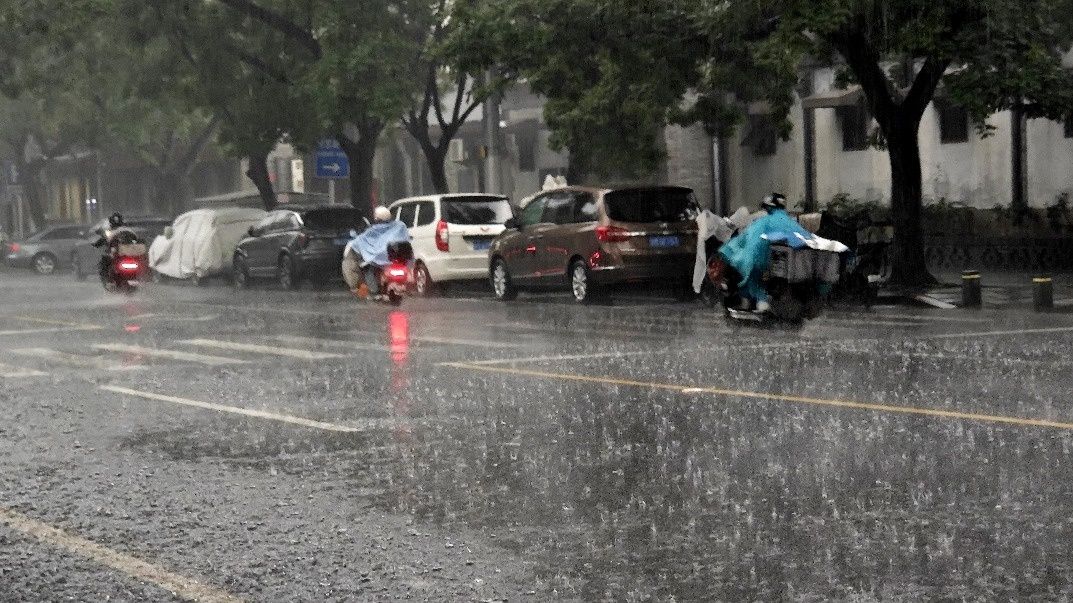
Beijing authorities have activated emergency protocols following the issuance of an orange-level rainstorm alert Thursday afternoon, marking the opening salvo of severe weather warnings for the city's 2026 flood season. The Beijing meteorological observatory released the alert at 1.30 pm, prompting immediate action from the capital's flood control office, which simultaneously implemented a Level-II flood control emergency response. This escalation reflects the severity of meteorological conditions expected to sweep across the sprawling metropolis over the coming weekend.
The forecast paints a picture of sustained and intense rainfall threatening the city from 2.00 pm Friday through 8.00 am Sunday. Meteorologists have identified several districts as flash points for particularly severe precipitation, namely Huairou, Miyun, Pinggu, Shunyi and Fangshan. The concentration of these districts suggests that areas on Beijing's periphery, particularly those with mountainous or hilly terrain, face the most acute risk of flooding and water-related hazards.
The rainfall projections are substantial by any measure. Hourly precipitation in isolated pockets is anticipated to surpass 70 millimetres, a rate that can overwhelm drainage infrastructure and trigger rapid surface runoff. Over the 48-hour window, cumulative rainfall across affected zones could accumulate to more than 150 millimetres, equivalent to a significant portion of Beijing's monthly precipitation in many months. Such concentrated downpours pose compounded risks: waterlogging in urban low-lying areas, potential landslides in elevated terrain, and swollen waterways that threaten both infrastructure and human life.
In response, the Beijing flood control office has urged the public to exercise caution and minimise unnecessary exposure to outdoor conditions. Residents have been explicitly advised to refrain from visiting scenic attractions that incorporate mountainous or waterside elements, to avoid underground shopping facilities where flash flooding poses particular danger, and to steer clear of geological hazard zones. The warnings underscore the multi-dimensional nature of rainstorm threats, which extend beyond simple surface flooding to encompass terrain instability and structural vulnerability in subterranean commercial spaces.
Transportation patterns are expected to shift significantly as authorities encourage commuters to rely on public transportation systems rather than personal vehicles, reducing congestion and potential accidents on rain-slicked roads. Enterprises and public institutions have been invited to implement flexible working arrangements or stagger employee arrival and departure times, effectively spreading commute pressures across extended hours and reducing peak-hour congestion during hazardous weather conditions.
The education sector faces particular disruption, as schools have been directed to suspend conventional classes, cancel in-person training sessions, and postpone field teaching activities where conditions warrant such action. This flexibility allows educators to adjust operations based on real-time meteorological developments rather than adhering to rigid schedules that could expose students and staff to dangerous conditions.
Beyond the consumer-facing guidance, the alert mandates a comprehensive suspension of outdoor activities, commercial operations and construction work across the city. This sweeping directive acknowledges that heavy rainfall creates hazardous conditions for workers exposed to elements on building sites, for deliveries and outdoor service provision, and for any human activity conducted in the open. The prohibition recognises that even brief exposure can become perilous during torrential downpours.
China's four-tier meteorological warning system contextualises this alert within a graduated framework. Red warnings denote the most critical threat level, followed by orange as the second-most severe category, then yellow and blue as progressively less urgent alerts. By issuing an orange alert, Beijing's meteorological authorities are signalling that Friday and Saturday's weather represents a significant threat requiring immediate precautionary action, though not reaching the absolute highest level of national emergency.
For the broader Southeast Asian region, Beijing's weather challenges carry indirect relevance. The capital's susceptibility to sudden intense rainfall during flood season reflects broader climatic patterns affecting East and Southeast Asia, where monsoon systems and frontal weather systems can generate devastating precipitation events. The Chinese capital's experience with weather management, emergency response coordination and public communication during such events offers instructive lessons for urban centres throughout the region that face similar meteorological hazards. As climate systems become increasingly volatile and urbanisation concentrates populations in sprawling metropolitan areas, the mechanisms that Beijing deploys to coordinate warnings, suspend operations and guide public behaviour increasingly assume comparative importance for cities facing analogous pressures. The integration of flexible work arrangements, transportation modal shifts and school suspensions represents a sophisticated urban adaptation strategy worth monitoring across regional contexts.

