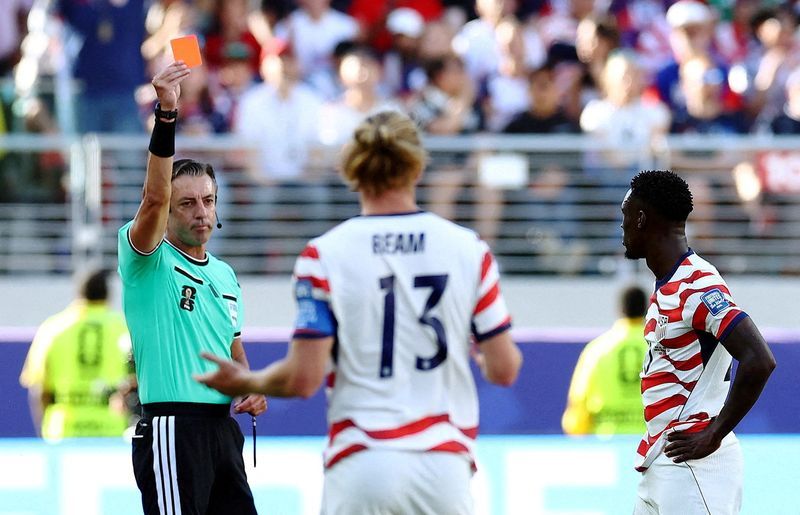
The controversy surrounding FIFA's intervention in disciplinary matters has become impossible to ignore after Belgian officials and citizens expressed outrage over the football governing body's decision to suspend a red-card ban for a prominent American player. The reversal, which came after U.S. President Donald Trump personally appealed to FIFA President Gianni Infantino, has fundamentally challenged the credibility of the organisation's regulatory framework and raised uncomfortable questions about the role of political influence in international sporting governance.
Folarin Balogun, a striker for the United States, was initially prohibited from playing in the team's upcoming knockout round fixture following a serious on-field incident that warranted the red card. However, FIFA's subsequent decision to lift this suspension—apparently prompted by Trump's direct involvement—has created an unprecedented diplomatic incident and cast doubt on the integrity of the disciplinary process. The match between Belgium and the United States was scheduled to take place in Seattle on Monday, making the timing particularly sensitive for both nations' preparation strategies.
Belgian public sentiment regarding the decision ranges from bewilderment to indignation. Therese Kpooubie, a resident of Brussels, articulated the widespread confusion about how FIFA could unilaterally overturn a sporting decision without addressing the underlying incident that prompted the suspension. She questioned whether reversing the red card effectively invalidated the referee's judgment on the pitch, suggesting that such interference with established disciplinary procedures undermines the entire foundation of fair play in professional football. Her comments reflect a broader concern that political pressure from high-ranking government officials should never supersede the technical and ethical judgments of match officials.
The notion that external political influence could reshape outcomes in international competitions contradicts fundamental sporting principles that have governed professional football for generations. Kpooubie expressed particular frustration at what she characterised as a potential manipulation of the process, describing any such interference as shameful. Her perspective represents the view held by many Belgian citizens who believe that the sport's governing body must operate independently of governmental pressure if it is to maintain any credibility in the eyes of players, teams, and fans across the globe.
However, not all Belgian observers interpreted the decision as a reason for despair. Bastien Noel, another Brussels resident, suggested that rather than allowing the controversy to undermine their preparations, Belgium's national team—known colloquially as the Red Devils—should use the situation as a rallying point. His comments suggest that sporting challenges are best addressed through superior performance on the pitch rather than through disputes about administrative procedures. Noel argued that regardless of how the disciplinary matter concluded, Belgium's path to victory must depend on the team's commitment, tactical execution, and collective determination during the actual match.
At the governmental level, Belgium's Deputy Prime Minister Maxime Prevot joined the criticism, delivering a more formal rebuke of what he characterised as a fundamental violation of sporting principles. Prevot's statement suggested that if Trump's telephone conversation with Infantino genuinely influenced the decision to lift the suspension, then FIFA would be breaching the most elementary rules that govern both football and athletic competition more broadly. His comments indicate that the issue has transcended the realm of casual sports discussion and entered the domain of serious political concern, with implications for how international sporting bodies should operate when confronted with pressure from powerful political figures.
The U.S. Ambassador to Belgium, Bill White, attempted to defuse tensions by categorically denying any inappropriate intervention. White's statement on Instagram clarified that Trump had merely thanked FIFA for their decision after the matter had already been concluded, rather than initiating the disciplinary review himself. This distinction, however, proved insufficient to quell Belgian concerns, as many observers questioned the plausibility of a fortuitous coincidence between the American president's communication with the FIFA leader and the sudden reversal of the suspension.
The broader context of this dispute reveals underlying tensions in how international sporting organisations balance governance, political relationships, and competitive integrity. FIFA's decision-making processes have long been scrutinised for opacity and susceptibility to external pressure, and this episode has crystallised those concerns in a manner that affects millions of football supporters. For Malaysian readers familiar with regional sports controversies and concerns about institutional independence, the Belgian situation resonates with similar questions about how governing bodies can maintain credibility when confronted with influential figures seeking to influence outcomes.
Belgian supporters, including passionate fans like Kpooubie, have channelled their frustration into encouragement for their national team, urging the Red Devils to demonstrate their superiority through sporting achievement rather than administrative complaint. This response reflects the pragmatic approach many fans adopt when facing situations beyond their control—focusing energy on what can be influenced within the match itself. The emotional investment evident in public statements underscores how international football competitions intersect with national pride and collective identity across Europe and beyond.
As Belgium prepared for their knockout encounter with the United States, the political dimensions of the disciplinary controversy seemed likely to persist in media discussions and diplomatic circles. The incident has exposed vulnerabilities in FIFA's governance structure and raised questions about whether international sporting bodies can adequately insulate themselves from political pressure when that pressure originates from the highest levels of national governments. For Southeast Asian nations with their own interests in international sporting governance, the precedent established by FIFA's decision carries implications for how future disciplinary matters might be handled and whether political influence can systematically reshape outcomes in major competitions.

