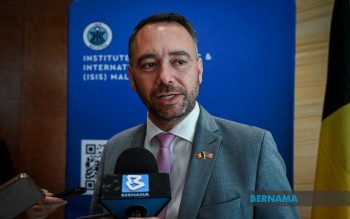
Belgium is positioning itself as a strategic partner for Malaysia's transition to renewable energy, with the country's second-ranking government official pitching offshore wind expertise during a high-level visit to Kuala Lumpur. Belgian Deputy Prime Minister Maxime Prévot told reporters that offshore energy represents a significant avenue for bilateral collaboration, particularly as both nations navigate the shift towards decarbonised power systems. Speaking at the 39th Asia-Pacific Roundtable forum, Prévot outlined a compelling case for partnership grounded in Belgium's outsized success in harnessing offshore wind despite geographical constraints that would seem prohibitive.
Belgium's credentials in offshore energy are unusual for a small European nation. With merely 60 kilometres of coastline along the North Sea, the country has constructed offshore wind farms capable of generating two gigawatts of electricity—a figure that powers millions of households while displacing fossil fuel consumption. More significantly, the Belgian government has committed to expanding this capacity to between six and seven gigawatts within the coming years, a scale equivalent to the output of five to seven nuclear power stations. This trajectory underscores how technological innovation and strategic investment can overcome natural limitations, a lesson potentially applicable to Southeast Asian nations evaluating their own offshore energy prospects.
Prévot framed offshore wind development as integral to Belgium's dual objectives of energy security and decarbonisation. The geopolitical context underpinning this emphasis remains relevant for Malaysia and the wider region. Europe's exposure to energy supply disruptions, particularly following Russia's invasion of Ukraine, has reinforced the strategic imperative to diversify energy sources away from imported hydrocarbons. Offshore renewables offer a domestic alternative that enhances resilience while reducing carbon emissions—a combination increasingly attractive to policymakers navigating climate commitments and energy stability concerns simultaneously.
Beyond offshore wind, Prévot identified several complementary sectors ripe for bilateral exploration. Semiconductors, logistics, clinical trials, biotechnology research and development, and pharmaceuticals all emerged as areas where Belgian expertise could mesh with Malaysian capabilities and market opportunities. This sectoral breadth reflects a more comprehensive vision of economic partnership than offshore energy alone, suggesting Belgium views Malaysia as a potential hub for multiple technological and industrial collaborations within Southeast Asia.
The European Union has signalled its commitment to regional energy transformation through concrete financial commitments. During his ministerial address, Prévot announced that the EU and its member states intend to mobilise €10 billion under the Global Gateway Strategy specifically to support the ASEAN Power Grid and broader energy transition efforts across the region. This represents a substantial investment in regional infrastructure, potentially unlocking downstream opportunities for European companies and technology providers while advancing ASEAN's collective decarbonisation agenda. The Global Gateway initiative itself reflects the EU's strategic pivot towards strengthening connectivity and resilience in Indo-Pacific markets, partly in response to competing regional influence from other major powers.
The proposed ASEAN Power Grid expansion carries profound implications for Malaysia's energy landscape and regional electricity markets. A more integrated regional grid could facilitate the efficient movement of renewable energy across borders, allowing nations with optimal wind or solar resources to supply their neighbours and optimise costs. This interconnectedness would also enhance grid stability by distributing demand across a larger system, reducing vulnerability to localised supply shocks. For Malaysia, which possesses both industrial demand and geographic positioning between major ASEAN markets, the grid expansion could create economic opportunities in energy trading and infrastructure development.
Prévot's visit marks his first tour of Malaysia since assuming the foreign affairs portfolio in February 2025, signalling priority attachment to the relationship. The timing reflects broader European recognition that Southeast Asian nations, particularly Malaysia, warrant elevated diplomatic engagement. Malaysia's economic weight, its role within ASEAN as an influential middle power, and its existing ties to European markets all justify high-level attention from Brussels and member state capitals seeking to deepen partnerships across the Indo-Pacific.
Bilateral economic ties provide a foundation for expanded cooperation. In 2025, total merchandise trade between Malaysia and Belgium reached RM9.74 billion, with Malaysian exports constituting RM6.85 billion and imports RM2.89 billion. This trade relationship, while modest relative to Malaysia's total international commerce, reflects established commercial networks and mutual market access. More pertinently, Belgian firms have invested substantially in the Malaysian economy. As of 2025, a cumulative total of 67 projects with Belgian participation had received government approval, representing aggregate investments worth RM5.1 billion and generating approximately 4,605 jobs across Malaysian industries. These projects suggest significant Belgian presence in manufacturing, services, and potentially energy-related sectors.
The energy transition conversation between Belgium and Malaysia occurs within a broader European strategy aimed at securing long-term sustainable growth and regional resilience. EU officials have articulated the view that climate action, clean energy investment, and infrastructure modernisation constitute interconnected objectives that simultaneously address environmental imperatives and economic competitiveness. By anchoring development cooperation in these domains, the EU positions itself as aligned with ASEAN's own aspirations for sustainable growth—language now enshrined in ASEAN's comprehensive climate and energy strategies.
For Malaysia specifically, Belgian overtures on offshore wind merit serious consideration alongside the nation's existing renewable energy targets and infrastructure plans. Malaysia has set ambitious goals for renewable energy deployment, and offshore wind represents a resource category in which the country possesses untapped potential. The monsoon wind patterns in Malaysian waters could support commercially viable wind farms, particularly in areas where space constraints or environmental considerations limit onshore development. Importing Belgian expertise and technology, potentially through joint ventures or knowledge transfer arrangements, could accelerate Malaysia's trajectory towards these targets while generating employment and industrial capabilities in the renewable energy sector.
The alignment of European and ASEAN interests in energy transition also reflects deeper strategic realignment within the international system. Both regions face pressure to reduce carbon emissions, ensure energy security, and maintain economic dynamism in an era of geopolitical competition and technological disruption. Collaboration between Belgium, Europe more broadly, and Southeast Asian nations on these shared challenges can yield mutual benefits—Europe gains access to growing markets and raw materials, while Southeast Asian nations acquire technology, financing, and expertise essential for managing their energy transitions at scale. This framing transforms energy cooperation from a purely technical matter into a geopolitical and economic imperative.

