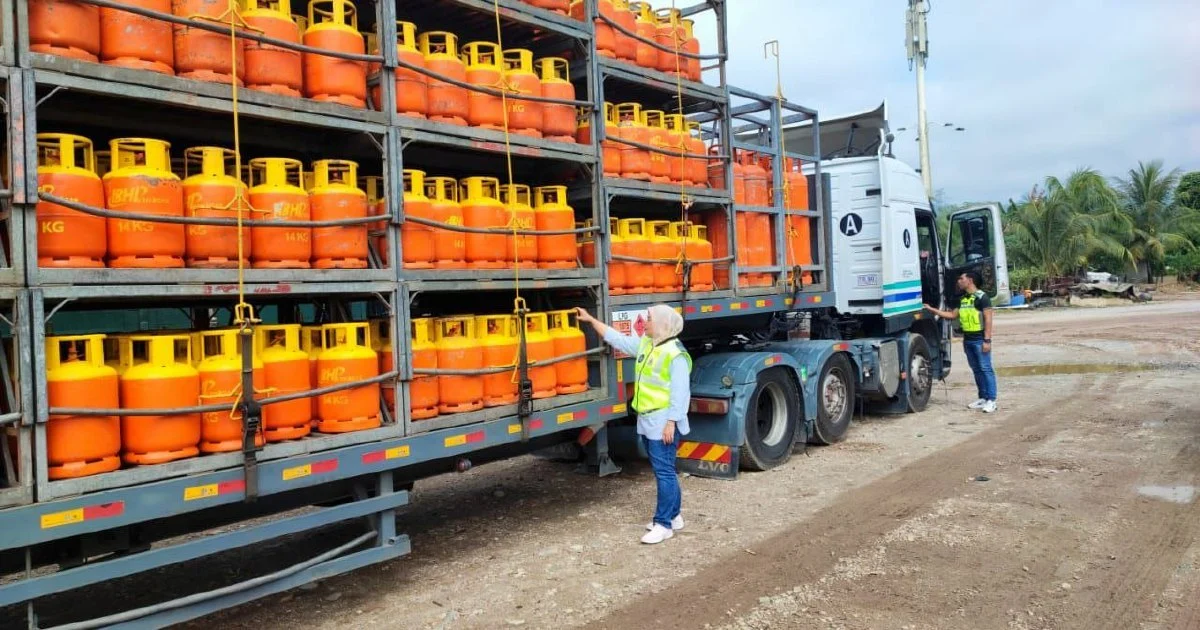
Enforcement officers conducting operations in Bentong have uncovered a substantial cache of liquefied petroleum gas (LPG) cylinders stored within a secured compound, with authorities valuing the haul at RM405,000. The discovery came during an inspection of a fenced facility where the gas cylinders were being held on a trailer, raising serious questions about the legality and safety compliance of the storage arrangement.
The seizure represents a significant enforcement action against what appears to be an unlicensed distribution or storage operation. LPG cylinders are strictly regulated commodities in Malaysia, subject to stringent safety protocols and licensing requirements overseen by multiple government agencies. The presence of such a large quantity stored in an improvised facility suggests potential violations of the Petroleum Act and related regulations governing the handling and distribution of liquefied petroleum gas throughout the country.
Liquefied petroleum gas constitutes a critical energy resource for domestic and commercial users across Malaysia, with millions of households relying on LPG for cooking and heating purposes. Any illicit stockpiling or unregulated distribution undermines the integrity of the legitimate supply chain and poses considerable safety risks to consumers and the wider public. Improperly stored cylinders, maintenance lapses, and lack of proper safety infrastructure can create hazardous conditions including leakage, explosions, and environmental contamination.
The Bentong discovery reflects ongoing enforcement challenges in Pahang and throughout Malaysia's peninsular regions, where remote or semi-rural areas sometimes become focal points for illicit commodity storage operations. The fenced nature of the facility suggests deliberate concealment, indicating operators were aware of regulatory non-compliance. Such operations typically supply informal markets or customers seeking to circumvent official channels and associated taxation or licensing mechanisms.
Authorities have not yet disclosed details regarding the intended destination of the cylinders or the operational structure behind the storage facility. Understanding these particulars would provide insight into whether this represents an isolated incident or part of a broader smuggling or distribution network. The involvement of a trailer suggests the cylinders were in transit or preparing for movement, potentially indicating a hub location within a wider supply operation.
From a consumer protection perspective, the seizure underscores the importance of sourcing LPG exclusively through authorised dealers and licensed retailers. Consumers purchasing from informal channels risk acquiring cylinders that lack proper maintenance records, safety certifications, and traceability. These substandard products pose genuine risks of malfunctions, gas leakage, or structural failures that could endanger lives and property.
The enforcement action also highlights the resource constraints faced by regulatory agencies tasked with monitoring vast geographic areas and numerous storage facilities across Malaysia. Bentong, situated in Pahang's eastern reaches, presents particular challenges for surveillance and compliance monitoring. Successful identification of this facility suggests either enhanced intelligence gathering or increased patrols in the region, though the scale of operations that evade detection likely exceeds what agencies are currently discovering.
Regional implications extend beyond Bentong, as such operations frequently span state boundaries and may involve coordinated networks across Pahang, Kelantan, and Terengganu. The enforcement framework requires coordination between federal agencies, state authorities, and local enforcement bodies to effectively disrupt such networks. The RM405,000 valuation indicates this operation possessed considerable financial scale and organisational sophistication.
For Malaysian consumers and businesses dependent on reliable LPG supplies, sustained enforcement against illicit operations supports price stability and supply security. Black market cylinders can distort markets, undercutting legitimate suppliers and potentially creating incentive structures that compromise safety standards industry-wide. Authorities must balance enforcement intensity with ensuring legitimate businesses can operate efficiently and meet growing demand.
The seizure also reflects evolving compliance challenges in Malaysia's energy sector as demand for alternative fuels and distributed energy resources grows. Stakeholders including regulatory bodies, industry associations, and consumer groups need to strengthen coordination in identifying and responding to illicit activities. Public awareness campaigns promoting the risks of unlicensed LPG purchases would complement enforcement efforts.
Going forward, the Bentong case demonstrates the necessity for enhanced monitoring technologies, inter-agency intelligence sharing, and community reporting mechanisms to detect similar operations before they accumulate substantial stockpiles. The apparent scale of storage suggests this particular facility operated for a considerable period without detection, raising questions about surveillance adequacy in peninsular Malaysia's less densely populated zones.
Authorities have not announced charges or arrests related to the seizure at this stage. Investigation outcomes will likely inform enforcement strategy refinements and may expose connections to other illicit operations across the region. The incident serves as a reminder that Malaysia's energy security and consumer safety require vigilant regulatory oversight and continued investment in enforcement capabilities targeting illegal commodity distribution networks.

