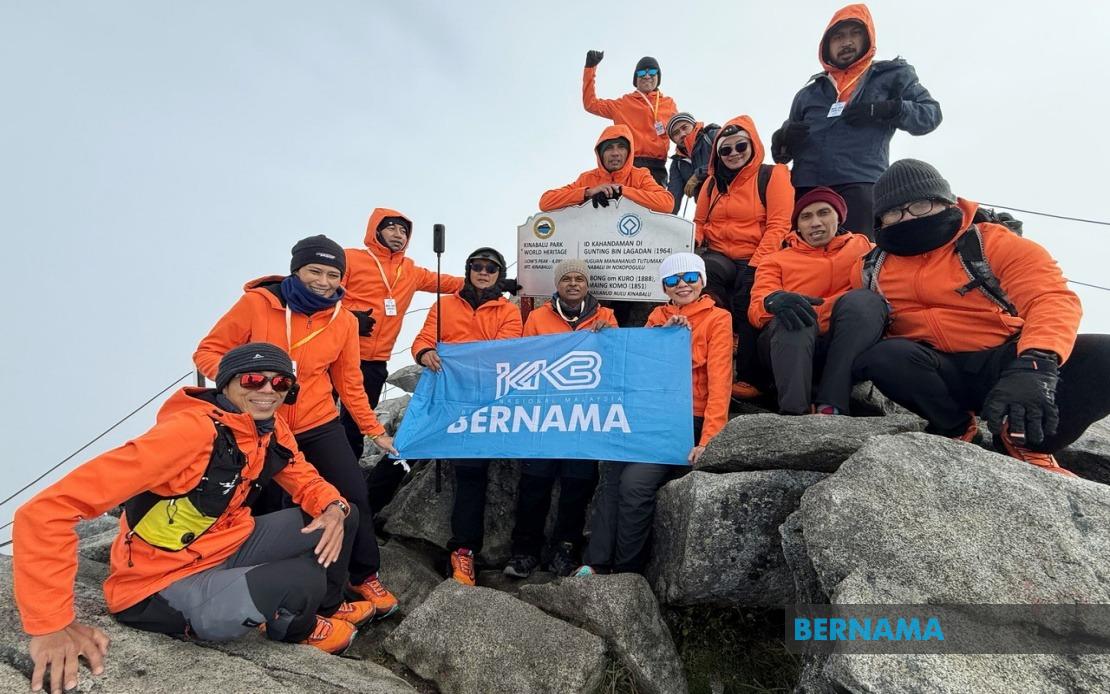
In a remarkable display of institutional unity and physical determination, twenty-three personnel from Bernama, Malaysia's national news agency, have successfully reached the summit of Mount Kinabalu on July 1st as part of an expedition marking the HAWANA 2026 National Journalists' Day celebrations. The coordinated ascent of Southeast Asia's highest peak represents a milestone for the news organisation and underscores a growing trend among Malaysian institutions to mark significant occasions through challenging physical undertakings that reflect broader values of team cohesion and resilience.
Editor-in-Chief Arul Rajoo Durar Raj, who personally led the expedition, characterised the climb as a dual-purpose initiative designed both to commemorate the journalists' celebration and to establish two distinct Malaysia Book of Records entries. The first record targets recognition as the largest contingent of media practitioners from a single organisation to successfully climb Mount Kinabalu, whilst the second seeks to acknowledge Bernama as the inaugural media organisation to produce multilingual news coverage from the mountain's summit itself—demonstrating how the expedition integrated professional responsibilities with physical achievement.
The composition of the expedition team reflected the breadth of Bernama's operational structure, encompassing reporters responsible for newsgathering, photographers documenting the journey, sub-editors involved in content refinement, television crew members, and supporting administrative personnel. This deliberately inclusive approach ensured that the expedition functioned not merely as a symbolic gesture but as a genuine team-building exercise spanning the organisation's entire workforce, from field journalists to behind-the-scenes support staff who collectively enable daily news operations.
The expedition followed a carefully planned itinerary that commenced at Timpohon Gate at 10 am on June 30th, with climbers establishing a rest point at Panalaban before undertaking the final ascent beginning at 2.30 am on July 1st. The team reached the 4,095.2-metre summit at approximately 7.20 am, completing the demanding ascent despite challenging meteorological conditions including rainfall, heavy mist, and forceful winds that tested both physical endurance and mental fortitude throughout the journey. Such adverse weather patterns are characteristic of Mount Kinabalu's unpredictable alpine environment and represent genuine hazards that mountaineers must navigate.
For Arul Rajoo personally, the successful summit represented a significant professional distinction—he became the first Editor-in-Chief of Bernama to achieve this accomplishment, underscoring the expedition's exceptional status within the organisation's institutional history. This individual milestone carries symbolic weight within the broader narrative of institutional achievement, signalling that even senior leadership participates directly in organisational endeavours rather than directing from a distance.
Mountain Kinabalu, designated a UNESCO World Heritage Site and situated within the 754-square-kilometre Kinabalu Park, constitutes not merely a geographical landmark but a site of considerable environmental and cultural significance. The peak forms part of the Kinabalu UNESCO Global Geopark, reflecting international recognition of the region's geological importance and biodiversity value. For Malaysian news professionals to conduct multilingual reporting from this elevation underscores the integration of journalism with the nation's natural heritage and global environmental commitments.
Beyond the immediate physical accomplishment, the expedition explicitly advanced institutional objectives concerning team cohesion, physical wellness promotion, and mental resilience development among Bernama personnel. The Bernama Staff Club, organising the climb for the first time, positioned the undertaking within a broader framework of employee wellbeing and institutional morale-building. In a professional landscape often characterised by deadline pressures and competitive news cycles, such initiatives provide counterbalance by emphasising collective achievement and shared challenge.
The expedition benefited from substantial logistical and financial support from strategic partners spanning multiple sectors. International sportswear manufacturer BMAI provided technical equipment and expertise, whilst domestic air carrier Batik Air facilitated transportation logistics. Beverage manufacturer 100PLUS supplied hydration support, EHH Food Industry Sdn Bhd and Saloma Bistro provided nutritional resources, and Malaysia Airports coordinated facility access. Specialist organisations including Sabah Parks and Marathon Baker contributed domain-specific knowledge and additional support resources, demonstrating how contemporary institutional undertakings require coordinated participation from multiple commercial and governmental stakeholders.
The multilingual news production objective—constituting one of the two targeted Malaysia Book of Records entries—reflects Bernama's operational mandate as a multilingual news service serving Malaysia's diverse population. Producing news content in four languages from Mount Kinabalu's summit would exemplify how professional responsibilities persist even in extreme environments and represent a distinctive achievement within regional media practice. This aspect particularly resonates for Southeast Asian media practitioners operating across linguistically diverse populations where inclusive information dissemination remains strategically important.
The timing of this expedition during HAWANA 2026 celebrations carries significance beyond the immediate institutional context. National Journalists' Day commemorates the profession's role in democracy and information stewardship, and marking this occasion through a physically demanding collective undertaking reinforces narratives about journalistic integrity requiring resilience, teamwork, and commitment to transcending obstacles. For Malaysian news professionals facing contemporary pressures including digital disruption, economic uncertainty, and evolving audience preferences, such institutional moments assert values of unity and shared purpose.
The successful expedition also carries subtle messaging regarding media institutional strength and capability. In an era when regional media organisations face financial pressures and changing consumption patterns, Bernama's capacity to mobilise resources for such an ambitious undertaking demonstrates organisational vitality and access to substantial institutional support. The participation of prominent commercial partners similarly signals confidence in the news agency's continued relevance and partnership value within Malaysia's business ecosystem.
Looking forward, the pursuit of these Malaysia Book of Records entries positions Bernama within a growing category of Malaysian institutions leveraging record-breaking achievements for publicity and institutional distinction. Whether the records are ultimately ratified by Malaysia Book of Records remains to be determined, but the expedition's real value extends beyond potential certifications to encompassing the demonstrated capacity for institutional coordination, employee engagement, and the integration of professional objectives with physical challenge. For Southeast Asian media organisations navigating profound sectoral transformation, such initiatives underscore enduring human and institutional dimensions that technological change cannot fully displace.

