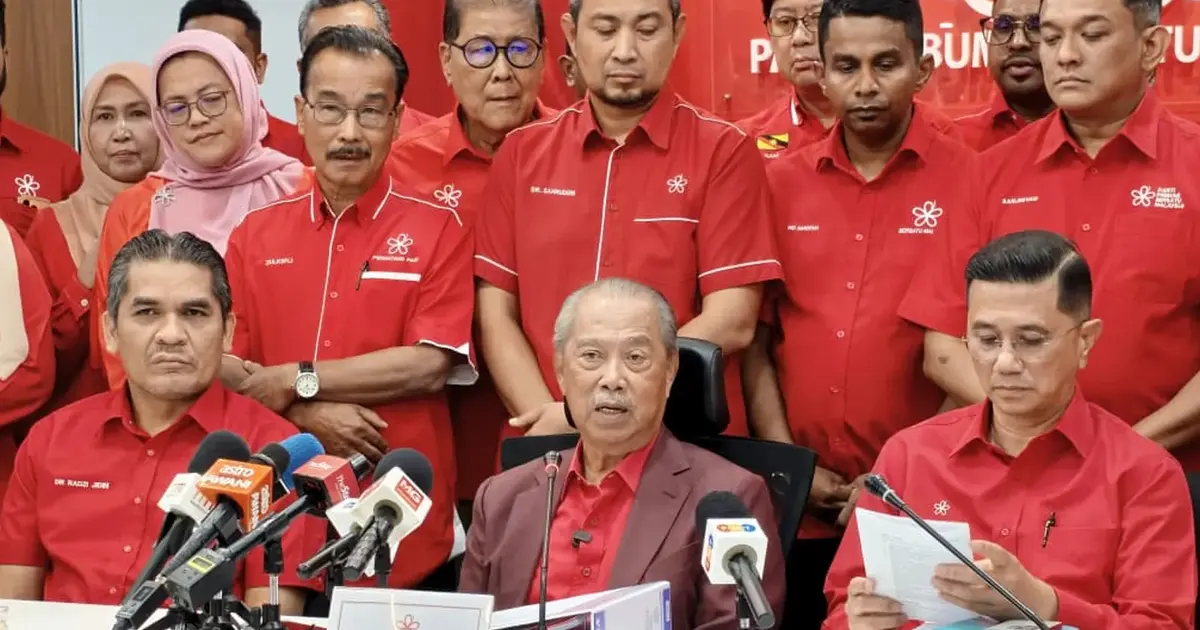
Bersatu will continue its involvement in the Perikatan Nasional coalition, according to party president Muhyiddin Yassin, who grounded the commitment in what he characterizes as strong public backing for the political arrangement. The declaration underscores the stability of the coalition structure that has shaped Malaysian politics since the 2022 general election, when Perikatan Nasional emerged as a significant political force offering an alternative to the Pakatan Harapan government.
The decision to remain anchored within Perikatan Nasional reflects deeper calculations within Bersatu's political strategy. As a mid-sized party that has experienced substantial fluctuations in electoral fortunes, Bersatu benefits from coalition membership by securing ministerial positions and maintaining relevance in federal governance structures. The coalition framework provides the party with a platform to influence policy decisions beyond what its parliamentary strength alone would allow, a consideration that has proven consequential across previous government formations in Malaysia.
Muhyiddin's emphasis on public acceptance as the foundation for this commitment speaks to the evolving nature of Malaysian electoral politics, where voter preferences increasingly shape coalition dynamics. Rather than relying solely on elite bargaining or internal party calculations, the Bersatu president is framing the coalition's durability as rooted in genuine public support. This rhetorical approach acknowledges the reality that Malaysian voters have demonstrated willingness to punish parties perceived as engaging in unprincipled political maneuvering, a lesson driven home by electoral shifts in 2018 and 2022.
The Perikatan Nasional coalition, formed through the convergence of Bersatu, PAS, and eventually absorbed components from other parties and independent politicians, has functioned as a stabilizing force in Malaysian governance despite periodic tensions. Bersatu's continued participation ensures the coalition maintains representation across Peninsular Malaysia and East Malaysia, where the party holds several parliamentary seats and strategic positions in state legislatures. The coalition's strength partly derives from this geographic diversity, which prevents either PAS or any other single component from achieving overwhelming dominance.
Within the Malaysian political landscape, Bersatu occupies a distinct position as a relatively centrist party with roots in former UMNO membership under Muhyiddin's leadership. This positioning allows it to serve as a potential bridge between more Islamist-oriented coalition partners like PAS and the broader electorate, a balancing function that becomes increasingly valuable in coalition management. By recommitting to Perikatan Nasional, Bersatu signals that it views this coalition arrangement as preferable to exploring alternative alignments that might prove less stable or electorally viable.
The party's reaffirmation carries implications for Malaysia's political trajectory heading toward the next general election, expected no earlier than late 2024. Coalition stability before an electoral contest typically provides governing parties with advantages in terms of policy implementation and resource allocation. Should Perikatan Nasional maintain cohesion through the election period, it would enter the electoral contest with an established governance record and ministerial incumbents seeking re-election, factors that influence voter decision-making in Malaysia's mixed electoral system.
Regional observers monitoring Malaysian politics will note that this commitment also reflects broader Southeast Asian patterns, where coalition governance has become increasingly prevalent as single-party majorities have become harder to achieve. Thailand, Indonesia, and the Philippines all operate within coalition frameworks that require ongoing negotiation and consensus-building. Bersatu's reaffirmation of its coalition commitment suggests Malaysian political actors are learning to work within such pluralistic arrangements rather than perpetually seeking dominance or wholesale realignment.
The role of public opinion in validating coalition arrangements marks a departure from earlier periods in Malaysian politics when coalitions were formed and reformed through elite decision-making largely insulated from immediate electoral pressures. Muhyiddin's framing suggests that contemporary politics requires coalition partners to justify their arrangements to voters actively, a development that could influence how political negotiations proceed in Malaysia. Parties can no longer assume that their base will automatically follow leadership decisions on coalition matters; they must instead cultivate and maintain visible public support for such arrangements.
For Bersatu specifically, remaining in Perikatan Nasional provides continuity for its members who have assumed government positions and built political capital within federal and state administrations. Ministers, deputy ministers, and officials from Bersatu embedded within government structures benefit from coalition stability, as sudden realignment could disrupt their career trajectories. This institutional interest in coalition preservation supplements whatever ideological or strategic calculations drive the party leadership's commitment.
Looking forward, Bersatu's continued participation in Perikatan Nasional will likely shape competition among coalition partners for parliamentary seats and state-level positions. PAS, as the dominant force within the coalition in terms of parliamentary representation, maintains considerable influence over coalition decision-making, yet Bersatu's presence ensures this influence remains contested rather than hegemonic. This internal coalition dynamics will influence whether Perikatan Nasional can present a unified electoral platform or whether internal contradictions become more pronounced as the next election approaches.
Muhyiddin's statement also implicitly contrasts Perikatan Nasional's ostensible stability with alternative political arrangements. The implicit message suggests that returning to the opposition benches or realigning with Pakatan Harapan would prove less appealing to both party members and voters who have come to associate Bersatu with governance participation. Whether this public confidence assessment proves accurate will become evident when Malaysian voters next head to polling stations, at which point the true durability of the coalition's public support will face its ultimate test.