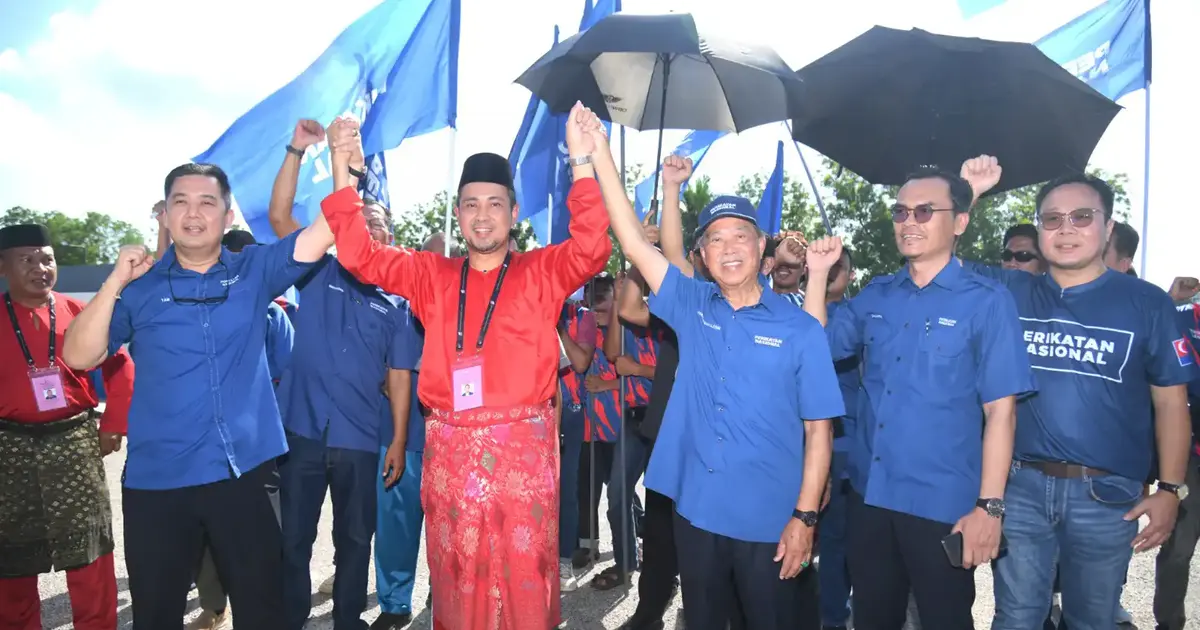
Bersatu president Muhyiddin Yassin has adopted a measured tone in response to PAS's apparent reluctance to deploy its campaign machinery for the party's benefit, characterising the snub as a matter of principle rather than conflict within their Perikatan Nasional alliance. The statement reflects an attempt to contain potential fissures in a coalition that has been central to Malaysian politics since 2020, when the partnership first formed following the political upheaval that brought Muhyiddin to the prime ministership.
Muhyiddin's response underscores a delicate balancing act within PN, where public harmony must be maintained despite divergent interests among member parties. By framing the rejection as compatible with the coalition's foundational values, he has sought to prevent the incident from escalating into a broader test of the alliance's viability. His assertion that Bersatu harbours no expectations of compulsory support from partners suggests an attempt to recast a potential weakness as a demonstration of democratic restraint within the coalition structure.
The incident itself highlights the distinction between rhetorical commitment to cooperation and the practical allocation of resources in multiparty political arrangements. Campaign machinery—encompassing grassroots networks, volunteer coordinators, and logistical capacity—represents one of the most tangible assets a political party can mobilise. PAS's reluctance to extend such infrastructure to Bersatu signals either resource constraints within the Islamic party or a calculated decision to prioritise its own electoral positioning over collective PN objectives.
For Malaysian political observers, this development carries particular significance given the competitive dynamics within PN itself. Bersatu and PAS operate in overlapping demographic and geographic spaces, particularly in Malay-Muslim constituencies where their electoral interests can clash. Unlike some coalition arrangements where parties occupy clearly demarcated niches, PN's three major components—Bersatu, PAS, and the Malaysian United Indigenous Party—frequently compete for the same voters. This structural reality means that cooperation at the leadership level must continuously navigate underlying electoral tensions.
The broader context of Malaysian coalition politics has grown increasingly complex following the 2022 general election and its aftermath. Bersatu's position within the ruling framework has fluctuated, with the party holding significant ministerial portfolios yet remaining vulnerable to shifts in parliamentary arithmetic. The party's ability to demonstrate its value to allies and coalition partners depends partly on visible institutional support, making PAS's machinery rebuff potentially more consequential than Muhyiddin's public demeanour suggests.
Muhyiddin's invocation of mutual support as a core PN principle appears designed to establish a philosophical framework within which the machinery denial can be absorbed. By emphasizing that such support operates on a voluntary rather than mandatory basis, he preempts accusations that the coalition's stated unity is illusory. The formulation also protects Bersatu's dignity by suggesting that the party never expected unconditional assistance in the first instance.
PAS, led by Hadi Awang, has traditionally maintained a more independent posture regarding its institutional resources, particularly its network of religious schools, study circles, and community organisations that constitute its ground-level organisational strength. The Islamic party's decision to withhold campaign machinery from Bersatu may reflect assessments about how such resource deployment might affect PAS's own electoral performance, or it may represent a subtle assertion of autonomy within an alliance where larger parties sometimes dominate decision-making.
The implications for Malaysian political stability warrant consideration. Coalition arrangements that contain unresolved tensions over resource distribution risk crystallising into open disputes during critical electoral moments. Bersatu's gracious public acceptance of the machinery refusal may suffice to prevent immediate escalation, but the underlying dynamic—where a coalition partner declines to mobilise assets for another member's benefit—establishes a precedent that could invite further assertions of autonomy by other PN components.
For Southeast Asian political developments more broadly, the Bersatu-PAS dynamic illustrates challenges inherent in multiethnic, multiparty coalitions operating within electoral systems that reward party competition. Unlike monolithic ruling parties, loose coalitions must continuously negotiate the tension between collective branding and individual survival. This tension becomes especially acute in polarised political environments where every electoral contest carries implications for ministerial portfolios, budgetary allocations, and institutional influence.
Muhyiddin's pragmatic response also reflects lessons from recent Malaysian political history, where coalition disputes have repeatedly threatened governmental stability. By treating the machinery question as a matter of principle rather than betrayal, he provides political space for PAS to justify its decision to its own constituencies while simultaneously affirming PN's continued functionality. This approach accepts a modest diminution of immediate campaign capacity in exchange for sustained coalition cohesion.
The machinery question itself deserves examination as an indicator of broader coalition health. When parties within alliances routinely share resources and voluntarily deploy institutional assets to support partners, it typically signals genuine collaborative commitment. Conversely, when such sharing becomes exceptional or contested, it suggests that parties are increasingly calculating their participation in coalition endeavours against narrower institutional self-interest. Bersatu's public acceptance of PAS's refusal may thus mask underlying anxieties about whether PN partnerships can survive beyond their current political utility.
Moving forward, the machinery incident may prove consequential not for immediate electoral outcomes but for shaping expectations about what genuine cooperation within Malaysian coalitions actually entails. Should Bersatu subsequently encounter similar requests from other partners and face additional refusals, the cumulative effect could transform Muhyiddin's current equanimity into a more assertive reassessment of his party's position within PN. For now, however, restraint appears to be the chosen strategy for managing an uncomfortable but manageable coalition friction point.

