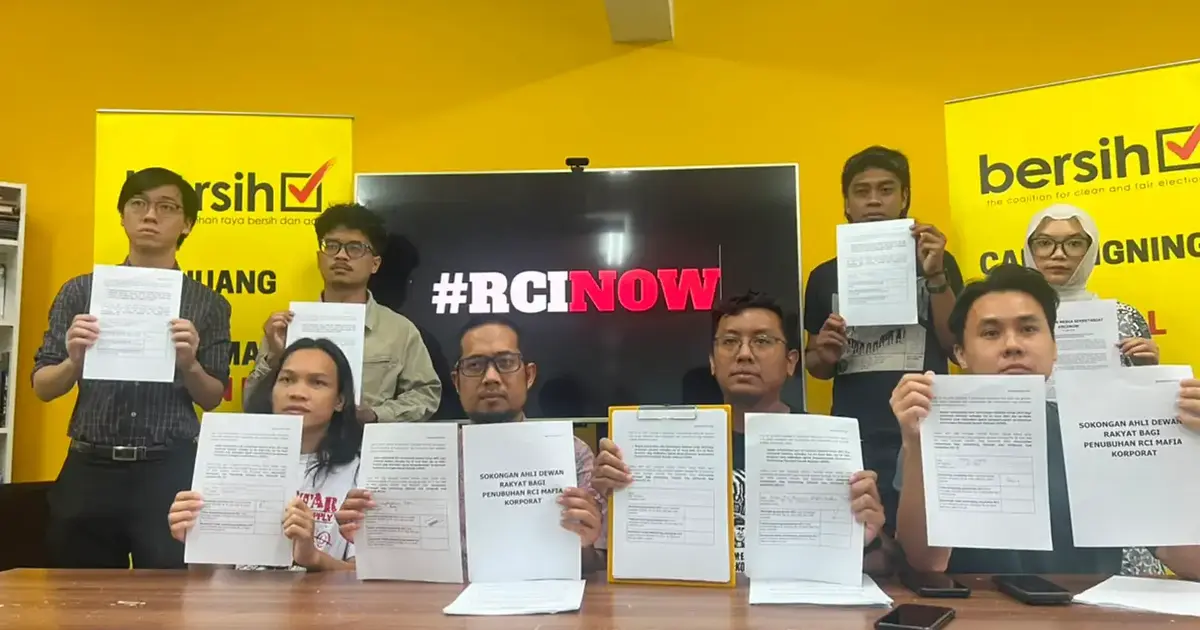
The electoral watchdog group Bersih has stated that 34 members of parliament have publicly backed the establishment of a Royal Commission of Inquiry to investigate what the group characterises as widespread corporate malfeasance. The cross-party support spans several major political formations, indicating that concerns about corporate governance and misconduct transcend traditional coalition boundaries in parliament. This development carries significance for Malaysia's ongoing efforts to strengthen institutional accountability and corporate integrity frameworks.
The backing cuts across ideological and political divides, with Bersih identifying members from Pakatan Rakyat component PKR, the Islamist PAS, the DAP, and the ruling coalition's Umno as among those lending their support to the initiative. Such multiparty consensus on governance reform remains uncommon in Malaysian politics, where partisan considerations typically dominate legislative agendas. The fact that lawmakers from both government and opposition benches have aligned on this issue suggests the perception of corporate wrongdoing has penetrated deep enough to overcome partisan friction.
Bersih's invocation of the term "corporate mafia" underscores the gravity with which the organisation views the alleged patterns of misconduct. The phrasing suggests not merely isolated incidents of fraud or regulatory breaches, but rather systemic patterns of illicit coordination, intimidation, and entrenchment of wrongdoing within Malaysia's corporate ecosystem. This framing reflects broader concerns among civil society observers that certain companies operate with impunity, leveraging political connections and institutional weaknesses to insulate themselves from meaningful oversight.
A Royal Commission of Inquiry represents one of Malaysia's most formal investigative mechanisms, typically deployed when the government seeks to examine matters of significant public concern with broad investigative powers. The establishment of such a body would grant investigators authority to compel testimonies, subpoena documents, and examine transactions across both public and private sectors. For those championing corporate accountability, an RCI would provide substantially more leverage than existing regulatory agencies or parliamentary committees can wield independently.
The timing of Bersih's announcement reflects ongoing national preoccupations with corruption, misappropriation of assets, and the abuse of corporate power for personal enrichment. Malaysia's experiences with high-profile corporate scandals and the entanglement of business with political patronage have created sustained public appetite for more rigorous scrutiny. Electoral reform groups and civil society organisations have consistently highlighted the nexus between poorly regulated corporate structures and political influence as a critical vulnerability in Malaysia's governance architecture.
For Southeast Asia more broadly, Malaysia's efforts to address corporate misconduct carry implications beyond its borders. The region has grappled with questions about whether rapid economic growth and corporate consolidation have outpaced institutional capacity to regulate effectively. Other nations in ASEAN looking to strengthen their own governance frameworks frequently benchmark their progress against Malaysian precedents. A robust RCI investigation could either model effective accountability mechanisms or expose structural limitations that other governments seek to avoid.
The parliamentary backing that Bersih has documented raises questions about whether political momentum might materialise into formal government action. Prime Minister and other ministerial figures would need to weigh the political calculus of launching such an investigation, balancing demands for accountability against potential complications that could emerge from scrutinising entities with political connections. The breadth of parliamentary support does, however, create political space for government consideration of the proposal without appearing to capitulate solely to opposition pressure.
Bersih's role in advocating for the RCI also reflects the electoral watchdog's evolution beyond its original mandate of electoral reform. The organisation has increasingly positioned itself as a generalist governance advocacy group, mobilising civic pressure on corruption, abuse of power, and institutional accountability across multiple domains. This expansion reflects both the interconnectedness of governance challenges and Bersih's assessment that electoral reform alone cannot address the structural problems that undermine democratic quality.
Critical observers have noted that the identity of the 34 supporting MPs and the strength of their commitment remain important variables. Public statements of backing differ qualitatively from active legislative advocacy or allocation of political capital to advancing the proposal. The durability of this apparent consensus would be tested should the government move toward actually establishing an RCI, potentially subjecting certain lawmakers' corporate associates or political allies to investigation.
The corporate governance challenges that Bersih highlights intersect with Malaysia's broader institutional reform agenda. Questions about regulatory capture, the revolving door between government and business, and transparency in corporate transactions have featured prominently in recent years' policy debates. An RCI focused on corporate misconduct could either catalyse systematic reform or, conversely, conclude its investigation without generating durable institutional changes if political will weakens following the formal inquiry process.
Looking ahead, whether this parliamentary backing translates into government action will likely depend on internal cabinet deliberations and the political calculations of Malaysia's executive. The announcement itself, however, documents that substantial segments of parliament recognise corporate accountability as a legitimate public concern meriting formal investigation. For Malaysian citizens and businesses with interests in transparent, rule-bound corporate practices, the statement signals that institutional pathways toward greater scrutiny remain open to mobilisation.

