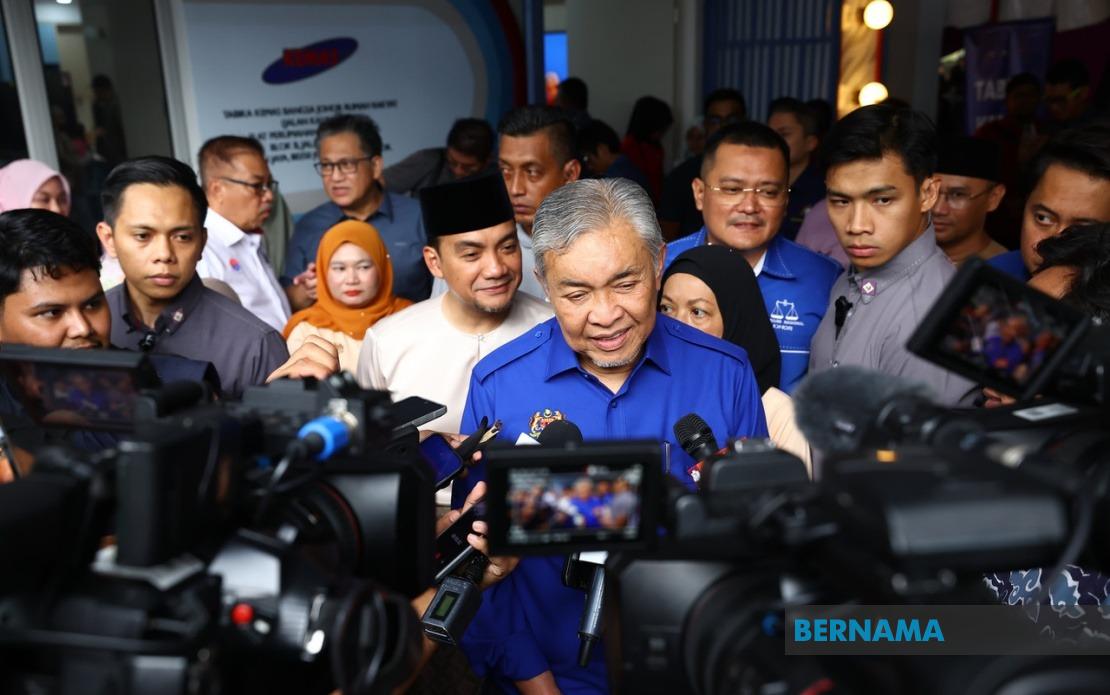
In a show of political courtesy ahead of Johor's crucial state election, Barisan Nasional Chairman Datuk Seri Dr Ahmad Zahid Hamidi has publicly acknowledged the opposition's campaign proposals, underscoring the competing visions both coalitions are presenting to voters in the economically significant state. Speaking in Johor Bahru on July 3, the Deputy Prime Minister made clear that despite their electoral rivalry, BN respects the platform that Pakatan Harapan has put forward for the contest, a sentiment that reflects Malaysia's maturing democratic culture where policy debate can coexist with partisan competition.
Ahmad Zahid's remarks came during an engagement session with parents at Tabika Kemas Bangsa Johor facilities at Larkin Court 1, underscoring how campaign activities in Malaysia often weave together community outreach and political messaging. His acknowledgement of PH's manifesto signals a confidence in BN's own position rather than dismissiveness toward the opposition's agenda. The recognition is particularly notable given the intensity of competition in Johor, where BN has traditionally held strong ground but faces determined challenges from a resurgent opposition alliance.
Packatan Harapan's manifesto, unveiled the same day, presents a comprehensive policy agenda centred on improving public welfare and economic opportunity. The ten-point platform includes several tangible offerings aimed at different demographics: the Johor Health Scheme would expand medical access, while deposit assistance for first-time homebuyers addresses the pressing affordability crisis confronting young Malaysians seeking to enter the property market. A RM500 million fund dedicated to youth development reflects recognition that employment and skills training remain critical issues for younger voters, whilst education sector strengthening initiatives acknowledge the ongoing debates about quality and accessibility in schools across the country.
Against this backdrop, BN has positioned its own campaign around proven governance rather than promises alone. Ahmad Zahid emphasised that the coalition's manifesto rests on documented achievements from the previous state government term, when officials claim more than 90 per cent of pledged initiatives were realised. This performance-based argument aims to position BN as a coalition capable of delivery, contrasting with what supporters characterise as opposition rhetoric untested at state level. The messaging suggests BN views electoral victory as contingent on voters valuing demonstrated competence over aspirational proposals.
Crucially, BN's framework presents itself as universalist in approach, rejecting characterisations that any community or social segment would be marginalised under its governance. Ahmad Zahid stressed that benefits span the entire lifecycle—from expectant mothers and young children through schooling, tertiary education, and into adulthood, with particular attention to single-parent households. The emphasis on inclusive coverage attempts to counter narratives suggesting BN administration favours particular communities, a sensitive issue in Malaysian politics where demographic composition and inter-communal relations remain significant electoral considerations.
The Deputy Prime Minister's assertion that anyone residing in Johor constitutes part of Bangsa Johor and merits equivalent support encapsulates BN's attempts to move beyond traditional communal appeal toward a broader territorial identity. This framing reflects broader shifts in Malaysian political discourse, where appeals to state-level nationalism and economic pragmatism increasingly complement or supplement community-specific messaging. The concept of Bangsa Johor—a Johor national identity—represents an effort to create political identity transcending conventional demographic divides.
Ahmad Zahid's pledge to continue backing Johor's development whilst leading the Rural and Regional Development Ministry adds a national dimension to the state contest. The minister's portfolio gives him resource allocation authority relevant to regional development projects, implicitly suggesting that voting for BN preserves access to federal development funding. This intertwining of state and national politics reflects Malaysia's federal structure, where state governments' capacity to deliver often depends partly on federal resource distribution.
The election itself involves substantial stakes, with 172 candidates competing across 56 state seats on July 11, following early voting on July 7. Johor's importance transcends its own governance; as one of Malaysia's most economically developed and populous states, its political direction influences national coalition dynamics and signals voter sentiment more broadly. The state has historically been a BN stronghold, making any significant opposition gains there particularly consequential for national political trajectories.
The two coalitions' competing manifestos reflect divergent philosophies about state development. PH's emphasis on targeted assistance—health schemes, housing deposits, youth funds—suggests an approach focused on direct intervention addressing specific pain points. BN's framework, emphasising comprehensive lifecycle coverage and proven delivery records, presents itself as offering stability grounded in experience. Both appeal to voters' material interests whilst framing their approaches as appropriate to Johor's needs and character.
Ahmad Zahid's respectful acknowledgement of PH's proposals, whilst promoting BN's record, exemplifies how Malaysian political competition increasingly balances partisan intensity with institutional norms. The recognition that opposition parties possess legitimate policy perspectives, even when disagreeing fundamentally with their approaches, suggests democratic maturation. At the same time, the campaign remains intensely competitive, with both sides mobilising supporters and resources to prevail in a contest that matters enormously for the state's governance and Malaysia's broader political equilibrium over the coming years.

