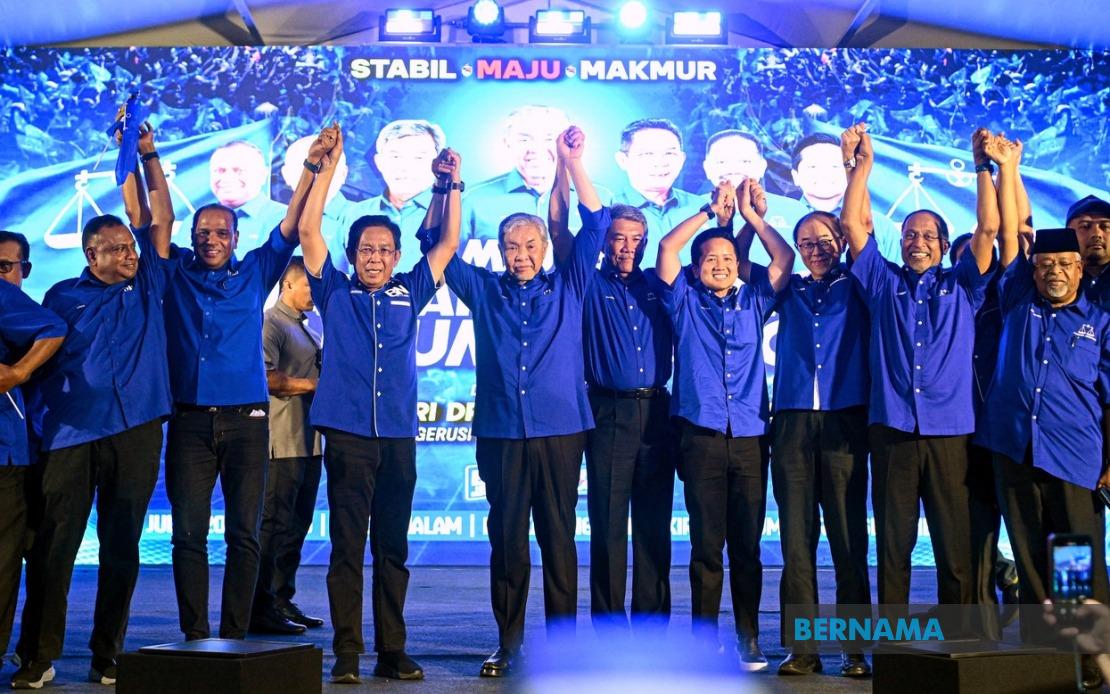
The Barisan Nasional coalition has officially announced its election machinery and 25-candidate lineup for the upcoming 16th Negeri Sembilan state election, blending political continuity with fresh recruitment as the opposition-ruled state heads toward the polls. The announcement came during a rally at Tuanku Abdul Rahman Stadium in Paroi, where party officials unveiled their strategy to challenge the incumbent Pakatan Harapan government that has controlled the state since 2018.
Negeri Sembilan BN chairman Datuk Seri Mohamad Hasan will continue as the coalition's standard-bearer in Rantau, a seat he has held since 2004 across two decades of electoral contests. Mohamad, who also serves as deputy chairman of BN at the national level, acknowledged the confidence placed in him by UMNO president Datuk Seri Dr Ahmad Zahid Hamidi in retaining this strategic constituency. His continued candidacy signals BN's intention to consolidate support in the region and maintain one of its traditional strongholds in the state.
Alongside Mohamad, the coalition retained another long-serving incumbent by nominating Negeri Sembilan UMNO Liaison Committee chairman and Jelebu Member of Parliament Datuk Seri Jalaluddin Alias to defend the Pertang state seat. Jalaluddin has represented this seat since 2013, making him one of BN's more experienced state-level representatives. The decision to retain both figures underscores the coalition's reliance on established personalities with deep roots in their constituencies, a strategy that contrasts with approaches emphasizing radical generational change.
Beyond these two prominent figures, BN preserved a broader cohort of sitting assemblymen. Datuk Mohd Faizal Ramli was renominated for Linggi, while Datuk Mustapha Nagoor secured BN's ticket for another term in Palong. These retentions suggest that BN has determined these incumbents remain electorally viable and capable of holding their ground against opposition challenges. However, the party's approach has not been uniformly protective of sitting members; some experienced assemblymen may have been stood down or asked to step aside for other positions within party or government structures.
Despite finalizing candidates for 14 seats, BN has left 11 constituencies without confirmed nominees as of the announcement date. These outstanding seats—Klawang, Serting, Lobak, Sikamat, Ampangan, Bukit Kepayang, Mambau, Paroi, Lukut, Bagan Pinang, and Gemas—represent areas where the coalition is still evaluating candidates or managing internal party negotiations. This incomplete slate reflects the complex internal dynamics within BN's component parties, particularly UMNO, Gerakan, and MCA, which must balance competing claims for nominations across constituencies with varying electoral prospects.
The timing of this incomplete announcement raises questions about BN's readiness for a snap election, a possibility that has loomed over Negeri Sembilan politics following political shifts at the state level. The delay in finalizing certain nominations may indicate protracted negotiations over winnable seats or uncertainty about ground conditions in particular areas. It also provides opposition coalitions with additional weeks to organize their own campaigns and identify vulnerabilities in BN's lineup.
For Malaysian political observers, the Negeri Sembilan contest represents a significant mid-term test of BN's organizational capacity and electoral appeal. The state has been under Pakatan Harapan control since the 2018 tsunami election, and BN will attempt to recapture lost ground. The coalition's emphasis on retaining recognizable figures like Mohamad Hasan and Jalaluddin Alias suggests a defensive posture aimed at stabilizing support in core areas rather than pursuing an aggressive expansion strategy. This approach may appeal to traditional BN voters seeking political stability but could struggle to mobilize younger or swing voters seeking change.
The composition of the announced candidates—a mixture of long-serving incumbents and new entrants—reflects broader patterns within Malaysian politics where parties balance loyalty to established figures with the need to refresh their image and broaden their appeal. How effectively BN integrates newcomers with veteran campaigners will influence their overall performance. New candidates bring energy and fresh perspectives but lack the name recognition and established voter networks of sitting assemblymen.
Negeri Sembilan's electoral landscape has shifted considerably since 2018. The state government's performance under Pakatan Harapan, economic conditions affecting local communities, and broader national political developments will all shape voter decisions. BN's candidate announcements represent the opening phase of what will likely be a competitive and closely watched campaign, with implications extending beyond the state to national coalition dynamics and the broader balance of power in Malaysia's electoral arena.

