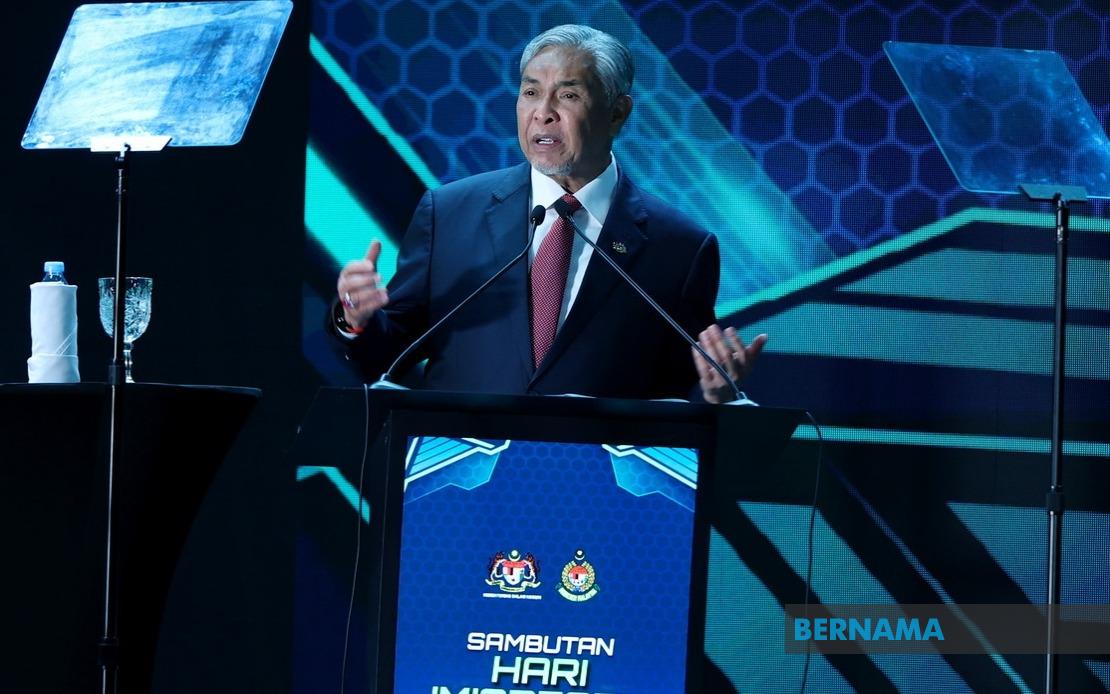
Barisan Nasional has formally committed to remaining within Malaysia's current Unity Government arrangement, with the coalition's chairman Datuk Seri Dr Ahmad Zahid Hamidi emphasising that this position reflects a binding resolution passed at UMNO's recent General Assembly. Speaking at an event marking the 2026 Immigration Day celebration in Cyberjaya on July 21, Ahmad Zahid, who simultaneously holds the portfolios of UMNO president and Deputy Prime Minister, underscored that the party recognises no authority above its General Assembly when it comes to major strategic decisions of this magnitude.
The reaffirmation carries particular significance given ongoing scrutiny of coalition dynamics and periodic speculation about the stability of the three-component Unity Government arrangement that has governed Malaysia since 2022. By invoking the General Assembly resolution, Ahmad Zahid sought to place the matter beyond debate within UMNO's ranks, signalling that party discipline demands adherence to what was decided through the party's highest deliberative body. This framing effectively converts an internal party decision into an institutional commitment that individual leaders cannot unilaterally reverse, thereby providing reassurance to coalition partners about BN's durability within the government.
The timing of this statement reflects heightened attention to coalition coherence, particularly as Malaysia approaches various electoral cycles and as the ruling coalition faces pressures from competing political interests across the country. The explicit invocation of General Assembly authority suggests that party leadership wished to preempt any potential fracturing or defections by emphasising that such decisions carry binding force across the entire membership. This approach reflects a calculated effort to stabilise internal party politics while simultaneously projecting confidence to external stakeholders about coalition stability.
In related remarks, Ahmad Zahid addressed the scope of Prime Minister Datuk Seri Anwar Ibrahim's authority over ministerial appointments and removals, characterising such powers as the absolute prerogative of the head of government. This statement emerged in the context of reported warnings issued by Anwar to government office-holders against using their official positions to publicly attack other components of the Unity Government during campaign activities in state elections. The Prime Minister's directive had reportedly threatened dismissal or compulsory resignation for any minister, deputy minister, or state agency official who contravened this instruction.
The distinction Ahmad Zahid drew—between the General Assembly's authority over BN's strategic coalition positioning and the Prime Minister's unfettered right to manage ministerial conduct—establishes separate spheres of decision-making authority. By accepting this delineation, the UMNO leadership implicitly endorsed the Prime Minister's ability to enforce discipline within the cabinet based on conduct that threatens coalition integrity. This represents an important clarification of how power operates within a multi-component coalition government, where different actors exercise authority over different domains.
Anwar's warning addressed a practical problem that emerges whenever coalition partners must campaign simultaneously in state-level elections: the temptation for government officials to prioritise their own party's electoral interests over maintaining the facade of unified governance. The admonition against public attacks on coalition partners during campaign periods reflects an effort to prevent the state election campaigns from becoming proxies for broader coalition conflicts that could destabilise the national government. Such tensions had historically complicated Malaysia's political landscape, making this effort at compartmentalisation a notable development in managing multi-party coalitions.
The Prime Minister's threat of removal for violations illustrates the potential consequences of coalition indiscipline, establishing clear deterrents for opportunistic behaviour. For ministers and deputy ministers seeking to balance their loyalty to their own parties with their obligations to the broader coalition, this creates a consequential trade-off: they cannot simultaneously campaign aggressively against coalition partners without facing personal political consequences. The clarity of these terms potentially reduces the ambiguity that might otherwise tempt officials to test the boundaries of acceptable conduct.
From the perspective of Malaysian political observers, Ahmad Zahid's statements serve multiple functions simultaneously. Domestically, they reassure BN's rank-and-file members that their party's leadership has committed the organisation to its current governing role, preventing speculative conversations about alternative arrangements. For other Unity Government components, the statements provide evidence of institutional commitment rather than merely personal preference by individual leaders. For the Prime Minister, the reaffirmation of Ahmad Zahid's position on coalition loyalty creates political space for him to enforce discipline across the broader cabinet without facing immediate resistance from BN's leadership.
The invocation of General Assembly decisions as binding also reflects how Malaysian political parties institutionalise commitments through democratic procedures. By explicitly tying current policy to decisions made through party assemblies, Ahmad Zahid invoked the democratic legitimacy of party structures to justify the coalition arrangement. This framing proves important in the Malaysian context, where party members retain considerable influence over leadership decisions, and where appeals to assembly authority carry weight with both members and the broader political community.
Looking forward, these statements suggest that BN's leadership has consciously chosen to anchor its coalition participation in enduring institutional commitments rather than leaving it contingent on shifting circumstances or leadership preferences. This choice has implications for coalition durability as Malaysia moves through upcoming electoral cycles, as it creates internal party constraints on any future leaders who might consider withdrawing from the government. The binding nature of General Assembly resolutions means that reversing the coalition commitment would require convening the assembly again and securing approval from party delegates, a considerably more complicated process than simple executive decision-making.
The episode also illustrates how coalition governments function through multiple layers of commitment—strategic decisions about coalition participation made at the party level, ministerial discipline enforced at the cabinet level, and individual accountability mechanisms applied at the personal level. These layered commitments create redundancy in the system, where coalition stability does not depend entirely on any single relationship or decision-maker but rather on institutions and procedures distributed across multiple levels. For Malaysia, where coalition governments have become increasingly common, developing such multi-layered commitment mechanisms represents an important evolution in democratic governance practices.

