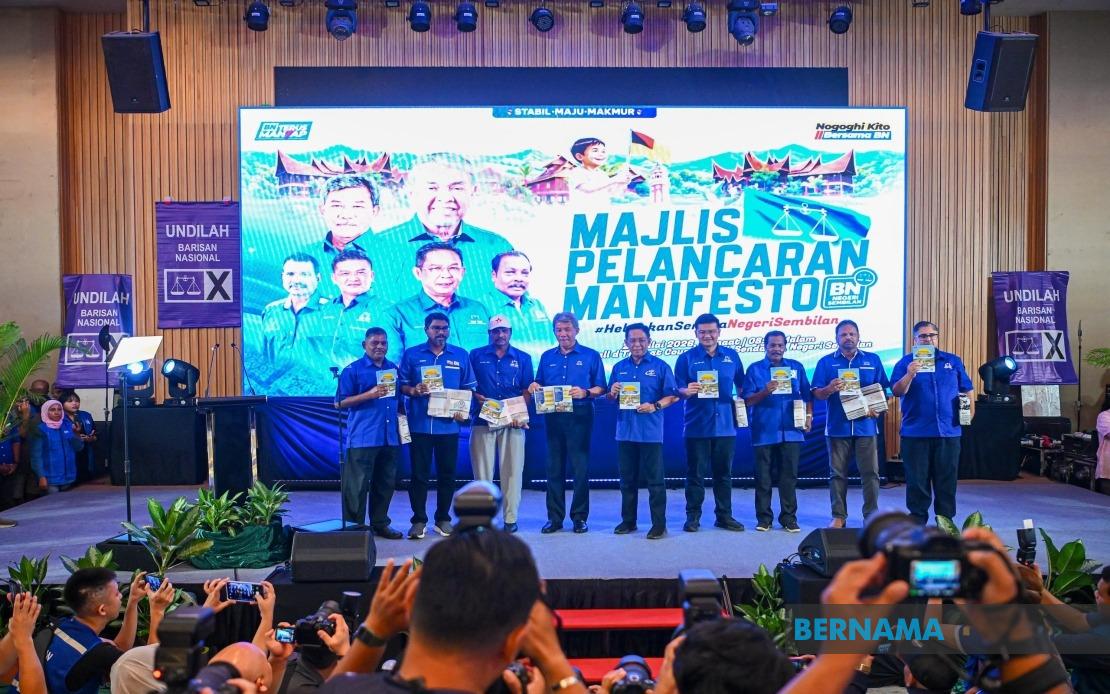
Barisan Nasional has unveiled a comprehensive nine-pillar manifesto for the 16th Negeri Sembilan State Election, signalling the coalition's strategic priorities as it seeks to retain control of the central Malaysian state. The manifesto was launched in Seremban on July 24, laying out an ambitious policy roadmap that coalition leaders argue addresses the diverse needs of Negeri Sembilan's electorate across multiple domains.
The economic dimension forms the foundation of BN's election pitch, with the first pillar dedicating itself to spurring economic growth and development. This emphasis reflects the coalition's belief that prosperity remains the principal concern of voters in a state whose economy depends heavily on manufacturing, agriculture, and commerce. The second pillar pivots toward social outcomes, aiming to elevate living standards, expand welfare provisions, and enhance overall well-being—an acknowledgement that while growth matters, its distribution and impact on ordinary households remains equally critical for electoral success.
Education and human development occupy central stage in the third pillar, encompassing initiatives for schooling quality, skills training, youth engagement, women's empowerment, and entrepreneurial opportunities. This addresses long-standing concerns about brain drain from smaller states and the need to equip younger Malaysians with competitive capabilities. The coalition's inclusion of gender equality and business creation signals responsiveness to demographic shifts and expectations among emerging constituencies in Negeri Sembilan.
Rural and agricultural interests receive dedicated attention through the fourth pillar, which targets strengthening farming sectors, agro-food industries, village infrastructure, and Felda schemes. For a state where considerable populations remain reliant on primary industries, this commitment may resonate particularly in constituencies beyond urban centres. The fifth pillar addresses residential development and housing, a perennial election issue across Malaysia where affordability and homeownership frustrate many families, especially first-time buyers and middle-income earners seeking stable accommodation.
Environmental sustainability and tourism development form the sixth pillar, reflecting broader Malaysian policy conversations about balancing growth with ecological responsibility and leveraging natural assets for revenue. The seventh pillar targets religious institutions, traditions, heritage preservation, and Orang Asli communities—constituencies that historically align with Barisan Nasional but whom the coalition recognizes require explicit policy attention to maintain support. Sports, recreation, and national cohesion constitute the eighth pillar, addressing quality of life and social bonding through non-partisan activities.
The ninth and final pillar emphasises government service delivery, a crucial consideration given voter frustration with bureaucratic inefficiency across Malaysian states. Better-run institutions and responsive administration can strengthen electoral performance and public confidence in BN governance. The breadth of these nine pillars suggests the coalition intends to present itself as a comprehensive steward of Negeri Sembilan's welfare rather than a single-issue operator.
A notable aspect of the manifesto launch was the diversity of leadership present, underscoring BN's multi-ethnic composition. Datuk Seri Jalaluddin Alias, who chairs the Negeri Sembilan UMNO Liaison Committee and directs the election campaign, anchored the event as the primary coordinator. Alongside him were Datuk Dr Mah Hang Soon, deputy president of the Malaysian Chinese Association, and Datuk M. Asojan, vice-president of the Malaysian Indian Congress, reflecting BN's traditional tripartite structure. The presence of BN candidates confirmed their readiness to contest across state constituencies.
Curiously, Datuk Seri Tuan Ibrahim Tuan Man, deputy chairman of Perikatan Nasional, also attended the event. His presence at a BN function underscores ongoing political fluidity in Malaysian state-level contests, where federal coalitions sometimes operate loosely or where individual politicians maintain cross-factional relationships. This attendance may signal either PN's support for certain BN candidates or simply the intersection of electoral interests across different political groupings in Negeri Sembilan.
Electoral arrangements have been finalized with early voting scheduled for July 28 and election day set for August 1. This compressed calendar reflects Malaysia's standard model for state elections, where voting occurs relatively quickly after nomination and campaign periods. The timing suggests the Election Commission determined conditions suitable for a mid-year poll, perhaps calculated to align with BN's perceived electoral strength or administrative convenience.
For Malaysian political observers, the Negeri Sembilan contest carries significance beyond state boundaries. As a historically BN-controlled territory, results will indicate whether the coalition retains its core support bases and whether newer opposition movements or dissidents have gained ground. The manifesto's emphasis on inclusive development, heritage protection, and service quality suggests BN strategists believe a defensive strategy combining traditional appeals with modernization messages offers the strongest pathway to victory.
The manifesto also reflects broader Malaysian political messaging, where state elections increasingly echo federal competition dynamics. Negeri Sembilan voters will evaluate BN's nine-pillar platform against competing visions from Pakatan Harapan, PN, and possibly independent candidates. How effectively each coalition translates these policy positions into ground-level campaign messaging will likely determine electoral outcomes on August 1, when voters determine the state's parliamentary direction for the coming years.

