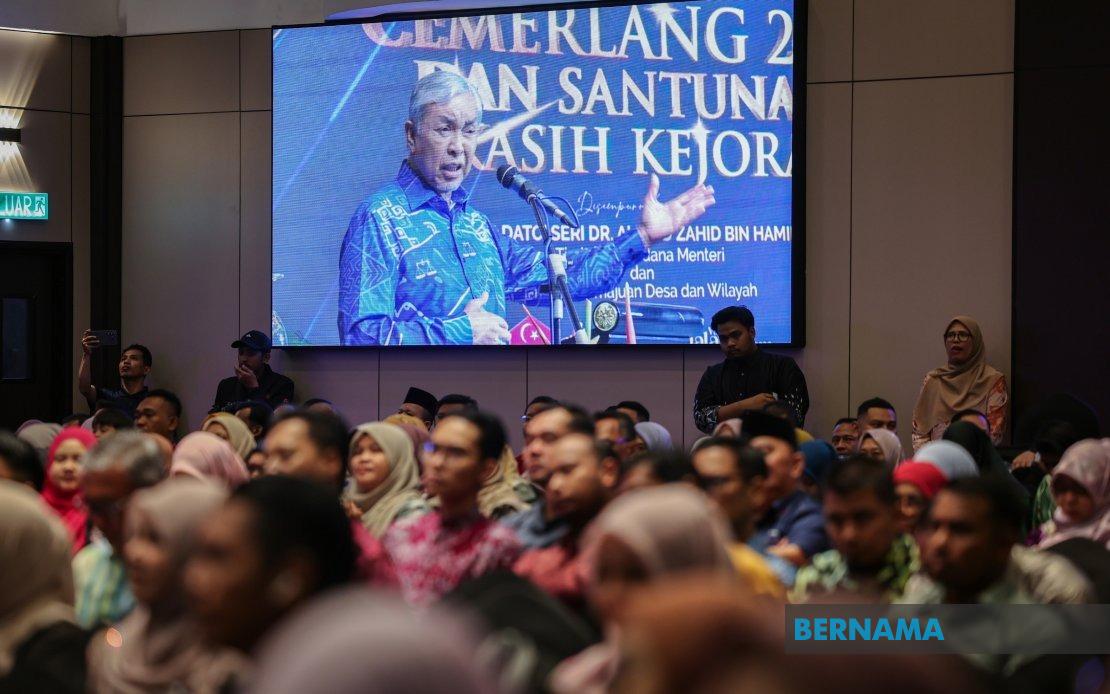
Datuk Seri Dr Ahmad Zahid Hamidi, the Barisan Nasional chairman, has dismissed characterisations of the coalition's campaign for the Johor state election as lacklustre, arguing instead that such assessments reflect political positioning rather than ground reality. Speaking at Kota Tinggi on July 2, Zahid maintained that BN's electoral machinery remains fully mobilised and active across the state, and he framed external criticism as a natural feature of competitive politics that does not concern the coalition.
The Deputy Prime Minister's remarks come as Johor prepares for one of the year's most closely watched state elections, scheduled for July 11, with early voting set for July 7. BN is contesting all 56 state seats, seeking to reinforce its governance of a state that has historically formed the coalition's southern anchor. Zahid's defensive posture underscores underlying anxieties within BN's leadership about campaign perception, even as the coalition projects confidence in victory.
Zahid framed opposing viewpoints as the prerogative of rival coalitions, noting that Pakatan Harapan and other political formations are entitled to their own assessments of BN's campaign effectiveness. This measured response reflects BN's broader strategy of avoiding direct confrontation with other coalitions, a posture shaped by the complexities of the Unity Government at the federal level. Rather than engaging in rhetorical warfare, Zahid emphasised that BN's focus remains squarely on mobilising its candidates and supporters.
A persistent challenge for BN in this election centres on voter confusion allegedly arising from federal-level cooperation between BN and Pakatan Harapan within the Unity Government. Critics have suggested that this partnership might alienate traditional BN supporters in Johor, particularly those accustomed to viewing PH as ideological opponents. Zahid directly addressed this concern, asserting that no confusion exists because Johor's state government was established before the federal Unity Government was formed, creating a distinct governance dynamic.
Zahid's explanation highlights a nuance that often escapes public discussion: Johor under Menteri Besar Datuk Onn Hafiz Ghazi operates as a BN-led administration that existed independently of federal power-sharing arrangements. This historical sequencing, Zahid argued, means that cooperation between state and federal governments—even when the latter involves multiple coalitions—remains professional and unproblematic. The argument essentially positions Johor's governance as continuous and unaffected by shifts in Putrajaya's political constellation.
Economic performance forms a cornerstone of BN's re-election pitch. Zahid highlighted that the Johor government recorded revenue of RM2.26 billion in the preceding year, the highest figure among Peninsular Malaysian states. This achievement, presented as evidence of Onn Hafiz's administrative competence, anchors BN's campaign narrative around delivering tangible development. The coalition is banking on the proposition that voters reward effective governance with extended mandates, and Zahid has explicitly stated that securing a stronger electoral result would empower the state government to pursue its five-year development agenda.
The political landscape in Johor is notably fragmented this election cycle. Beyond BN and Pakatan Harapan fielding 56 candidates each, Perikatan Nasional contests 33 seats, Bersama fields 15 candidates, and smaller formations including MUDA, Parti Orang Asli Malaysia, Parti Sosialis Malaysia, and six independents complete the ballot. This splintering creates an environment where vote distribution becomes less predictable, potentially benefiting a well-organised coalition like BN that can consolidate support efficiently.
Comments from PAS president Tan Sri Abdul Hadi Awang calling for voters to reject Pakatan Harapan outright—even in contests where BN opposes PH—complicate BN's positioning. Rather than reciprocating Hadi's inflammatory rhetoric, Zahid adopted a measured tone, describing BN's approach as professional while declining to comment extensively on PAS strategy. This restraint reflects BN's calculation that it benefits more from appearing statesmanlike than from escalating partisan hostilities.
Zahid's invocation of the ballot box as the ultimate arbiter carries particular weight in Malaysian electoral politics, where results often validate or invalidate pre-election commentary with decisive clarity. By suggesting that July 11 will provide conclusive answers to campaign vigour assessments, Zahid implicitly acknowledged that BN's claims would face empirical testing. This framing places the onus on voters to demonstrate through their choices whether BN's self-assessment or external criticisms prove accurate.
For Malaysian political observers and Southeast Asian analysts monitoring BN's fortunes, the Johor election represents a significant test of the coalition's ability to maintain state-level dominance amid shifting federal dynamics. BN's performance will signal whether the Unity Government arrangement at the national level has eroded its traditional support base or whether state-level governance and economic delivery can transcend federal-level political complications. The coalition's confidence in victory, demonstrated through Zahid's robust defence of campaign operations, will face its sternest examination when ballots are counted and seats are allocated.
The outcome also carries implications for Malaysia's broader political trajectory. A commanding BN victory in Johor would reinforce the viability of the current federal coalition arrangements, suggesting that voters can compartmentalise state and national politics. Conversely, a weakened BN performance might signal that traditional voters find the federal partnership arrangements genuinely confusing or unappealing, prompting recalibration of political strategies across multiple coalitions heading into the next general election.

