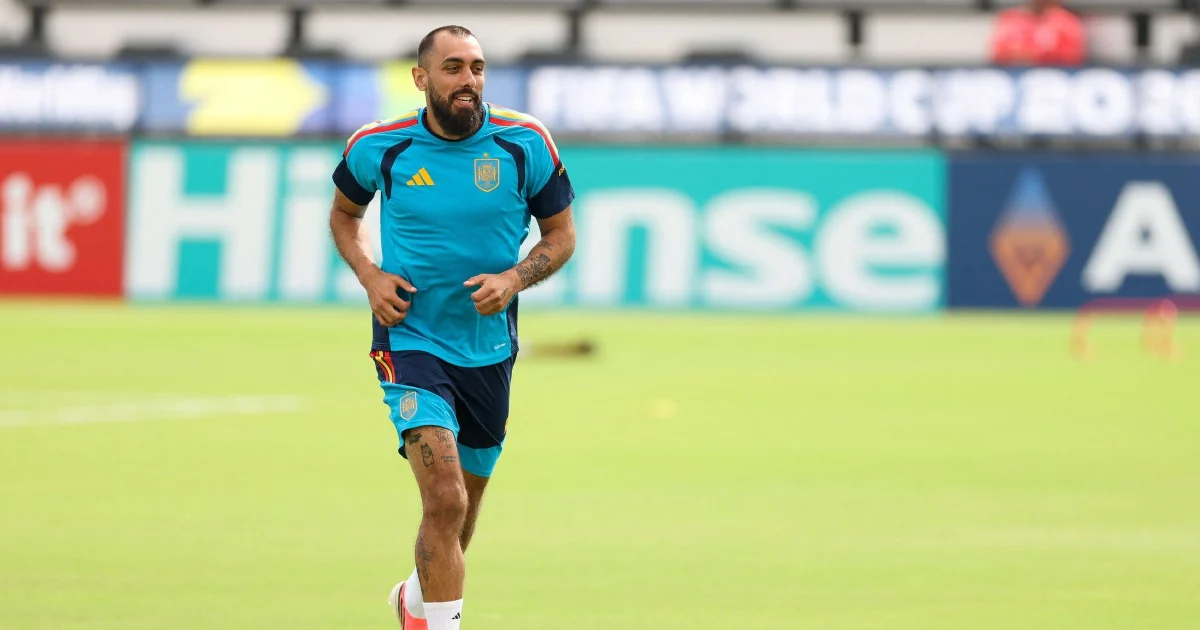
Borja Iglesias has carved out an unusual identity within professional football by refusing to confine himself to the standard athlete's script of post-match platitudes and sponsorship obligations. The Spanish striker, who represented his nation at the World Cup, has made a deliberate choice to engage with pressing social and political questions—from the humanitarian crisis in Gaza to systemic homophobia within sport—in ways that have prompted both admiration and bewilderment from observers accustomed to footballers' carefully managed silence on such matters. His willingness to articulate substantive positions on injustice, coupled with personal style choices like painted nails that defy traditional masculinity norms in sport, has positioned him as something of an outsider within the football establishment, earning him the somewhat dismissive epithet of "the alien of football."
The labelling reflects a broader tension that persists in professional sports: the expectation that athletes should remain politically neutral and focused solely on their sporting pursuits, versus the growing recognition that prominent figures possess both the platform and arguably the moral responsibility to address significant global issues. Iglesias appears to have resolved this tension entirely on the side of conscience, understanding that silence in the face of injustice constitutes its own form of statement. His approach challenges the notion that footballers should be confined to their pitch, content to be vessels for entertainment while refusing engagement with the world beyond the touchline.
For Malaysian sports fans and the broader Southeast Asian audience, Iglesias represents a model of athlete activism that contrasts sharply with the predominantly apolitical stance of most professional players in the region. While Southeast Asian footballers have occasionally ventured into social commentary, few have demonstrated the sustained commitment to speaking out on international issues that characterises Iglesias's career. His willingness to address Gaza—a topic that carries significant emotional weight across much of the Muslim-majority region—while simultaneously confronting homophobia demonstrates an intersectional approach to social justice that extends beyond single-issue advocacy.
The implications of Iglesias's visibility extend to questions about power dynamics within professional football. Established stars often face consequences for political speech, whether through sponsorship losses, team management pressure, or media criticism. Yet Iglesias's continued prominence in Spanish football, despite his outspokenness, suggests that accumulating enough on-pitch credibility creates space for athletes to express views that organisations might otherwise suppress. This dynamic matters particularly in Southeast Asia, where political sensitivities can restrict public discourse, and where young athletes may look to international figures for models of acceptable dissent.
His personal presentation choices—the painted nails—carry symbolic weight within a sport that has been historically resistant to challenging heteronormative masculine expression. Across Southeast Asia, where LGBTQ+ rights remain contested in many jurisdictions, seeing a high-profile international footballer embrace such visible markers of gender non-conformity normalises the concept that athletic excellence and traditional masculinity need not be inextricably linked. This representation matters for young footballers in the region navigating their own identities within deeply conservative sporting cultures.
The phenomenon of Iglesias being characterised as unusual for expressing opinions on justice issues illuminates the constructed nature of athlete neutrality. Professional sports organisations have invested enormous effort in depoliticising athletes, treating their pronouncements on social matters as departures from proper form rather than legitimate expressions of human consciousness. Iglesias's refusal to accept this artificial constraint represents not a transgression but a reclamation of basic personhood—the right to possess and articulate values beyond one's sporting function.
Within the Spanish national team context, Iglesias operates within a football culture that has itself grappled with questions of social responsibility, particularly following the controversial 2010 World Cup-winning squad's political dimensions. Spanish football has produced athletes willing to engage with social questions, yet Iglesias distinguishes himself through the breadth and international scope of his concerns. His focus on Gaza reaches beyond European parochialism, demonstrating awareness of and engagement with suffering that occupies no particular national claim on his attention—a consciousness that transcends the typical footballer's limited sphere of concern.
The resistance Iglesias encounters for his openness reflects institutional discomfort with athlete autonomy. When footballers restrict themselves to approved narratives about hard work, team spirit, and personal improvement, they pose no threat to the commercial and political interests that benefit from sport's carefully managed neutrality. An athlete who insists on discussing injustice introduces unpredictability into a system designed for predictability, making him genuinely threatening to stakeholders invested in maintaining sport as an escape from the complications of actual human life.
For Malaysian readers, Iglesias's example raises questions about the role athletes should play in society and whether the silence of prominent regional footballers on matters of justice represents a genuine lack of concern or rather a rational calculation about the costs of speaking out. The contrast between international athletes who engage substantively with social issues and the relative quietism of Southeast Asian sports figures suggests structural factors—including political context, sponsorship dependencies, and cultural norms—that constrain athlete expression in the region beyond simple personal choice.
Ultimately, Iglesias's reputation as football's conscience and his construction as an outsider for articulating values beyond the sport itself represents a failure of the broader sporting industry to accommodate basic human decency within its framework. His willingness to paint his nails and discuss Gaza should be unremarkable; that it remains noteworthy demonstrates how thoroughly professional football has sought to colonise athlete identity, permitting expression only within severely circumscribed bounds. In that context, being called "the alien of football" becomes not an insult but a description of resistance—an athlete who remembers that he is human before he is a footballer.

