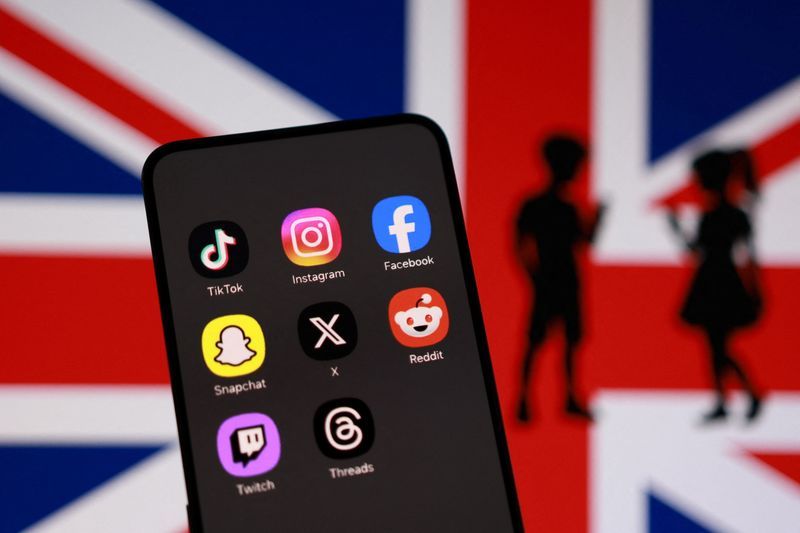
Britain's government has announced plans to impose mandatory overnight restrictions on social media use for teenagers aged 16 and 17, marking the latest step in its push to protect younger users from the perceived harms of digital platforms. Under the new safeguarding regime, young people in this age group will be unable to access social media applications between midnight and 6 a.m. without actively changing default settings, a shift that underscores growing concerns across democracies about the mental and physical wellbeing of young people in the digital age.
The announcement comes just one month after the government unveiled an even more sweeping proposal to ban social media entirely for users under 16. Together, these measures represent one of the world's most comprehensive approaches to restricting teenage access to platforms, positioning Britain alongside Australia in seeking to enforce age-based digital boundaries at the legislative level. Technology minister Liz Kendall framed the curfew initiative as addressing fundamental challenges facing young people, arguing that the restrictions would enable better sleep patterns, improved academic focus, and stronger family relationships by creating protected offline hours during critical late-night periods.
The mechanism of the proposed curfew relies on reversing the current default approach taken by social media companies. Instead of allowing unrestricted access unless users enable parental controls, platforms would need to lock out teenage users automatically during overnight hours. Additionally, algorithmic features designed to encourage prolonged engagement—such as infinite scroll functionality and autoplay capabilities—would be disabled by default, fundamentally altering how these platforms operate for this demographic. Online safety minister Kanishka Narayan stated unequivocally that technology companies would face legal obligations to implement these changes, emphasizing that regulatory authorities would pursue severe penalties against firms that fail to comply or neglect proper age verification procedures.
The British approach introduces a critical middle ground between permissive access and total prohibition, a distinction that carries implications for how other nations might structure their own digital safeguarding policies. Rather than banning platforms outright, the government seeks to modify usage patterns through default settings, placing responsibility on companies rather than users to enforce restrictions. This strategy acknowledges that many teenagers already use social media and that abrupt removal of access might prove politically untenable, while still addressing documented concerns about sleep disruption and excessive screen time during developmental years.
Implementation of these regulations faces significant practical hurdles, particularly regarding age verification. Australian authorities tasked with monitoring the world's first comprehensive social media ban for minors discovered that major platforms struggled fundamentally with the initial step of verifying users' actual ages. This finding suggests that even with legal mandates in place, technology companies may lack effective mechanisms to distinguish between different age groups, potentially rendering restrictions porous and ineffective. For Malaysia and other Southeast Asian nations considering similar policies, this implementation gap represents a cautionary lesson about the gap between legislative intent and technical capability.
The regulatory timeline the government has established appears deliberately measured. Specific regulations will be presented to parliament by the end of 2024, with enforcement expected to commence in spring 2027. This extended implementation window provides technology companies time to develop compliant systems but also allows political circumstances to shift and stakeholder positions to evolve. The staged approach reflects recognition that overhauling the fundamental architecture of global social media platforms cannot occur instantaneously and that proper consultation with industry, child welfare advocates, and privacy specialists requires sustained engagement.
Major technology firms have thus far declined to comment publicly on the proposals. Meta, which operates Instagram and Facebook; ByteDance, parent company of TikTok; and Google, owner of YouTube, have remained notably silent following the announcement. Their reticence likely reflects calculation about how to respond to what are simultaneously legislative proposals with unclear certainty of passage and regulatory interventions that could substantially affect their business models and global operations. These companies have considerable experience opposing age restrictions in other jurisdictions, and their eventual response will significantly influence how successfully Britain implements its agenda.
Political opposition has emerged swiftly from the Conservative Party, with education policy spokesperson Laura Trott arguing that the measures represent incoherent policy. She contends that allowing teenagers to easily disable the curfew undermines the entire exercise, presenting the choice between prohibition and permissiveness as binary, with halfway measures unlikely to achieve meaningful behavioral change. This critique highlights a genuine tension in the government's approach—whether restrictions that users can immediately circumvent genuinely serve safeguarding objectives or merely create an illusion of protection.
The UK initiative must be understood within a broader international context of escalating regulatory pressure on social media platforms. Recent litigation in the United States, which has resulted in substantial settlements from Google and TikTok to a minor plaintiff claiming mental health damages, demonstrates that legal accountability for platform harms is extending beyond age restrictions into liability frameworks. These parallel developments suggest that platforms face converging pressures from multiple jurisdictions, each seeking to define the terms under which teenagers can access digital services.
For Malaysia specifically, the British approach offers a potential template for future regulation, though Southeast Asian implementation would need to account for different technological infrastructure, varying levels of digital literacy among enforcement agencies, and distinct cultural contexts surrounding family authority and parental control. The experiments currently underway in Britain and Australia will provide valuable empirical evidence about whether default setting modifications and curfews actually achieve their stated objectives of protecting adolescent wellbeing or whether they represent largely symbolic gestures that savvy young people readily circumvent.
The success or failure of these British measures will likely reverberate through global policy discussions for years. If the regulations prove effective at reducing late-night social media use and demonstrable improvements in teenage sleep and mental health outcomes emerge, other democracies will likely pursue similar mechanisms. Conversely, if implementation proves technically impossible or young people routinely bypass the controls, the failure could discredit regulatory approaches to social media more broadly and embolden industry arguments that legislation cannot effectively manage platform use among determined audiences.

