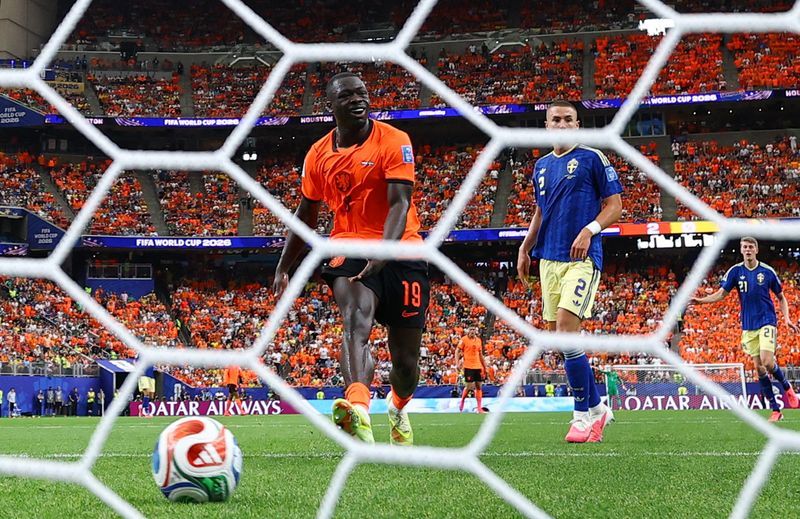
Ronald Koeman's gamble on selecting Brian Brobbey as the spearhead of the Netherlands' attack has paid spectacular dividends, with the 24-year-old's brace in a commanding 5-1 victory over Sweden on Saturday reshaping perceptions about the country's forward options at the World Cup. The decision represents a dramatic vindication for the Dutch coach, who had faced considerable criticism just days earlier for his tactical adjustments during a disappointing 2-2 draw with Japan in Dallas that marked the beginning of the Group F campaign. Where Koeman's substitutions in that opening fixture failed to generate the desired momentum, his selection of Brobbey against the Swedes proved inspired, establishing an entirely different dynamic in the Dutch attacking line.
The stakes surrounding this tournament have made the forward position a matter of considerable strategic importance for the Netherlands. Memphis Depay has long served as the national team's primary attacking fulcrum, but the experienced striker carries considerable mileage in his career and has been dealing with injury complications that have limited his match sharpness. Koeman has recognized for some time that nurturing a successor capable of shouldering this responsibility represented an essential component of long-term squad planning. Brobbey's pathway back into contention had been circuitous—he was overlooked during the 2026 World Cup qualifiers and spent roughly a year operating outside the national team setup before his March recall marked a turning point in his international trajectory.
What makes Brobbey's emergence particularly significant is the trajectory of his club career. His season at Sunderland in the English Premier League appears to have functioned as a genuine developmental leap, transforming him from a fringe international prospect into a more rounded attacking threat. The physical demands and tactical sophistication of the English top flight have evidently refined his overall game, moving him beyond the one-dimensional profile that characterized his earlier career assessments. Speaking at the Dutch training facility earlier in June, Brobbey articulated the nature of this evolution with clarity, emphasizing that his development extended well beyond simple physical battles with opposition defenders. His improved capacity for timing runs from deeper positions, constructing passing angles through intelligent movement, and creating space through positional awareness all suggest a striker who has genuinely matured in his understanding of modern attacking play.
The first 17 minutes of Saturday's encounter against Sweden underscored precisely how much Brobbey's development has progressed. Two clinical finishes established an attacking dominance that the Netherlands would never relinquish, setting the tone for a performance that ultimately yielded five goals and propelled the Dutch to the top of their group. This swift strike rate carries particular significance because it demonstrates the finishing precision that top-level football demands—the capacity to convert the limited chances that even the best teams receive during matches. Depay, by contrast, has shown occasional rustiness following his fitness setbacks, which creates an opening for a forward hitting peak physical condition to claim primary responsibility for leading the line.
The supporting cast surrounding Brobbey provides additional context for understanding how his qualities might be maximized within this Dutch system. The Netherlands possess a collection of creative talents capable of manufacturing opportunities for a well-positioned striker. Cody Gakpo has established himself as a potent force on the left flank, while the attacking thrust from fullback Denzel Dumfries on the right provides an additional dimension of width. The emergence of Crysencio Summerville as another creative option in attacking positions enhances the overall tactical flexibility. These supporting elements matter enormously when evaluating whether Brobbey possesses not merely the individual capability but also the contextual fit to operate effectively as the Netherlands' primary forward.
Koeman's managerial credibility, while tested by the Japan performance, now benefits considerably from the emphatic Swedish victory. The football environment operates within a peculiar dynamic where tactical judgements are often vindicated or condemned based on immediate outcomes rather than underlying logic. A manager perceived as making poor decisions can transition to being viewed as a mastermind within the span of a single match, and Brobbey's performance has tilted narratives decisively in Koeman's favor. This psychological dimension matters in terms of squad morale and confidence, elements that become increasingly important as international tournaments progress and teams face elimination scenarios.
The broader implications for the Dutch national team extend beyond merely identifying a successor to Depay. Finding a striker capable of operating at world-class level requires identifying players possessing not only technical proficiency but also the mentality to perform under the enormous pressure that international football at tournament stage entails. Brobbey's willingness to embrace an opportunity that had seemed to be slipping away, combined with his demonstrated capacity to deliver when selected, suggests a player with the psychological resilience necessary for sustained international performance. The Netherlands cannot afford to develop another striker prospect tentatively—they need someone capable of making an immediate impact while also providing consistent production across multiple tournament matches.
The competitive advantage that early confidence in a tournament can provide should not be underestimated. Nations that establish their tactical templates and settle their personnel early tend to build momentum more effectively than teams still experimenting with formations as the tournament deepens. By identifying Brobbey as his lead attacker and receiving such emphatic validation on Saturday, Koeman has potentially provided his squad with psychological anchoring that extends beyond football into the realm of collective confidence. The players surrounding him now understand their roles in service of Brobbey's positioning and strengths, enabling smoother transition into future matches without the tactical uncertainty that characterized the Japan performance.

