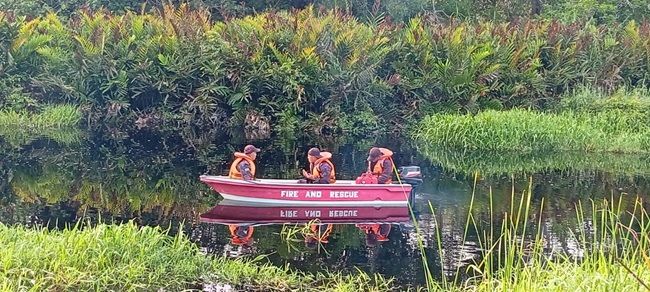
Rescue operations in Brunei have entered their third consecutive day in the hunt for a man believed to have been fatally attacked by a crocodile while fishing in Kampong Baru Sungai Bera, as multiple government agencies struggle to locate any trace of the victim. The coordinated effort represents one of the region's most intensive responses to a suspected wildlife incident, highlighting both the seriousness of crocodile threats in Southeast Asian waterways and the urgency with which authorities treat such cases.
The Fire and Rescue Department received an emergency call on Wednesday, June 24, reporting that a male victim had been attacked near the river in what family members believed was a crocodile encounter. Two fire engines carrying nine personnel, led by Acting Station Officer Mohd Zulkifli Md Tahir, were dispatched immediately to the scene. Initial interviews with the victim's family at the location provided the foundation for understanding what had occurred—a fishing expedition that turned tragic when the man came into contact with the apex predator inhabiting these waters.
What began as a single-agency response has since evolved into a multi-departmental search coordinated by the Operations Branch of the Fire and Rescue Department. Senior Superintendent Amirul Hadi Junaidi, the Commanding Officer of this branch, now oversees all aspects of the operation, delegating resources and strategic decisions across various teams. The structure reflects the complexity involved in locating a person in a sprawling river system where currents, vegetation, and the behaviour of large predators complicate recovery efforts substantially.
The search methodology deployed reflects modern rescue capabilities combined with traditional waterway expertise. Fire and Rescue Department boats conduct continuous patrols along the Sungai Bera, maintaining vigilance for any signs of the victim or evidence related to the incident. Simultaneously, teams systematically search the riverbanks on foot, examining shorelines and accessible areas where the victim might have been displaced or where remains might have washed ashore. This ground-level approach complements aerial surveillance, with the department's drones providing overhead coverage of broader sections of river that would be impractical to patrol manually.
The Royal Brunei Police Force has mobilized significant resources to support the Fire and Rescue Department, recognizing this as a matter of both public safety and criminal investigation potential. Officers from Seria Police Station and the specialized Royal Brunei Police Force Marine Police unit, known as POLMAR, have joined the effort. POLMAR's expertise in waterborne operations proves particularly valuable in this context, as officers trained in marine rescue and recovery bring specialized knowledge of river navigation and victim recovery techniques. Their presence underscores how seriously law enforcement treats incidents involving potential loss of life.
The Wildlife Division's involvement adds another critical dimension to the operation. These specialists understand crocodile behaviour and river ecology, providing intelligence about where the animal might be positioned, its movement patterns, and the likelihood of locating remains given prevailing river conditions. They also assess risks to rescue personnel, as continuing to search in a crocodile-infested river presents dangers to the teams themselves. This balancing act between recovery efforts and personnel safety represents a constant tension in such operations.
Crocodile attacks in Southeast Asian rivers remain rare but devastating incidents that capture public attention whenever they occur. The Sungai Bera has historically been known to harbour saltwater crocodiles, a species capable of growing to substantial sizes and possessing the predatory instincts and strength to prey on humans. Fishing in such waters carries inherent risks that local residents understand, yet economic necessity and cultural tradition often compel people to continue using the river despite potential dangers. This incident serves as a sobering reminder of the hazards present in the region's waterways.
For Malaysia and broader Southeast Asia, the incident carries relevance beyond Brunei's borders. Crocodile populations exist across the region's river systems, from Sarawak to Peninsular Malaysia, and incidents involving attacks have occurred sporadically throughout recorded history. The response mounted by Brunei's authorities provides a case study in how well-resourced nations approach such crises—with coordination between emergency services, specialized units, and wildlife expertise. Smaller communities or less-developed areas might lack such comprehensive response capabilities, leaving victims with fewer options for rescue and recovery.
The psychological impact on the victim's family and the broader Kampong Baru Sungai Bera community cannot be underestimated. The absence of a body or definitive closure extends the trauma, leaving relatives in a state of suspended uncertainty. This prolonged anguish is not uncommon in water-based incidents where bodies may never be recovered, especially when predation or decomposition removes all traces. The community's trust in waterway safety may also suffer lasting damage, potentially affecting livelihoods dependent on fishing.
Looking forward, this incident will likely prompt discussions about public awareness campaigns regarding crocodile safety, particularly targeting fishing communities who regularly encounter such risks. Education about appropriate safety measures—from avoiding dusk and dawn hours when crocodiles hunt actively, to maintaining distance from riverbanks, to employing spotters—could reduce future incidents. Whether Brunei authorities will implement such preventive measures following this tragedy remains to be seen, but the incident has certainly focused attention on the intersection of human activity and wildlife habitat in densely populated river regions.
The ongoing search demonstrates the commitment of Brunei's emergency services to pursuing recovery operations exhaustively, even when prospects diminish with each passing hour. Third-day searches typically yield fewer discoveries than initial efforts, yet authorities persist, driven by responsibility to the victim's family and the principle that no citizen should be abandoned to the waters without maximum effort expended. This operation will conclude once weather conditions, resource constraints, or decision-making leadership determine that further efforts are unlikely to succeed.

