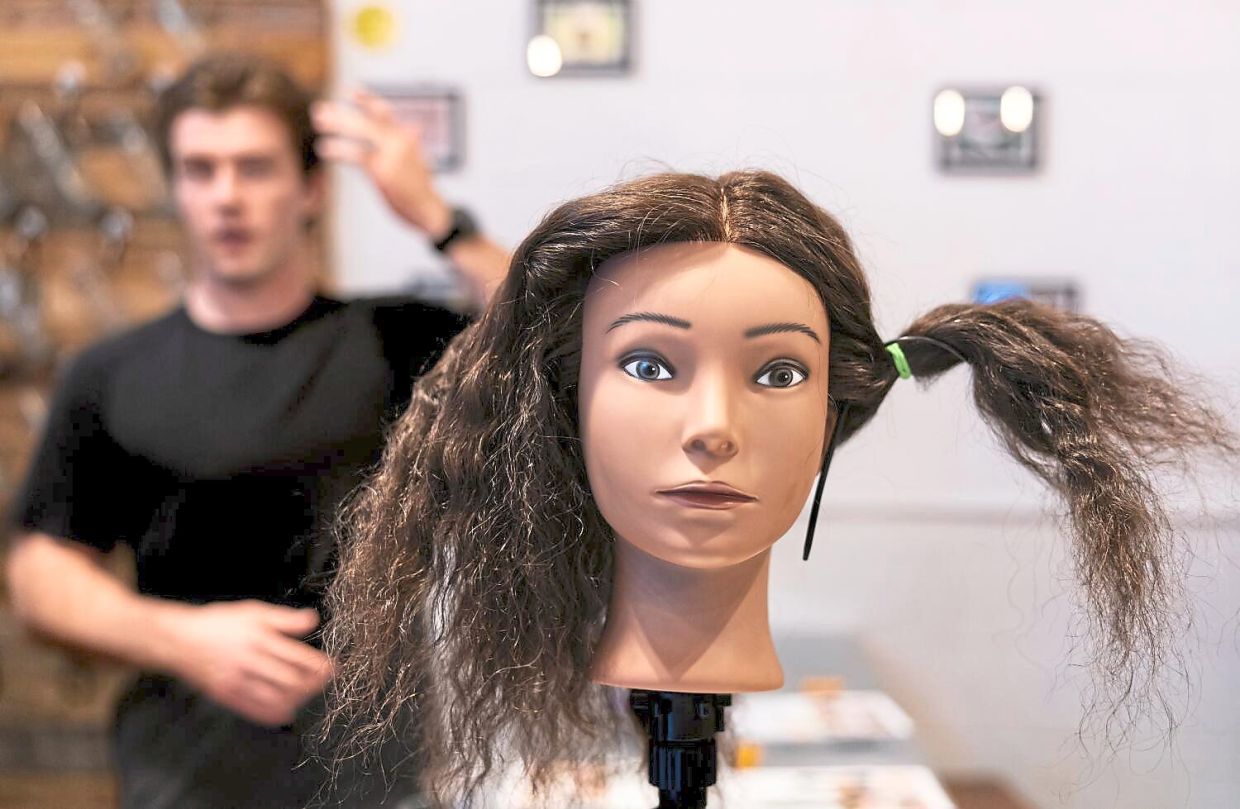
Austin Nieves arrived in Santa Barbara with a mission that went beyond settling into a new home. The recent transplant had discovered something profound through his own experience of fatherhood: men raising children were starved for the kind of organised community support that mothers took for granted. By late May 2025, Nieves had gathered 15 fathers at Captain Fatty's Brewery for an unconventional evening that would challenge their comfort zones and, ultimately, forge unexpected bonds among them.
The event drew inspiration from a viral British trend called "Pints and Ponytails," a deceptively simple concept that proved transformative. Professional hairstylists guided the assembled fathers—ranging from their early 30s to 60—through the fundamentals of combing and braiding hair using salon mannequin heads as practice tools. What began with visible tension melted away after the first round of drinks, as the men transitioned from the edges of the bar to enthusiastically attempting techniques they'd previously found intimidating. For many, learning to braid their children's hair represented far more than a practical skill; it symbolised permission to embrace a more hands-on, nurturing approach to fatherhood.
Nieves founded the Santa Barbara Dads group after moving to the area in April 2025, building on success he'd already achieved with an earlier venture. When his son Hudson was born three years ago, Nieves confronted an uncomfortable reality that many fathers experience but rarely articulate. His wife, Katie, immediately accessed a robust ecosystem of support—multiple mothers' groups, classes offering advice, training and friendship. As a first-time father navigating the same transition, Nieves found himself largely dependent on his brothers, who happened to have children of their own. The asymmetry struck him forcefully. Conversations with his unchanged friend group felt increasingly surreal; while they discussed entertainment and leisure activities, Nieves was marvelling at his infant's ability to lift his head. That profound disconnection prompted him to act.
Scientific evidence validates what Nieves intuited from personal experience. Research published in 2006 in the Journal of Family Issues by Chris Knoester and David J. Eggebeen documented that fatherhood paradoxically leads to declines in wellbeing and social participation as men spend progressively less time with friends. Clinical psychologists Hillary Halpern and Maureen Perry-Jenkins have mapped the emotional turbulence accompanying the transition from single adulthood to fatherhood, revealing a landscape far more complicated than popular culture suggests. More recently, researchers at Stockholm's Karolinska Institute conducted a 2021 study concluding that fathers specifically benefit from structured support during their early years of active parenting. The study found that men participating in dedicated father groups reported high satisfaction rates and observed tangible improvements across multiple dimensions of their lives—enhanced confidence in their parenting role, stronger partnerships with their partners, deeper connections with their children, and measurably reduced isolation.
Nieves transformed this research-validated insight into action. In October 2023, while still living in Costa Mesa, he established the Orange County Dads club. The group embraced an intentionally inclusive social model, hosting coffee meetups and zoo visits, organising communal jam sessions during holidays, and even offering CPR training—practical skills that addressed the broader anxiety many new fathers feel about their capacity to protect their children. Though the club maintained its exclusively male membership, Nieves recognised that much of the group's growth came through wives and partners sharing his social media announcements with husbands who might otherwise have felt too self-conscious to join.
Mikhail Alfon, founder of Blue Light Media, a social media strategy company, discovered the group through these organic sharing patterns and attended multiple meetings with his son Santos. In a social media reflection, Alfon articulated what many fathers in similar circumstances experience: the recognition that life fundamentally transforms upon a child's arrival, and that finding peers at the same life stage provides invaluable perspective. For Alfon, the group offered something his professional networks and family connections could not—other men actively engaged in the messy, joyful reality of early parenting.
When Nieves relocated his family to Santa Barbara in April 2025, he faced an immediate choice: permit the connections he'd built to dissolve through geographic distance, or replicate the model in his new community. Within a month, he had established the Santa Barbara iteration of his fathers' group. The first gathering occurred in May 2025, and the group committed to monthly meetups, deliberately structuring regular occasions for fathers to connect. This disciplined approach to community building acknowledges that fathers, juggling professional responsibilities, partnership demands, and parental obligations, require intentional structures to maintain friendships and seek support. Without scheduled gatherings, the isolation that research identifies as inherent to active fatherhood quietly deepens.
Austin Jones, a Santa Barbara real estate agent and investor, discovered Nieves through Instagram and recognised an immediate kinship. Jones articulated a tension many successful men never publicly acknowledge: the accumulation of roles—husband, father, businessman—can paradoxically increase rather than decrease feelings of loneliness. Each domain demands competence and creates pressure; few spaces exist where a man can acknowledge genuine struggle across all three simultaneously. Jones attended the Pints and Ponytails event partly because it addressed a specific practical challenge: his two-and-a-half-year-old daughter Noa possessed textured, curly hair that demanded techniques beyond his existing knowledge. More fundamentally, however, Jones was drawn to a space where admitting such gaps in knowledge felt normal rather than shameful.
By the evening's conclusion, Jones had developed sufficient confidence in his ponytail-braiding technique that he committed to attempting the style on his daughter in the coming days. His self-deprecating observation—that previously his limit had been fastening a headband—masked a deeper truth. Through the group's structured activity, Jones had crossed an invisible threshold from spectator to participant in the daily rituals of his daughter's care. The brewery setting, the casual drinking, the male camaraderie, and the practical instruction combined to make hair care feel achievable rather than intimidating, masculine rather than foreign.
The success of father-focused groups like those Nieves has pioneered suggests a broader shift in how contemporary men approach parenting. The traditional model wherein mothers cultivated networks and expertise while fathers maintained emotional distance has begun cracking. Yet the infrastructure supporting this transition remains underdeveloped. Mothers' groups are ubiquitous, institutionalised, and celebrated; fathers' groups remain novel enough to require social media-driven awareness building. As more men demand access to community, advice, and practical training, the gap Nieves identified—and addressed—will likely expand into something more substantial and permanent. For fathers navigating the legitimate challenges of active parenting, these groups offer something beyond camaraderie: they provide cultural permission to be the involved, present, and sometimes uncertain parent that contemporary fatherhood increasingly demands.
The Pints and Ponytails event, sold out and enthusiastically received, represented a single evening, yet it exemplified something essential about why these communities matter. Fathers gathered to learn a skill, certainly, but more significantly, they gathered to learn that their uncertainty was shared, their desire to excel at parenting was reasonable, and their need for support was legitimate. In a brewery in Santa Barbara County, fifteen men discovered that the path to better fatherhood ran through community rather than isolation.

