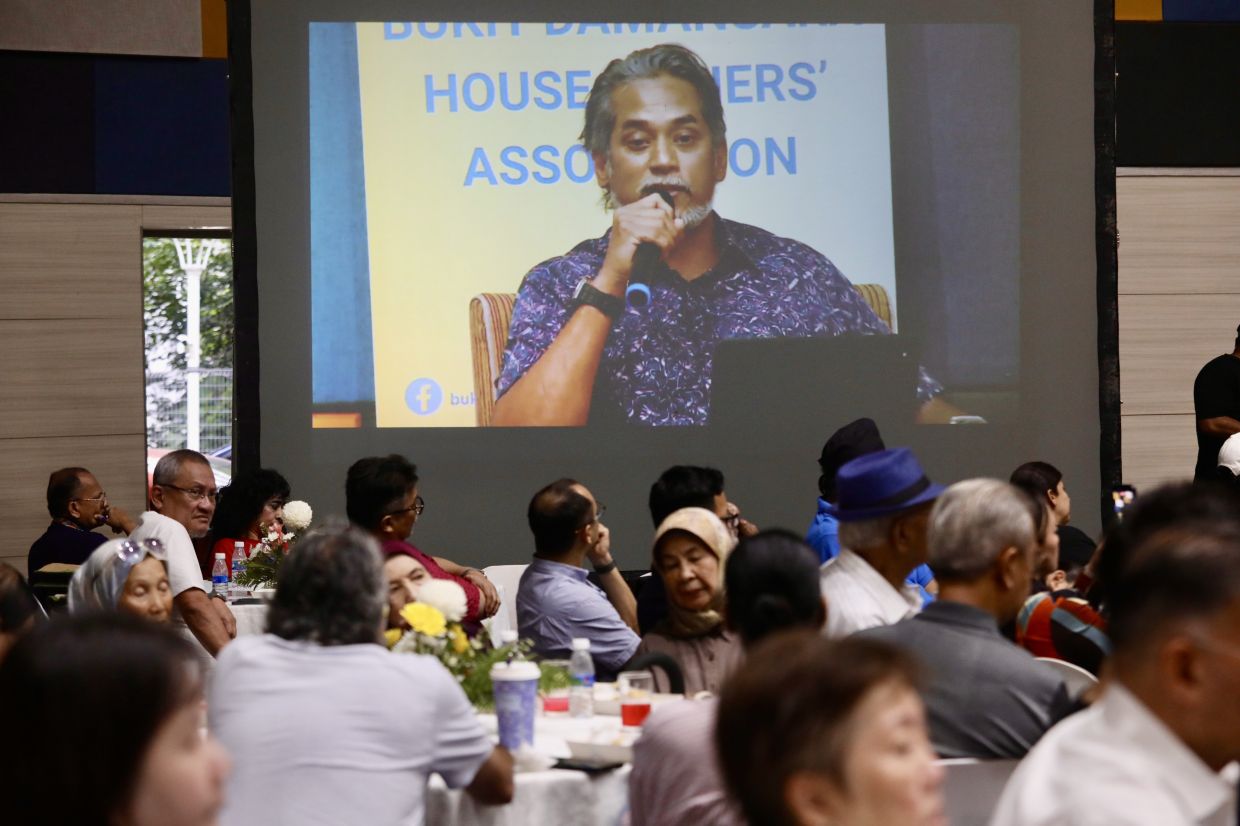
Around 400 residents of Bukit Damansara gathered for a town hall meeting organised by the Bukit Damansara Home Owners' Association, where they voiced strong opposition to a construction permit issued by Kuala Lumpur City Hall for the renovation and vertical expansion of a semi-detached residence. The three-hour dialogue session, held at Pusat Komuniti Bukit Damansara and themed "Your Voice Matters," marked the first major community engagement since Khairy Jamaluddin assumed the presidency of the association in early August.
The core grievance among residents centres on the city council's approval for converting an original double-storey semi-detached house into a three-storey structure—a decision that community members argue was made without meaningful consultation with neighbouring households. Resident A. Zakki explained that the project fundamentally compromises the architectural consistency of the street, as all other properties maintain the double-storey configuration that has historically defined the neighbourhood's character. The expansion represents not merely a cosmetic upgrade but a significant structural alteration that, in residents' view, disrupts the visual and spatial harmony carefully maintained across the residential row.
The timeline of the permit saga underscores the contentious nature of the approval process. City Hall granted initial permission in December 2025 for the additional floor construction. However, community resistance materialised quickly, prompting authorities to issue a stop-work order in January 2026. This apparent reversal proved temporary. Approximately two months prior to the town hall meeting—around June 2026—the city council re-approved the project, enabling construction to proceed. By the time residents gathered to voice their concerns, the development had already reached approximately 10 per cent completion, with supporting pillars visibly erected at the site.
Beyond aesthetic objections, residents presented evidence of tangible structural damage attributable to the construction activities. Multiple neighbouring properties have developed visible cracks, suggesting that the building works are exerting pressure on adjoining foundations. A petition organised by concerned residents garnered 19 signatures from immediate neighbours, representing a substantial show of local opposition. This documentation of physical harm lends particular weight to community arguments that the project should never have advanced to this stage without comprehensive impact assessments and stakeholder agreement.
The town hall included representation from key city authorities and service providers, creating an opportunity for residents to directly engage with decision-makers. Rosli Nordin, executive director of City Hall's Planning Department, acknowledged the concerns raised and committed to noting the issues residents face due to the renovation. However, he stopped short of committing to permit withdrawal, a response that likely disappointed many attendees who had attended specifically to press for permit cancellation. Khairy Jamaluddin, moderating the proceedings, positioned the town hall as a mechanism for bridging the gap between communities and administrators, pledging personal follow-up to accelerate problem resolution.
Beyond the headline issue, residents leveraged the town hall to address compounding neighbourhood problems. Traffic congestion in the vicinity of SK Bukit Damansara and Stella Maris International School Damansara during peak hours—7:00 to 7:30 in the morning and 2:00 to 4:00 in the afternoon—has intensified, with residents attributing much of this disruption to construction vehicle movements. Deputy police chief Supt Ahmad Firdaus Mustafia Kamal indicated that the matter is receiving attention, though his remarks lacked specificity about preventative measures. The school's Parent-Teacher Association chairman Ameirul Azraie Mustadza disclosed that the association has explored bringing in Rela (the People's Volunteer Corps) to manage traffic but lacks financial resources, highlighting how residents often depend on overextended public systems to manage spillover effects of development.
Another grievance surfaced concerning water infrastructure reliability. Residents reported multiple pipeline burst incidents throughout Bukit Damansara, with some suspecting that construction vibrations may have aggravated ageing underground systems. An Air Selangor representative acknowledged the company's awareness of these bursts and confirmed plans to replace the deteriorating pipeline network serving the neighbourhood. This infrastructure concern reflects a broader Malaysian challenge: older residential areas face cumulative strain as development pressures intersect with ageing utilities, creating cascading service disruptions that collectively degrade quality of life.
The Bukit Damansara situation illustrates persistent tensions within Malaysian urban governance between development approval processes and community protection mechanisms. While City Hall possesses statutory authority to issue construction permits based on technical compliance and zoning regulations, the incident raises questions about whether these formal processes adequately account for neighbourhood character preservation and cumulative impact on existing residents. The initial approval, followed by a stop-work order, followed by re-approval without apparent resolution of underlying concerns, suggests administrative inconsistency that erodes public confidence in planning decisions.
For Malaysian residential communities more broadly, the Bukit Damansara case offers a cautionary narrative about the importance of organised collective advocacy. The 19-signature petition and the attendance of 400 residents at the town hall demonstrated that sustained community mobilisation can force official attention to local concerns. However, the mere staging of dialogue platforms does not automatically translate into policy reversal or meaningful protection for neighbourhoods resisting unwanted development. The ultimate outcome will signal whether Kuala Lumpur City Hall views resident consensus and architectural preservation as legitimate policy considerations or treats them as secondary to individual property owner rights and formal permitting procedures.

